
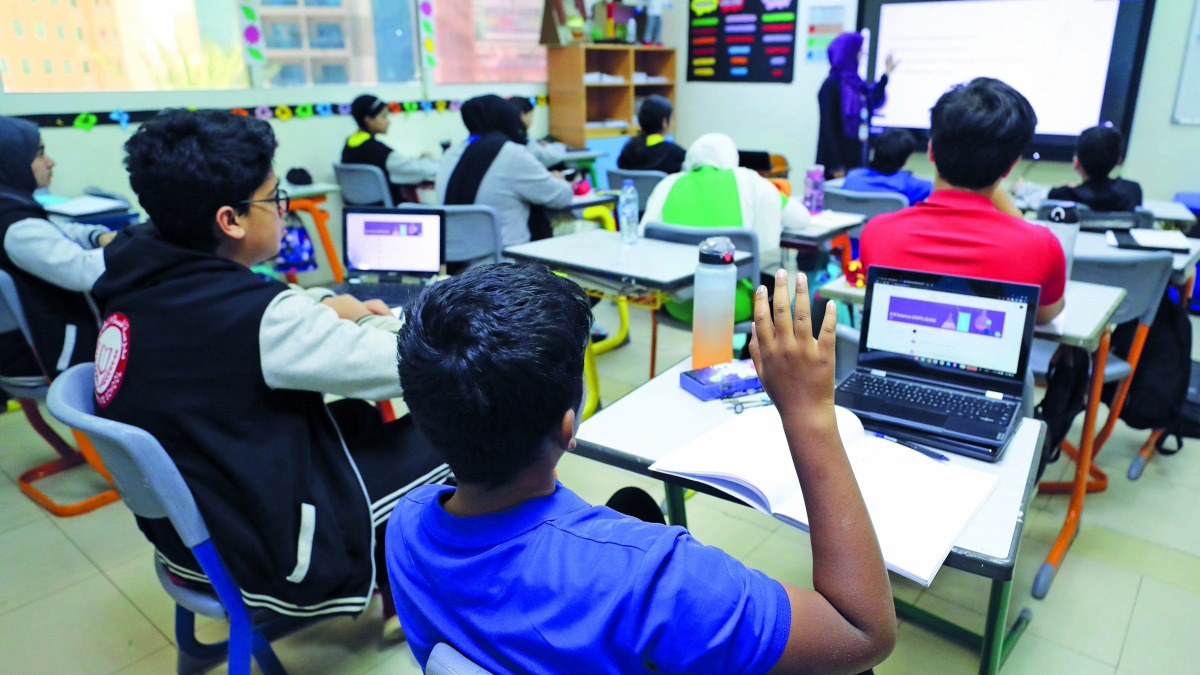
Several private school administrations have confirmed their readiness to confront infectious diseases, such as “seasonal influenza” and colds that affect students from time to time with the advent of the winter season, and multiple factors, most notably climate change, and the mixing of students coming from different geographical areas.
She told Emirates Today that this health reality forces school administrations and parents to adopt comprehensive preventive and remedial plans to protect the health of students and ensure their safety, and schools become an environment that turns the cold of winter into educational and healthy warmth for learners.
Health challenges
In detail: Private school principals: Sarah Tariq, Salma Eid, Kholoud Fahmy, and Muhammad Badwan said: “With the advent of winter, the educational field faces increasing health challenges, as some infectious diseases, such as seasonal influenza and colds, spread among students, so early preparation becomes necessary.” Prevention is a top priority within the plans for students to return to school in the second semester.”
They reported that there are established procedures for dealing with cases of colds among students, where the necessary health care is provided within the school clinic, with the necessary immediate treatments provided, with care being taken to isolate the case from the rest of the students in the classroom, and parents are informed of the student’s condition, accompanied by recommendations. Ensures his safety and health.
Distance learning
They added: “The affected student is committed to attending lessons and classes remotely from home, with close follow-up by his teachers in various academic subjects, in addition to providing the necessary educational and psychological support to ensure the continuity of the educational process without any negative impact on his academic career.”
They stressed that the return of the injured student to school cannot occur until he has fully recovered, with the necessity of submitting a medical report approved by the treating physician, proving his health readiness to return without posing a risk to the health of his colleagues.
Approved procedures
They explained that all the adopted measures aim primarily to ensure the safety of everyone, with special attention paid to first-year students who need additional care, given their young age and lack of awareness of how to properly deal with colds and influenza.
They said: “It is difficult to determine specific percentages of infected student cases, as they are variable and diverse, but not worrying, as colds and influenza are common cases, and families and schools are accustomed to them in the educational field,” stressing that “plans for the winter season are systematic and studied and enable schools to maintain safety.” Students, and the continuation of study without obstacles.”
Education patterns
Teacher Ibrahim Al-Qabbani emphasized that the multiplicity of education styles in the system is the most prominent honorable aspect, which provides diverse options and extreme flexibility in educating students and preserving their safety and health, and this became clear when dealing professionally with some students suffering from various colds.
He added: “Schools have the ability to protect students and deal with cases of colds with high efficiency and a studied methodology, with solid plans that ensure the continuation of the educational process for infected students, while taking the necessary measures to prevent the transmission of infection to others, in addition to awareness and educational campaigns that raise awareness of common winter diseases.” “On her.”
Contain injuries
Parents Saeed Murad, Hasna Ali, Amin Abdullah, and Alia Hassan said: “Schools play a pivotal role in containing cold infections, which exhaust children’s energies and affect their physical strength, with plans that maintain the continuity of education and provide lessons and study materials for those infected, without exposing them to “Healthy students are at risk of infection.”
They explained that this approach reflects a culture acquired from the pandemic experience, which has deepened the experiences of educational staff and parents in dealing with disease cases, and has contributed to consolidating awareness of ways to prevent and protect others from infection.
Fertile environment
In turn, the family and educational advisor, Omaima Hussein, confirmed to Emirates Al-Youm that schools are a fertile environment for the spread of infectious diseases among students due to constant mixing, such as influenza, colds, sore throats, and conjunctivitis (pink eye), so a strong culture has developed among everyone about How to deal with these diseases.
She said: “School plans for the winter period should include awareness campaigns and the organization of educational workshops on personal hygiene and means of prevention, in addition to the necessity of providing a clean school environment, with periodic sterilization of classrooms and common surfaces.”
Vaccination compliance
The family and educational advisor stressed the role of parents in teaching children the rules of personal hygiene, ensuring their health and keeping them at home if sick symptoms appear, stressing the importance of communicating with the school if children are infected with infectious diseases, and the necessity of adhering to the child’s vaccinations to ensure that he receives the necessary vaccines.
She stressed the importance of adhering to the vaccine appointments included in the national program, not only for students but for all family members, in order to enhance personal and community prevention of diseases. She also stressed the necessity of following health regulations in daily life to ensure everyone’s health and safety.
Closed spaces
Family and educational advisor, Omaima Hussein, said: “Closed spaces in schools are witnessing an increase in the incidence of diseases, due to the closeness of students, which contributes to greatly facilitating the transmission of viruses,” noting that environmental factors and followed behaviors play a decisive role in the variation in the rate of spread of diseases among students. Students in the winter compared to the rest of society are less susceptible to infection.
School principals:
. Preventive and remedial measures to protect the safety of learners.
teachers:
. Multiple types of education provide options that ensure continuity.
Parents of students:
. Schools plan to provide lessons and educational materials for those infected.

Follow our latest local and sports news and the latest political and economic developments via Google news
