
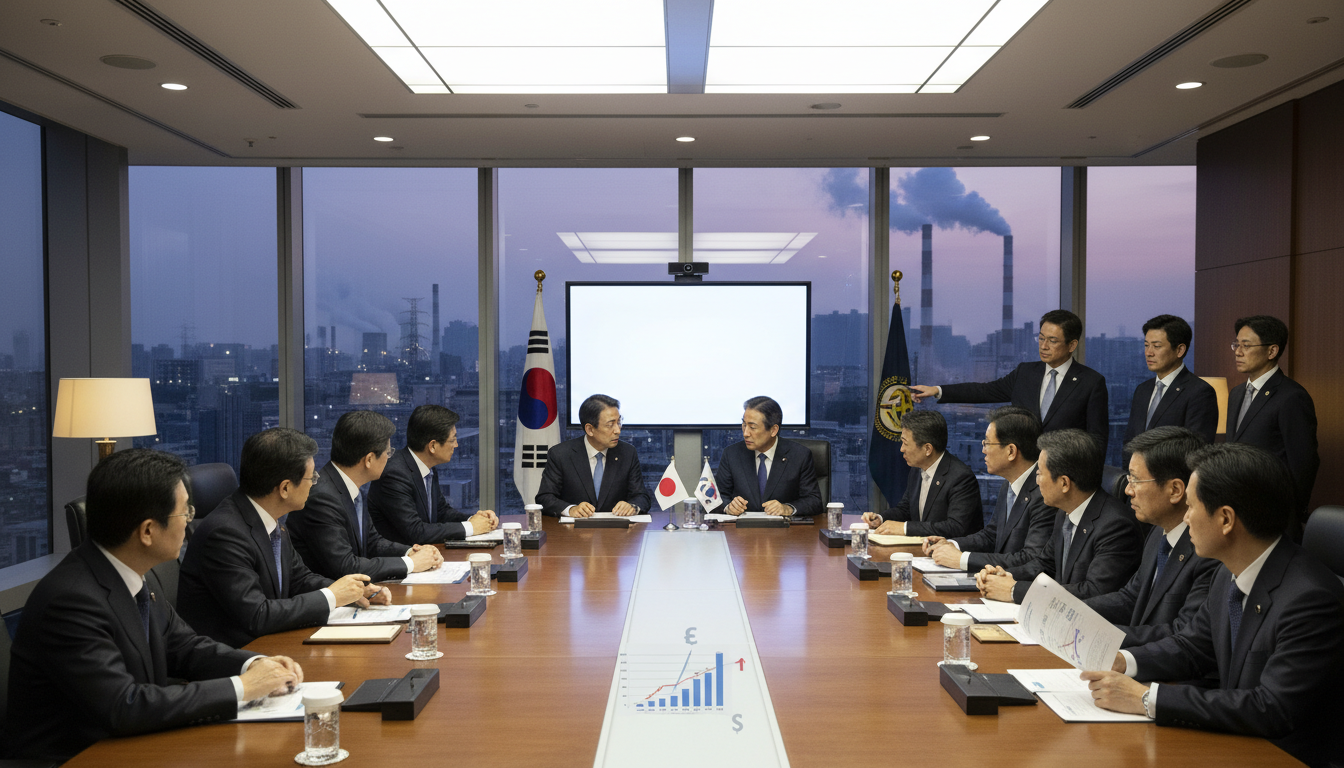
Asia energy security divide widens as financial strength dictates resilience
Major Asian economies with deep reserves and policy tools are better placed to weather disruptions; weaker states face higher inflation, currency stress and investment risk.
Asia energy security has become the defining fault line for the region’s economies as recent Middle East tensions expose stark differences in countries’ ability to secure fuel and finance during crises. The disruption risks to routes like the Strait of Hormuz — which handles about one-fifth of global oil shipments — reverberate unevenly across Asia, favoring states with large foreign-exchange reserves and deep capital markets. Investors and policymakers are now reassessing regional risk on the basis of energy access and monetary capacity rather than geography alone.
Reserves and fiscal firepower separate winners and losers
Countries with large foreign-exchange cushions and fiscal room are absorbing global energy shocks far better than those without, according to recent trends. Japan, with reserves exceeding $1 trillion, and South Korea, with buffers above $400 billion, can subsidize fuel costs, defend currencies and finance higher import bills without immediate market panic. Smaller or less-resourced economies lack the same flexibility and are showing faster pass-through of import price rises into inflation and public finances.
Immediate impacts on inflation, currencies and trade
Higher import costs are translating quickly into domestic price pressures and currency weakness in vulnerable markets. Several economies are reporting double-digit increases in import prices year-on-year and consumer inflation is already trending upward beyond comfortable targets in places that heavily import energy. Those currency depreciations in turn amplify local-currency import costs, creating a feedback loop that tightens monetary conditions and squeezes households and businesses.
Investors recalibrate regional allocations
Global investors are increasingly differentiating within Asia, directing capital toward markets that can demonstrate both energy diversification and credible policy frameworks. Nations with diversified energy mixes, stable fiscal profiles and reliable reserves are drawing inflows at the expense of countries facing balance-of-payments stress. This repricing is visible in currency interventions and sovereign debt markets, where borrowing costs are rising faster for economies with weaker external positions.
Case studies: advanced buffers versus rising vulnerability
Japan, South Korea and Singapore exemplify economies that can deploy large-scale interventions when necessary, cushioning the immediate shock of oil and gas supply dislocations. By contrast, countries such as Bangladesh are feeling acute pressure from fuel import bills and elevated inflation, with rates above 8 percent that strain public finances and social cushions. Even middle-income exporters that long benefited from cheap energy are seeing margins squeezed and supply-chain timetables disrupted.
Monetary actions and market consequences
Some central banks and treasuries have already taken visible steps to stabilise markets, using reserves to support currencies or to subsidise fuel costs for critical sectors. Japan’s substantial interventions, for example, have demonstrated how reserve firepower can blunt market shocks in the short term. However, repeated or prolonged interventions risk depleting buffers and widening fiscal gaps for countries without policy credibility or deep capital markets.
Structural risks for export-driven and precision manufacturing
The combination of higher shipping, insurance and energy costs poses a structural threat to export-oriented production systems that rely on just-in-time deliveries. Delays, rising storage expenses and disrupted supply chains erode competitiveness for exporters with thin margins and tightly scheduled manufacturing. Over time, persistent disruptions could lead to relocation decisions and a reassessment of global value chains that have long favoured particular Asian hubs.
A new regional ranking for investment and resilience
Analysts and policymakers are now using a new set of metrics — foreign-exchange reserves, current-account balances and energy import dependence — to rank countries for resilience and investment readiness. This emerging hierarchy places a premium on diversified energy sources, credible macroeconomic policy and access to international capital markets. Large economies such as China and India occupy complex positions: both have strategic advantages but retain substantial import dependence that leaves them sensitive to sustained price shocks.
The changing landscape means Asia will no longer be treated as a uniform investment bloc. Decision-makers across the Gulf, East Asia and beyond are watching how each Asian economy adapts its energy mix, fiscal policy and market interventions. The evolution of these responses will shape trade patterns, capital flows and economic growth across the region for years to come.
