
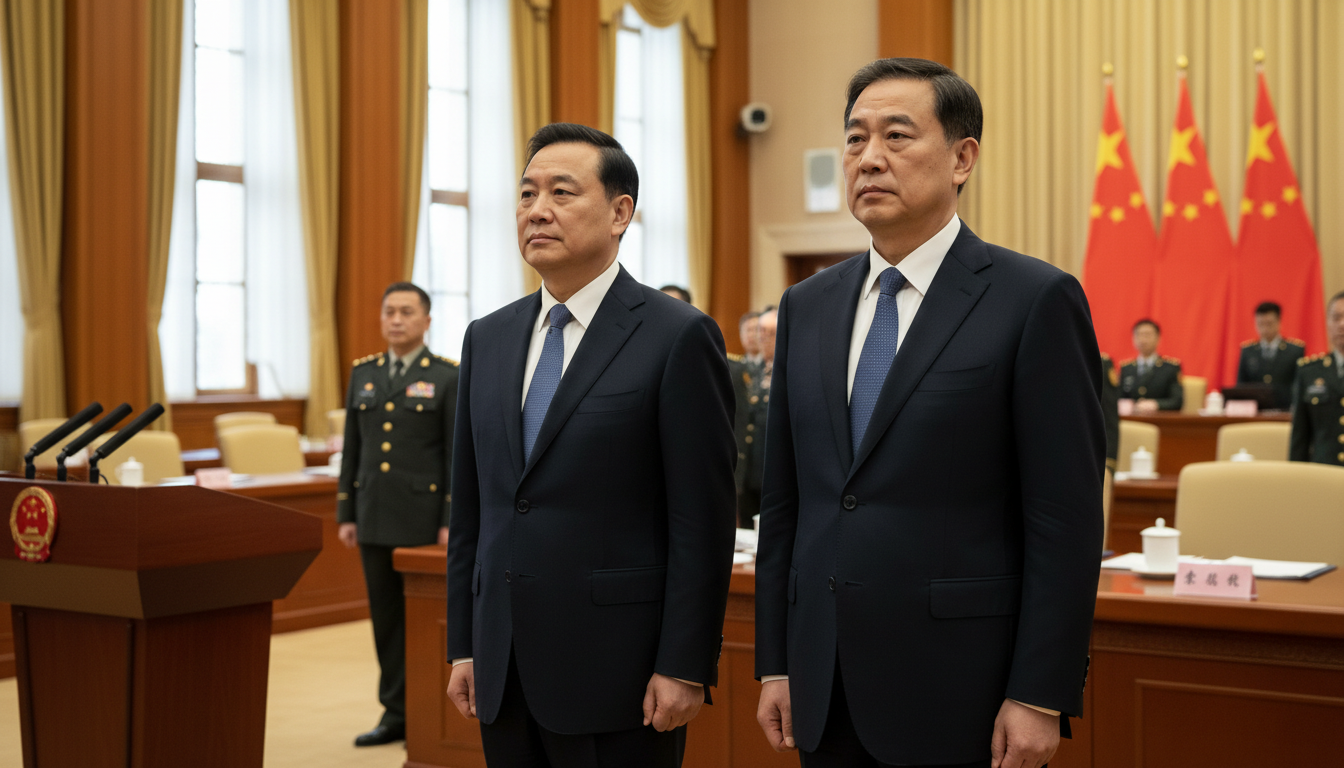
Chinese former defence ministers sentenced to death with two-year reprieve in corruption case
China’s state news agency Xinhua reports that two former defence ministers, Wei Fenghe and Li Shangfu, were sentenced to death with a two-year reprieve on corruption charges.
China’s state-run Xinhua news agency reported on Thursday that former defence ministers Wei Fenghe and Li Shangfu were given death sentences with a two-year reprieve after being convicted on corruption charges. The brief report said both men were expelled from the ruling Communist Party in 2024 for “serious violations of discipline,” a term commonly used to describe corruption. The decision, announced by Chinese authorities, underscores a rare high-profile prosecution involving senior military figures.
Court ruling and official announcement
Xinhua did not publish full court documents but said the sentences were handed down following convictions on corruption-related charges. The report provided limited detail on the specific offences or the evidence presented at trial. State media coverage emphasized the formal disciplinary action and the court outcome without offering extensive legal analysis.
The sentences carry a two-year reprieve, a mechanism often applied in Chinese criminal law to allow for commutation under certain conditions. The announcement followed the earlier party expulsions that were revealed in 2024 and framed the legal process as the culmination of internal disciplinary findings.
Party expulsion in 2024 and the charges described
Both men were expelled from the Communist Party in 2024 for what officials termed “serious violations of discipline.” That phrase is typically used by Chinese authorities as shorthand for corruption or abuse of power, and it signalled an intensified probe into their conduct. Xinhua’s report connected the disciplinary findings directly to the subsequent criminal prosecution.
Official accounts from the party and court did not enumerate the precise acts that led to the convictions, and the announcements stopped short of providing a timeline of the alleged misconduct. The lack of granular detail is consistent with past high-profile cases where state outlets provide summary findings while withholding full evidentiary records.
How a death sentence with two-year reprieve works in China
A death sentence with a two-year reprieve in China is distinct from immediate execution and is frequently commuted to life imprisonment if the convict does not commit further criminal acts during the reprieve period. Courts may apply this sentence in cases deemed particularly serious while reserving the possibility of a lesser, long-term punishment. Legal experts have noted it is a tool that allows the judiciary to impose severe penalties without enforcing capital punishment immediately.
Under the typical process, if behavior during the reprieve is judged non-recidivist, the sentence is often reduced, though the precise outcome can vary depending on subsequent legal and administrative reviews. The reprieve mechanism therefore creates a conditional pathway from capital sentencing to long-term incarceration.
Implications for military governance and public perception
The prosecution and sentencing of senior military figures raise questions about accountability and governance within China’s armed forces. Moves against high-ranking officials are likely to affect perceptions of internal discipline and may be framed by authorities as part of a broader effort to enforce standards. For the public, such cases are often presented as demonstrations of the state’s commitment to combating corruption at all levels.
Observers point out that prosecutions of prominent military leaders can have ripple effects on morale and institutional stability if they are perceived as politically motivated or as part of factional struggles. Official narratives typically emphasise rule of law and anti-corruption rigor, while external analysts may seek more transparent documentation to assess the proceedings fully.
Limited public detail and international response
State coverage of the sentences was succinct and focused on the outcomes rather than the trial record, leaving foreign governments and independent observers with few new facts to assess. Requests for comment or official responses from other capitals were not referenced in the Xinhua dispatch, and the report did not indicate any immediate diplomatic repercussions. The sparse detail has prompted calls from some analysts for clearer disclosure of judicial reasoning in cases involving senior officials.
International reaction to similar past cases has tended to be measured, with many governments awaiting formal legal documents or official statements before commenting. In this instance, the primary informational source remains the state announcement and Xinhua’s brief coverage.
The sentencing of Wei Fenghe and Li Shangfu marks a rare and consequential legal development involving former defence ministers, and Xinhua’s report says both were expelled from the ruling party in 2024 before being tried and sentenced.
