
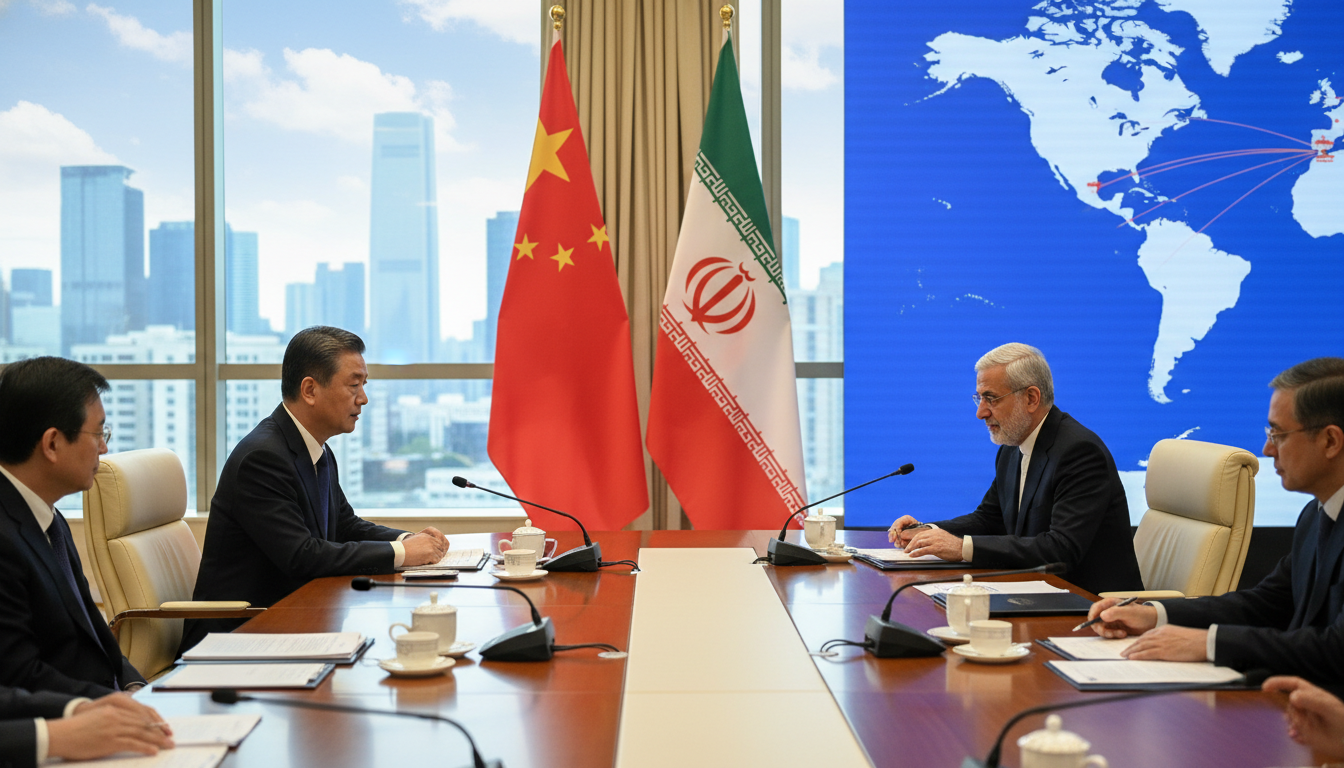
China-Iran talks in Beijing focus on reopening Strait of Hormuz amid mounting international pressure
China-Iran talks in Beijing saw Foreign Minister Abbas Araghchi meet Wang Yi as global partners press Tehran to reopen the Strait of Hormuz to shipping.
China-Iran talks opened in Beijing on Wednesday as Foreign Minister Abbas Araghchi held discussions with Chinese counterpart Wang Yi, marking the first senior Iranian visit to the Chinese capital since the outbreak of conflict in late February. The meeting, confirmed by state news agency Xinhua, proceeded with few public details as Beijing signalled a cautious diplomatic push to de-escalate tensions while avoiding direct entanglement. Reopening the Strait of Hormuz to commercial shipping and oil tankers was a central subject that underscored the session, reflecting both strategic and economic stakes for regional and global trade.
Diplomatic exchange in Beijing
Abbas Araghchi’s arrival represented a significant diplomatic step, the highest-level Iranian mission to China since the fighting began. Chinese officials framed the talks as part of measured efforts to encourage a cessation of hostilities without becoming a party to the conflict. Xinhua’s confirmation of the meeting offered no further readout, leaving observers to infer that sensitive negotiations were taking place behind closed doors.
The visit also served as a conduit for discussing immediate operational matters, notably maritime access through the Strait of Hormuz. Chinese diplomats have repeatedly emphasised stabilising regional shipping lanes as a priority, and Wednesday’s meeting was widely interpreted as an attempt to translate that priority into concrete commitments from Tehran.
Strait of Hormuz at the heart of discussions
Iran’s effective closure of the Strait of Hormuz for two months has emerged as a major disruption to global commerce, particularly energy shipments. The blockade, combined with a U.S. naval restriction on vessels bound to or from Iran, has heightened concerns over safe passage for commercial vessels and oil tankers. China has a direct interest in the uninterrupted flow of energy supplies and was reported to be seeking assurances that shipments to its ports could resume reliably.
The strategic waterway’s closure has contributed to surging global energy prices, placing further pressure on importing nations. Beijing’s public posture has balanced calls for calm with private efforts, according to officials cited by foreign delegations, to secure concessions that would allow regular commercial transit to continue.
International appeals and public pressure
U.S. officials publicly urged China to press Tehran to lift restrictions on the strait during the Iranian minister’s visit. Mr. Rubio told reporters in Washington that China should tell Iran that closing the straits was producing global isolation and harming Chinese interests as well. That appeal underscored the international dimension of the talks and the expectation among some partners that Beijing could act as a mediator or influential interlocutor.
At the same time, the U.S. operation to escort commercial shipping through the strait was briefly paused amid what American officials described as progress toward an agreement with Iran. The pause reflected a tactical shift in U.S. engagement and highlighted the fluidity of on-the-ground arrangements while diplomatic channels remained active.
China’s balancing act ahead of a major summit
Beijing’s handling of the talks came as it prepared to host a high-profile summit with U.S. leadership next week, a meeting expected to include discussion of the conflict and the reopening of the strait. Chinese officials appear keen to maintain stable ties with Washington while preserving strategic relations with Tehran, a dual-track approach that requires careful diplomatic calibration.
Observers note that China’s willingness to engage reflects an interest in reducing regional volatility without assuming direct responsibility for enforcement or coalition operations. That stance aligns with broader Chinese policy preferences for mediation and quiet diplomacy, particularly when major powers and regional allies are directly involved.
Economic impacts and sanctions dynamics
The halt in maritime traffic and the rise in energy prices have had tangible effects on China’s economy, which relies heavily on secure energy imports. While Tehran has permitted some tankers carrying Iranian oil to sail — including vessels bound for China — the broader disruption has strained markets and prompted urgent diplomatic outreach.
Tensions over sanctions have also complicated relations: after the U.S. Treasury imposed penalties on a Chinese refinery known to purchase significant volumes of Iranian oil, Beijing reportedly instructed domestic companies not to comply with those U.S. measures. That move signalled a willingness to push back against extra-territorial sanctions even as China pursued diplomatic engagement to stabilise shipping and energy flows.
Possible outcomes and regional implications
China’s talks with Iran are likely to remain focused on short-term measures to reopen shipping lanes while seeking a framework for longer-term de-escalation. Foreign officials have credited Beijing with a backroom role in the fragile cease-fire reached in April, and the current engagement may aim to convert that tenuous peace into concrete operational steps in the strait. Successful negotiations would ease pressure on global energy markets and reduce the risk of further escalation that could draw in extra-regional navies.
For Gulf states and other regional stakeholders, the outcome of China-Iran talks will be watched closely, as any agreement to ensure unimpeded passage through the Strait of Hormuz would have immediate economic and security benefits. Continued diplomacy offers the most promising path to restore regular commerce and diminish the prospects for wider military confrontation.
The Beijing meeting underlined China’s emerging role as a diplomatic intermediary and highlighted the international urgency to resolve disruptions in the Strait of Hormuz that have reverberated through energy markets and maritime security.
