
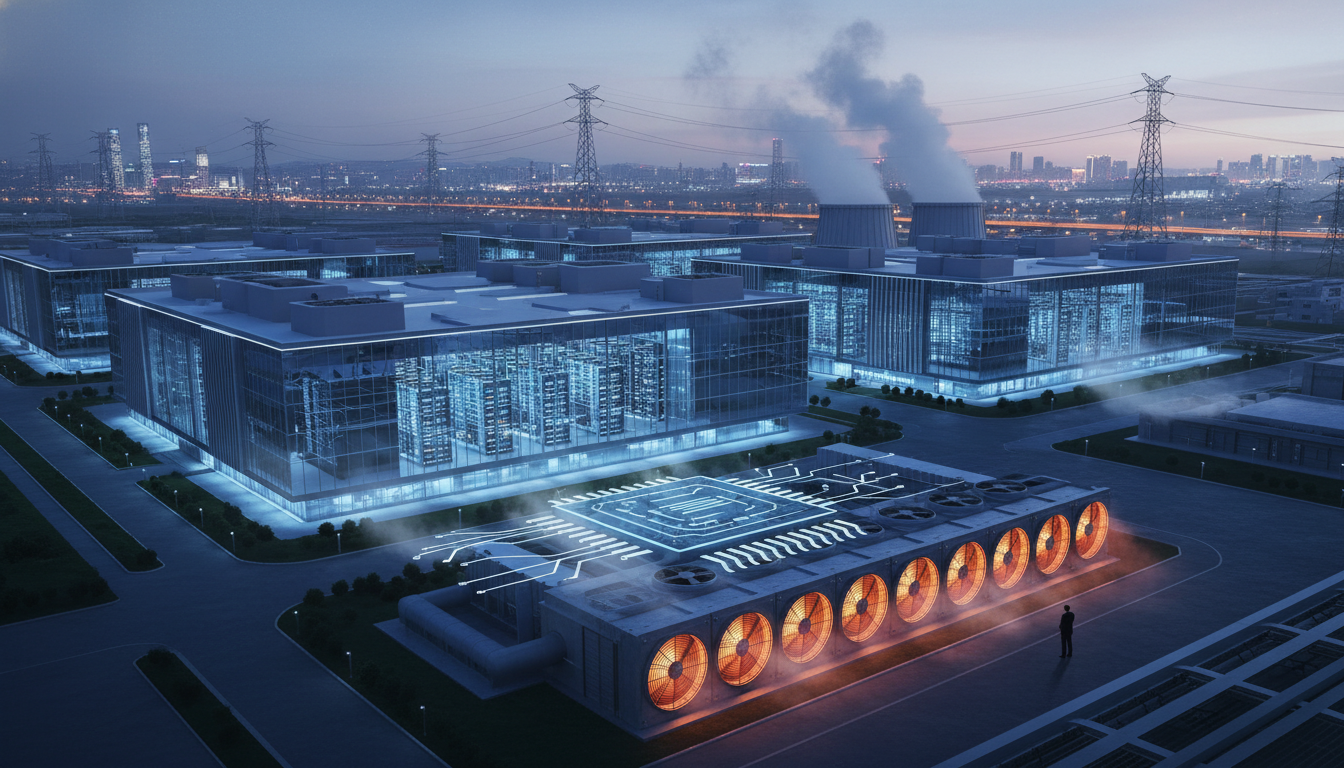
China data centres give Beijing an energy advantage in the AI race as US holds chip lead
China’s data centres are leveraging cheap, rapidly expanding renewable electricity to gain an AI infrastructure edge, narrowing the gap with the US in compute capacity.
Strong lead in power generation
China’s fast-growing electricity system and heavy state investment give its data centres access to abundant, low-cost power that many Western rivals cannot match. The country produced more than twice the electricity of the United States and added a vast share of global wind and solar capacity in recent years, creating a foundation for large-scale computing clusters. Analysts say this energy surplus makes it easier for Chinese operators to site hyperscale facilities and meet the immense power needs of modern AI models.
Linking renewables to computing
Beijing has pursued policies that explicitly connect renewable energy expansion to data centre development, concentrating new builds in interior regions with plentiful wind and solar resources. Under the “East Data, West Computing” initiative, authorities are routing large volumes of clean power from remote generation hubs to cloud facilities, and state bodies recently began operating a 500-megawatt wind-and-solar farm tied directly to a commercial data centre. These dedicated transmission projects reduce operating costs and help lower the carbon intensity of AI workloads, reinforcing China’s push to couple energy and compute growth.
US maintains chip manufacturing advantage
Despite China’s energy edge, the United States remains dominant in access to cutting-edge AI semiconductors and advanced chip design ecosystems. US firms and foundry partners continue to supply the most capable processors used for training large language models, and investment into AI-related data centres and services in Silicon Valley remains substantial. However, export controls and supply constraints have limited China’s access to top-tier chips, prompting Beijing and local firms to speed up domestic chip production and alternative supply chains.
Rapid data centre expansion and utilisation challenges
China has built data centre capacity at a blistering pace, with rack counts and power footprints rising year on year, but officials and experts warn utilisation lags in places. Estimates suggest a significant share of new capacity sits partially idle, reflecting mismatches between construction speed and demand, as well as integration challenges with heterogeneous hardware stacks. Industry observers note that although modular builds can be erected quickly, operational complexity and quality control issues have emerged when inexperienced developers take on large projects.
Grid constraints and community resistance in the US
In the United States, the AI buildout increasingly runs into limits posed by local grids and permitting hurdles. Energy consultants reported a sharp slowdown in new data centre projects tied to regional transmission capacity and interconnection delays, while community opposition has stalled dozens of proposals. That contrast — US willingness to invest in chips and cloud services but constrained by distributed, regulated power systems — highlights how infrastructure and social acceptance shape where AI can scale.
Technical and systemic limits in China’s network
China’s power system also faces structural limits that complicate nationwide, seamless electricity flows to compute hubs. Provincial dispatch arrangements and a fragmented transmission framework mean long-distance corridors often operate unidirectionally, reducing flexibility even as the central state seeks more sophisticated wholesale markets. Experts caution that resolving those bottlenecks and improving coordination between generation, transmission and load centres will be necessary for the western renewables-to-data-centre strategy to fully deliver.
What it means for the global AI competition
The competition between chip-rich Western firms and power-rich Chinese operators is increasingly framed as complementary bottlenecks rather than a single winner-takes-all race. Countries that can align advanced silicon, firm long-term power contracts, and efficient cooling and operational ecosystems will have the most robust AI infrastructure. Policymakers and industry leaders worldwide are now recalibrating plans to address both semiconductor supply and energy availability, acknowledging that raw compute growth depends as much on reliable electrons as on the latest processors.
As both sides move to fix their respective constraints, the immediate future of AI infrastructure will be shaped by how quickly the US scales grid upgrades and how effectively China translates generation capacity into high-quality, well-utilised data centres. The balance between chips and power — and the policies that underwrite them — will determine where the next wave of AI capabilities is trained and deployed.
