
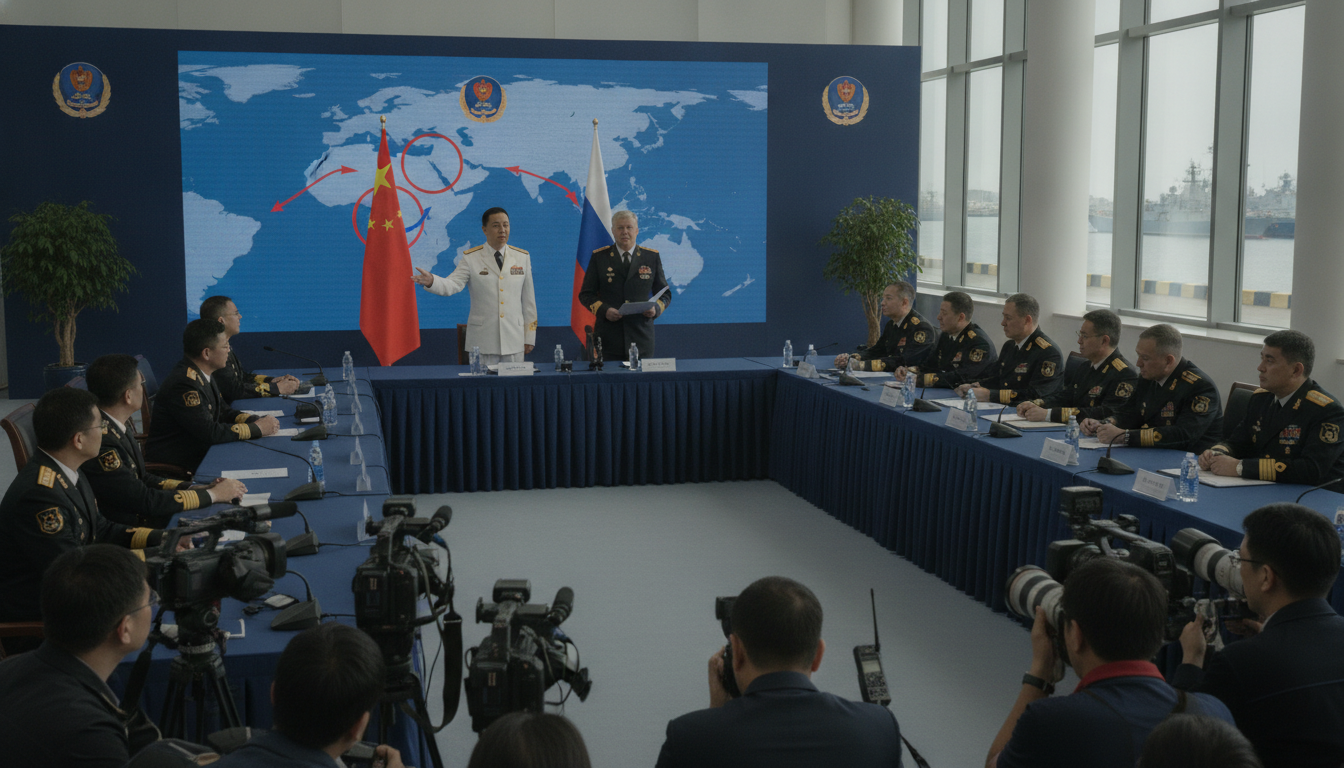
China-Russia naval exercises to be held off Qingdao, with follow-on Pacific patrols planned
China-Russia naval exercises will be held off Qingdao this month, with some forces set to conduct joint maritime patrols in parts of the Pacific afterward.
Joint drills announced off Qingdao
The Chinese Ministry of National Defense announced on Sunday that China-Russia naval exercises will take place in the waters and airspace off the eastern port city of Qingdao later this month, stating the drills are part of regular military cooperation between the two countries. The ministry said in an official statement that, following completion of the exercises, select vessels and aircraft from both sides will proceed to designated areas in the Pacific to carry out joint maritime patrols. The announcement framed the operations as routine, aimed at enhancing coordination and readiness between Beijing and Moscow.
Plans for follow-on patrols in the Pacific
According to the ministry’s statement, the forces participating in the Qingdao drills will not all return to home ports immediately but will redeploy to specific Pacific zones to undertake coordinated patrols and surveillance missions. The announcement did not specify exact patrol routes, dates, or the precise sectors of the Pacific that will be visited, saying only that some units will head to “certain areas” in the ocean for follow-on activity. Such post-exercise patrols are intended to extend the operational footprint of the participating fleets and to provide continued training in multinational seamanship and maritime domain awareness.
Beijing describes the exercises as annual cooperation
The ministry emphasized that these China-Russia naval exercises form part of an annual program of joint training designed to address shared security challenges and to help preserve regional peace and stability. Beijing described the drills as recurring and cooperative, reflecting a pattern of military engagement with Moscow that officials portray as defensive and stabilizing. The statement repeated familiar language used in previous years, stressing mutual trust-building, interoperability and a joint approach to non-traditional maritime threats without offering a detailed operational doctrine.
Scope of likely participants and capabilities
While the official notice gave no detailed order of battle, the format of recent China-Russia maritime exercises suggests participation by surface combatants, support ships and naval aviation elements from both countries, alongside associated command-and-control and logistics components. Qingdao, a major naval base on the Yellow Sea, routinely hosts People’s Liberation Army Navy units and offers shore facilities for multinational drills, making it a practical choice for combined operations. Observers expect a mix of drills that could include maneuvers at sea, coordinated air-sea exercises and communications interoperability trials, though the specific scenario set by the two militaries has not been released.
Regional security context and potential reactions
The expansion of China-Russia naval engagement comes amid a broader security environment in which regional states and external powers closely monitor large-scale naval activity in and around the East and South China Seas and the wider Pacific. Analysts caution that joint patrols extending into the Pacific may prompt heightened diplomatic attention from neighboring capitals and from Western navies that maintain forward deployments in the region. Beijing and Moscow have repeatedly characterized their bilateral drills as measures to ensure regional stability, but the exercises are also viewed by some foreign officials and commentators as part of a pattern of deeper strategic coordination.
Operational and diplomatic implications
Operationally, the joint exercises and subsequent patrols offer both militaries an opportunity to refine combined procedures, test logistics over extended distances and demonstrate sustained presence in multiple maritime domains. Diplomatically, the activities are likely to be noted in routine communications between the two governments and their regional counterparts, and may factor into upcoming defense and foreign policy discussions among Pacific Rim states. The announcement underscores the continuing role of military-to-military ties in China-Russia relations and signals that, at least for this cycle, both capitals are prioritizing visible joint training and maritime cooperation.
The coming weeks will show how extensive the drills and patrols prove to be and how regional governments respond to the expanded presence; officials in the region and international observers will be watching for further details and official schedules as they become available.
