
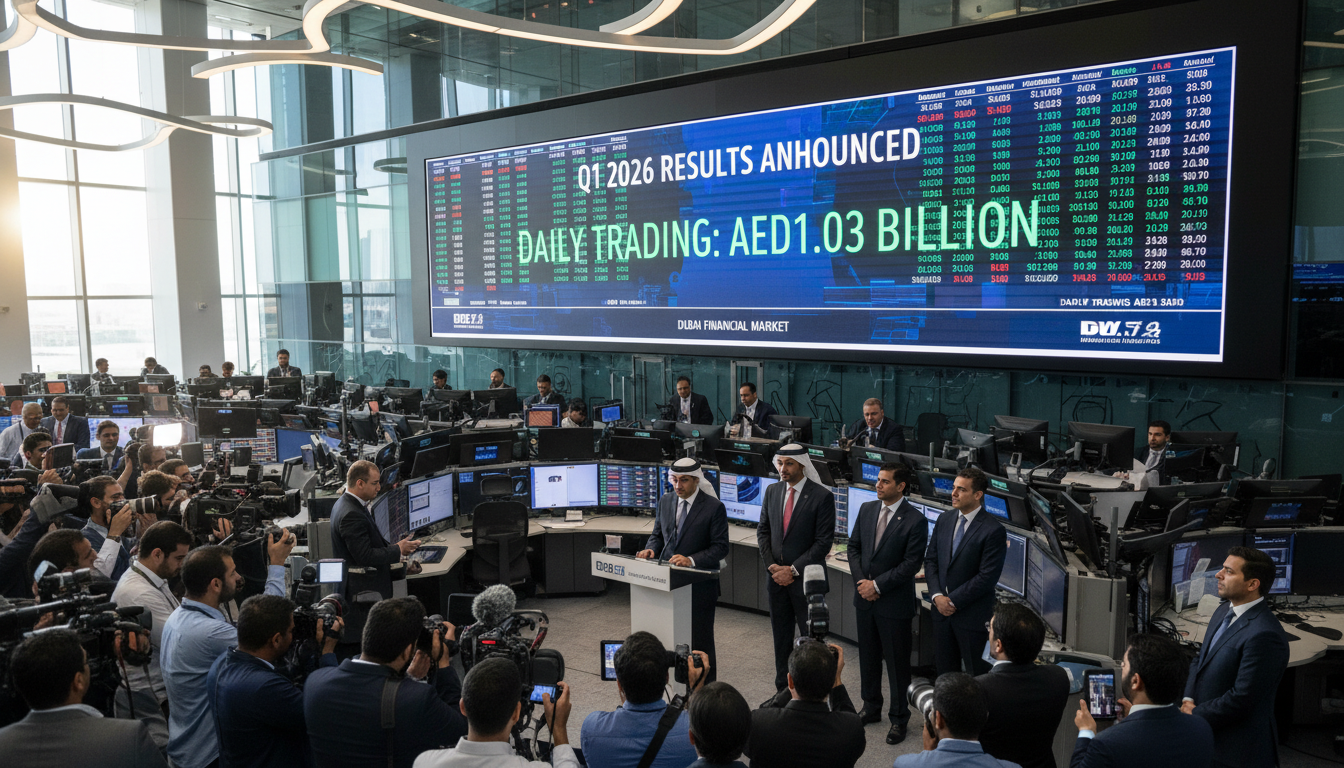
Dubai Financial Market posts strong Q1 2026 results as average daily trading tops AED1.03bn
Dubai Financial Market posts strong Q1 2026: consolidated revenue AED253.1m, average daily trading AED1.03bn, total trading AED61bn, market cap AED897bn.
The Dubai Financial Market reported a robust start to 2026 with consolidated first-quarter revenue of AED253.1 million, driven by heightened trading activity and increased liquidity. The market’s average daily trading value climbed to AED1.03 billion, a key indicator cited by exchange officials as evidence of growing investor confidence. Consolidated profit before tax rose to AED193.3 million, underscoring the exchange’s improved operating momentum in the period. The results reflect stronger participation from both institutional and international investors across the board.
Strong First-Quarter Financial Performance
The consolidated results for Q1 2026 showed revenue of AED253.1 million, up from AED186.5 million in the same period last year. Operating income contributed AED171.9 million, while investment returns and other income accounted for AED81.2 million. Net profit before tax reached AED193.3 million, compared with AED134.9 million a year earlier, and total expenses excluding tax were AED59.8 million.
Dubai Financial Market officials emphasized that the higher revenues and profit margins were supported by broader market activity and efficiency gains. The exchange highlighted that the financial mix reflected both recurring operating revenue and one-off investment-related returns. Management framed the quarter as a validation of structural enhancements to market infrastructure and fee generation.
Trading Activity and Liquidity Surge
Market turnover intensified during the quarter, with total traded value rising 48% year‑on‑year to AED61 billion from AED41 billion. Average daily turnover exceeded the AED1 billion mark for the first time, registering AED1.03 billion compared with AED663 million in Q1 2025, a 56% increase. Officials said the surge in liquidity points to deeper market participation and improved price discovery.
The uplift in trading was particularly strong in the opening months of the year, with heightened activity in January and February. Exchange executives noted that sustained order flow across multiple sectors helped maintain elevated liquidity even as market conditions softened toward the end of March. The spike in activity was cited as a central driver behind quarterly revenue and operating-profit gains.
Investor Composition and International Participation
Investor inflows remained broad-based, with the Dubai Financial Market attracting 20,702 new investors during the quarter, up from 19,366 a year earlier. Around 79% of the newly registered investors were from outside the UAE, reinforcing Dubai’s role as an international capital hub. Foreign participation contributed 54% of total traded value, while institutional investors accounted for roughly 70% of turnover.
Exchange leaders pointed to the diverse investor mix as a strategic strength that supports market stability and depth. They said the sustained participation of global asset managers and regional institutions underlines confidence in Dubai’s regulatory and market frameworks. The increase in international accounts was also linked to ongoing initiatives to simplify market access for overseas investors.
Market Index Movement and March Volatility
Despite the strong trading backdrop, the main market index experienced notable swings during the quarter. The index reached 6,774 points on February 9, 2026, reflecting early-year momentum, but closed the quarter down 10.1% after market conditions deteriorated in the latter part of March. Exchange officials described the late‑March corrective pressures as market-driven and not indicative of underlying liquidity trends.
Executives stressed that trading volumes and investor participation remained elevated even as the index retraced. They highlighted the exchange’s ability to support orderly trading through periods of volatility and pointed to robust market infrastructure that preserved continuity. The combination of high turnover and index adjustment illustrates active repositioning by market participants.
Strategic Priorities and Market Development
Dubai Financial Market leadership said the exchange will prioritize widening access, enhancing infrastructure, and expanding opportunities for issuers and investors. Chairman Hilal Saeed Al Marri emphasized that the quarter’s performance reflects Dubai’s strong economic fundamentals and its stature as a global financial centre. He cited the AED1 billion average daily trading milestone as evidence of growing market depth and international reach.
Chief Executive Hamed Ali noted that the exchange’s focus remains on improving market accessibility and delivering efficient services to a diverse investor base. Management intends to build on the first-quarter momentum by advancing digital capabilities, streamlining listing processes, and fostering products that attract long-term institutional capital. These measures are presented as steps to sustain liquidity growth and broaden market participation.
The Dubai Financial Market closed March with a market capitalisation of AED897 billion, positioning it as one of the region’s most valuable exchanges. Officials said the fundamentals that supported Q1 performance—liquidity, institutional engagement and international flows—remain in place and provide a platform for continued development.
Looking ahead, the exchange signalled that it will monitor market conditions closely while pursuing initiatives to deepen investor engagement and enhance market transparency. Management remains focused on translating the quarter’s operational gains into sustained long-term growth for Dubai’s capital markets.
