
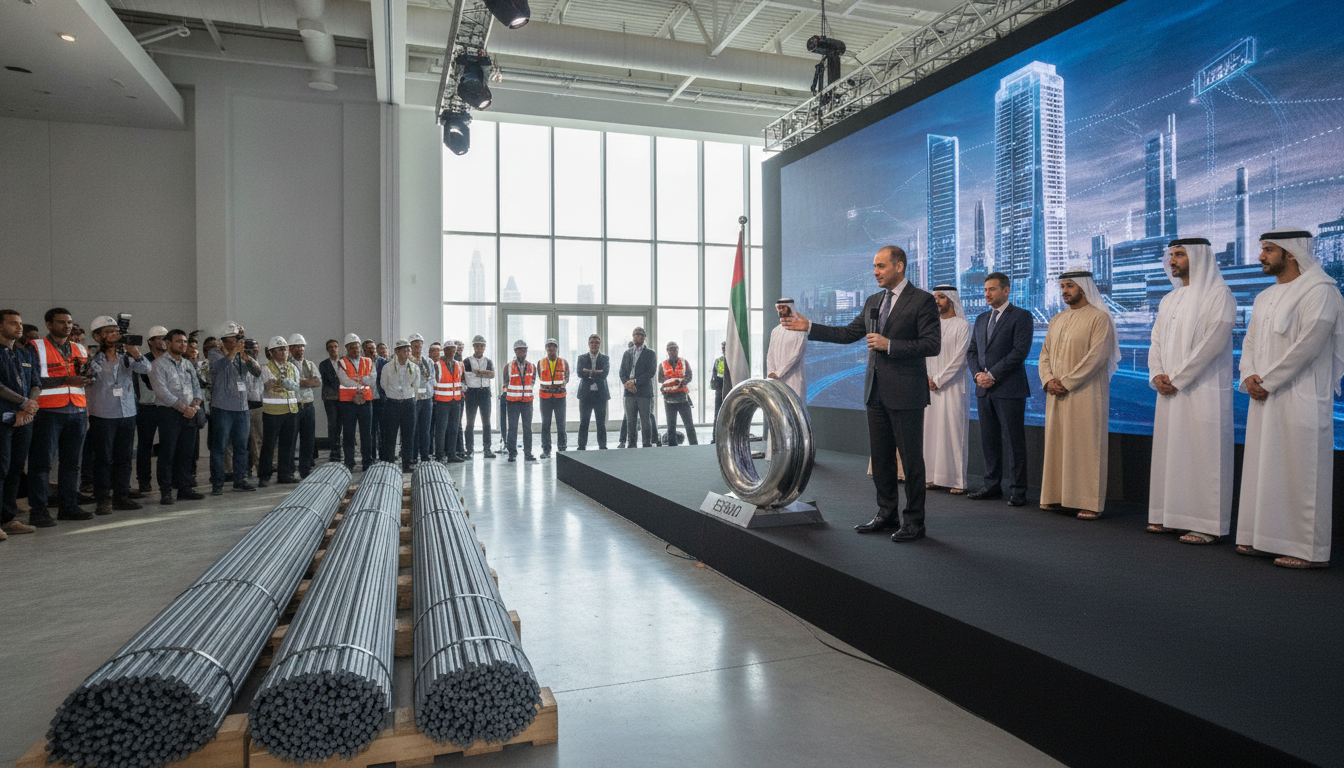
Emsteel launches ES600 high‑strength rebar, accelerating UAE industrial innovation
Emsteel unveils ES600 high-strength rebar, boosting UAE industry with AED 625m upgrade, wider exports and significant emissions cuts toward net-zero 2050.
Emsteel announced the commercial launch of ES600, the highest-grade rebar produced in the United Arab Emirates, marking a notable milestone for the country’s industrial sector. The new product, developed to meet evolving design and sustainability requirements, underscores Emsteel’s strategy of pairing advanced metallurgy with large-scale manufacturing. ES600 is positioned to give developers and consultants greater design flexibility while supporting the UAE’s push for higher-value industrial output.
Emsteel introduces ES600 as UAE’s highest-grade rebar
ES600 represents a step change in reinforcement technology available locally, combining higher tensile strength with compliance to international standards. Emsteel says the grade was engineered to support modern high-rise, infrastructure and resilient-structure specifications without compromising ductility. The company characterises ES600 not only as a product innovation but as a strategic capability that enables more efficient structural designs and reduced material usage on major projects.
The launch signals a shift in the domestic supply chain toward more advanced construction materials, reducing reliance on imports for high-specification projects. Industry sources note that locally produced ES600 can shorten lead times for large contracts and alter procurement strategies for constructors in the UAE and neighbouring markets. Emsteel has framed the product as part of a broader move to export higher-value manufactured goods from the Emirates.
Scale of operations and export footprint
Emsteel operates an integrated manufacturing ecosystem of 14 plants that use modern processes including direct reduction and electric arc furnaces. The group reported annual production capacity of approximately 3.5 million tonnes of long steel products, alongside 4.6 million tonnes of cement and clinker, and some 85 million masonry units. Those volumes underpin a deep regional supply presence and the ability to supply bulk infrastructure projects.
The company exports to more than 70 countries across Europe, the Americas, Asia, the Middle East and North Africa, reflecting a growing global reach for UAE-made building materials. Emsteel is publicly listed on the Abu Dhabi securities market, and executives describe the export footprint as evidence that the UAE’s industrial base can compete on quality as well as scale.
Market share and role in national projects
Within the UAE, Emsteel controls an estimated 45 percent of the steel reinforcement market and roughly 12 percent of the domestic cement market. These shares position the group as a strategic supplier for both public and private sector development programs nationwide. Officials highlight the firm’s role in enabling major infrastructure and urban development projects that are central to national economic plans.
Project teams and consultants are increasingly specifying higher-grade inputs to meet longevity and resilience targets, and Emsteel’s expanded product range is intended to meet that demand. The company’s market position gives it a direct channel to influence material standards and contribute to local content objectives in state-led programs.
AED 625 million upgrade to expand advanced rebar range
Emsteel has committed an AED 625 million asset-improvement programme to boost capacity for advanced steel products and broaden its portfolio of high-performance rebar. The investment will be used to upgrade production lines, expand process automation and introduce new finishing capabilities for premium grades like ES600. Management describes the programme as aligned with federal initiatives such as Project 300 Billion and the National Strategy for Industry and Advanced Technology.
The upgrade aims to raise operational efficiency and reduce unit production costs while enabling faster product qualification for export markets. Executives say the capital expenditure is intended to future-proof the business as demand shifts toward higher-performing, lower-environmental-impact materials.
Industry 4.0 technologies underpin production
Emsteel is integrating Industry 4.0 tools across its plants, deploying artificial intelligence, industrial internet of things sensors and advanced data analytics in production and quality control. These technologies are reported to enhance process stability and enable predictive maintenance, reducing downtime and improving product consistency. The group’s adoption of digital systems is presented as a core enabler for producing technically demanding grades such as ES600 at scale.
The company also cites improved decision-making speed and traceability through digital platforms, which benefits clients requiring certified performance and full batch records. Emsteel says these capabilities help accelerate approvals from engineers and regulators for use of advanced reinforcement in complex projects.
Emissions cuts and net-zero 2050 commitment
Sustainability metrics form a central part of Emsteel’s corporate narrative, with the group reporting a 34 percent reduction in carbon emissions in its steel operations and a 9 percent reduction in its cement operations in 2025 versus 2019. The business also increased its reliance on cleaner electricity sources, with 88.7 percent of power used in iron and steel processes and 28.6 percent in cement operations coming from low-carbon supplies last year. Emsteel has set a goal to reach climate neutrality by 2050 and frames ES600 as consistent with that transition.
Executives say material efficiency gains from higher-strength reinforcement and ongoing plant electrification are expected to deliver further emissions improvements. The company intends to continue investing in cleaner energy and process technologies to meet national climate targets and to maintain competitiveness in regulated export markets.
Emsteel’s ES600 launch combines product innovation, substantial capital investment and an explicit climate agenda to strengthen the UAE’s industrial base. The new rebar grade is presented as both a technical solution for demanding construction needs and a signal of the sector’s evolution toward higher-value, lower-carbon manufacturing.
