
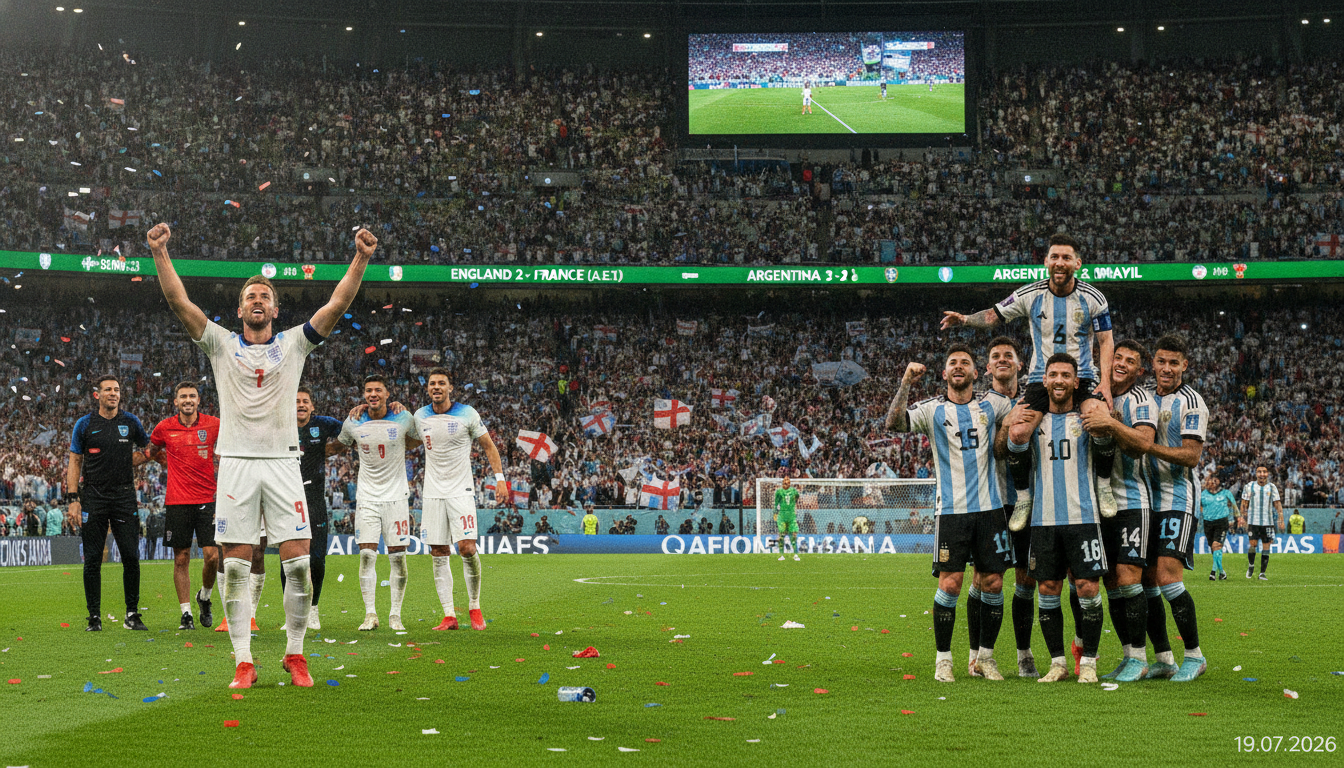
England and Argentina set up World Cup 2026 semi with extra-time victories
England and Argentina both advanced to the World Cup 2026 semifinals after dramatic extra-time wins, highlighting tactical flexibility and decisive individual moments.
England reached the last four after a 2-1 extra-time victory over Norway, while Argentina defeated Switzerland 3-1 following a late extra-time surge. Both matches required changes in approach against disciplined, deep-lying defensive opponents, and individual moments proved decisive in breaking stalemates. The two teams will meet in the semi-final on Sunday, July 19, 2026 at 23:00 UAE time.
England edge Norway after Bellingham brace
England were forced into extra time after a tight 1-1 regulation period against a well-organised Norway side. Jude Bellingham emerged as the match-winner, scoring late in normal time and again deep in stoppage to seal a 2-1 victory that sent England through.
The match was notable for Norway’s compact 4-5-1 block, which limited England’s central penetration for long spells. England adapted by increasing tempo and introducing attacking substitutes, which created the gaps Bellingham exploited.
Argentina break Swiss resistance in closing stages
Argentina needed extra time to subdue Switzerland after Alexis Mac Allister put them ahead in the 10th minute and Dan Ndoye equalised in the 67th. The match remained deadlocked until Argentina’s late intervention in added time, when Julián Álvarez and Lautaro Martínez struck in the 112th and 121st minutes respectively.
Switzerland’s defensive organisation, marshalled by Granit Xhaka, kept Argentina at bay for much of the contest. Argentina’s decision to overload the forward line in extra time produced the numerical superiority that finally unlocked the Swiss defence.
Shared tactical themes in both quarter-finals
Both matches underlined the effectiveness of defensive compactness in knockout football, forcing dominant teams to probe patiently. England and Argentina encountered low blocks that compressed space between lines, prompting wide circulation and few clear chances during regular time.
Each winner found success by shifting strategy rather than insisting on a single template. High pressing and targeted positional switches created moments of disorganisation in otherwise disciplined defences, and both sides capitalised on opponent mistakes when opportunities arose.
Turnovers and numerical advantages decided key moments
Errors and shifts in possession were decisive in both fixtures, as mistakes were ruthlessly punished in tight encounters. England’s goals came after pressure forced a Norwegian error in and around the box, while Argentina benefitted from a Swiss sending-off that left their defence undermanned.
Once the balance tilted numerically, the victors increased their attacking density and exploited spaces left by opponents searching for an equaliser. That tactical adjustment proved decisive in both matches as extra time wore on and fatigue affected defensive cohesion.
Bench influence and managerial gambles paid off
Substitutions altered the dynamic in both ties, with coaches taking calculated risks to break the deadlocks. England’s attacking changes injected pace and directness, stretching Norway’s backline and creating pockets for Bellingham to exploit.
Argentina’s coach also moved to an aggressive late-game formation, adding clear goal threats alongside Lionel Messi and overloading the Swiss penalty area. Those bench decisions turned the momentum and helped convert tactical intent into concrete goals.
Key individual performances shaped outcomes
Jude Bellingham’s physical intelligence and finishing were central to England’s win, with his two strikes delivered at pivotal moments. For Argentina, Messi’s tactical withdrawal to create space and his incisive movement enabled teammates to penetrate, culminating in Álvarez’s extra-time strike.
Goalkeeper and defensive performances also influenced the ties, with the winners’ backlines holding firm at critical stages and strike partnerships delivering under pressure. Individual quality combined with team discipline produced the decisive margins.
Sunday’s England–Argentina semi-final promises a high-stakes tactical duel with both sides proven in extra-time scenarios. Expect managers to prepare for compact defensive setups while planning decisive substitutions and moments of individual brilliance.
The World Cup 2026 now features a marquee semi-final pairing that will test England’s balance between structure and forward urgency against Argentina’s blend of creative playmaking and late-match finishing. The match on July 19 will be a focal point for fans and pundits alike as both nations vie for a place in the final.
