
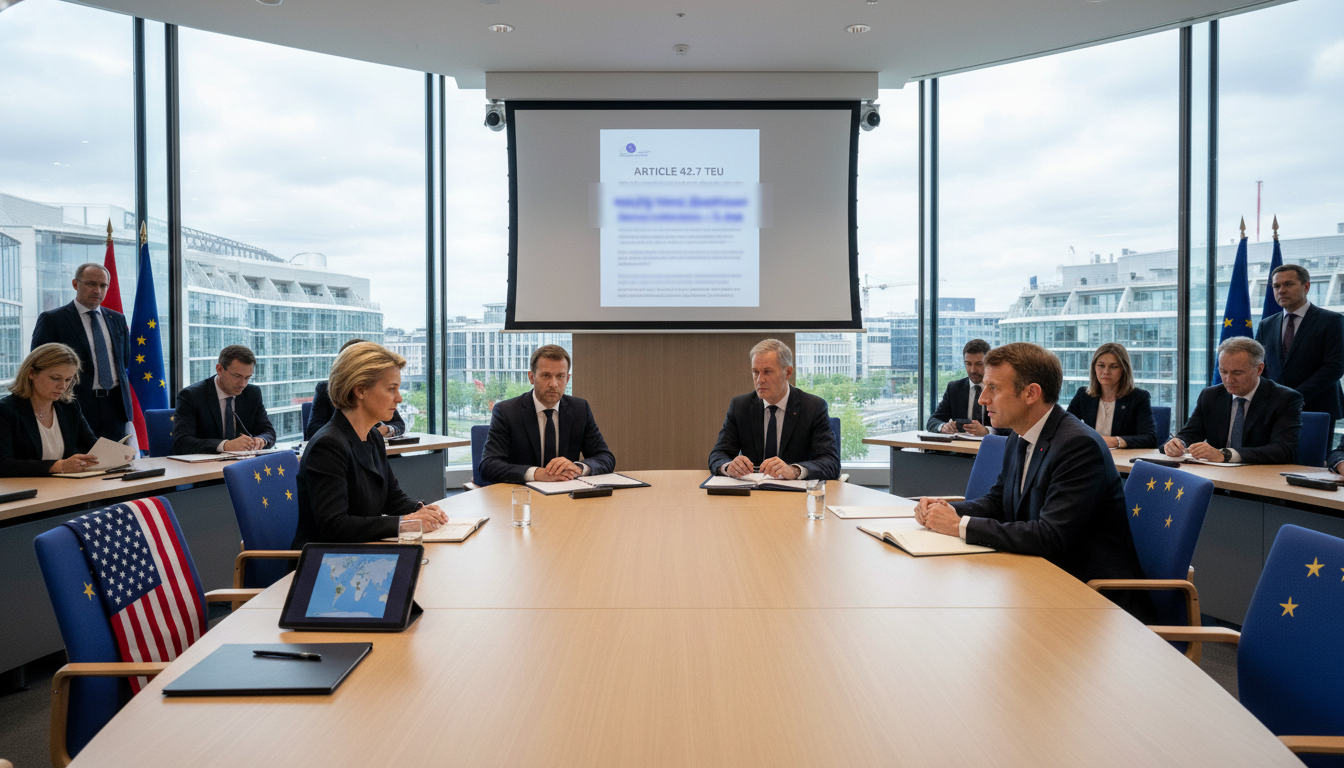
EU leaders move to define Article 42.7 as transatlantic rift raises NATO doubts
European leaders move to clarify Article 42.7, the EU’s mutual defence clause, as growing strain with the US raises doubts about NATO and transatlantic ties.
European Union heads of state have instructed Brussels to draw up a practical blueprint for implementing Article 42.7 as concerns mount over Washington’s long-term commitment to NATO. Leaders cited recent tensions with the United States and the fallout from the conflict involving Iran as catalysts for seeking a clearer operational role for the little-used defence clause. The move signals a renewed push for European security planning that could operate alongside, or independently of, NATO contingencies.
Why Article 42.7 is in focus
Article 42.7 of the Treaty on European Union obliges member states to provide aid and assistance if a fellow EU country suffers armed aggression on its territory. Unlike NATO’s Article 5, the EU clause has no standing military command, permanent rapid-reaction force, or automatic response measures tied to a non-EU guarantor. That structural difference is central to debates over whether Article 42.7 can be turned from a political pledge into a credible military guarantee.
Differences with NATO’s security guarantee
NATO’s Article 5 has been reinforced by decades of integrated planning, joint exercises and the United States’ military weight within the alliance. By contrast, Article 42.7 relies on individual member states’ decisions to assist and must operate within UN Charter constraints. Officials and analysts say this legal and operational gap is what EU capitals want to address if Europe is to reduce strategic dependence on external actors.
Which leaders and states are pushing for clarity
Cyprus, which is an EU member but outside NATO, has been among the most vocal proponents of a defined process after a drone strike near a British airbase raised alarms at the recent summit. French President Emmanuel Macron has insisted the clause be treated as a binding commitment rather than symbolic language, and the European Council presidency has tasked the Commission with producing a handbook for activation. EU foreign policy officials, including the bloc’s top diplomat, have urged member states to step up defence cooperation in response to shifting transatlantic relations.
Transatlantic tensions driving the debate
The drive to define Article 42.7 follows a period of strained U.S.–Europe ties, marked by criticisms of NATO burden-sharing and high-profile disputes between Washington and European capitals. Recent episodes have included U.S. leadership rhetoric questioning alliance value and published reports that U.S. officials discussed punitive measures against allies perceived as unsupportive during a conflict. These developments have prompted EU leaders to weigh how to ensure collective security if U.S. political support becomes uncertain.
Historical use and practical limits of the clause
Article 42.7 has been invoked only once, by France after the 2015 Paris attacks, and then mainly for intelligence sharing and political solidarity rather than coordinated military action. NATO’s Article 5 was also used a single time after the September 11, 2001 attacks, and that invocation led to multi-year coalition operations including substantial troop deployments. Analysts caution that the EU’s current tools lack the integrated military architecture that allowed NATO to mobilise large-scale support in the past.
Legal questions and alliance cohesion
Legal experts note there is no formal mechanism to expel a member from NATO, though withdrawal by a member is possible under the alliance treaty. Observers say political friction—rather than treaty mechanics—poses the greater risk to cohesion, especially if major powers diverge on core values or strategic aims. Debates over Article 42.7 are therefore unfolding alongside broader discussions about whether Europe should build a more autonomous defence pillar to complement existing transatlantic structures.
Funding and planning for greater European defence capacity
Several European governments have signalled intentions to increase defence spending substantially and to develop more interoperable forces and planning tools. Proposals under discussion include clearer activation procedures for Article 42.7, pooled capabilities, and regularised contingency planning inside EU structures. Senior strategists urge the bloc’s largest militaries to coordinate on capabilities and command arrangements so any future invokeable clause can be backed by tangible, rapid-response options.
European leaders frame the current work as an effort to strengthen, not replace, transatlantic ties while reducing risky reliance on uncertain political dynamics abroad. The Commission-led blueprint and the council’s handbook are expected to outline scenarios, decision timetables and the political-administrative steps for activation, though any operational capabilities will require sustained investment and political agreement among member states.
As EU capitals seek practical answers, the debate over Article 42.7 will test whether political will can be transformed into credible defence arrangements that reassure members and preserve alliance flexibility. The outcome will shape Europe’s security posture in a period of heightened geopolitical uncertainty and could redefine how the bloc balances cooperation with NATO and autonomous defence planning.
