
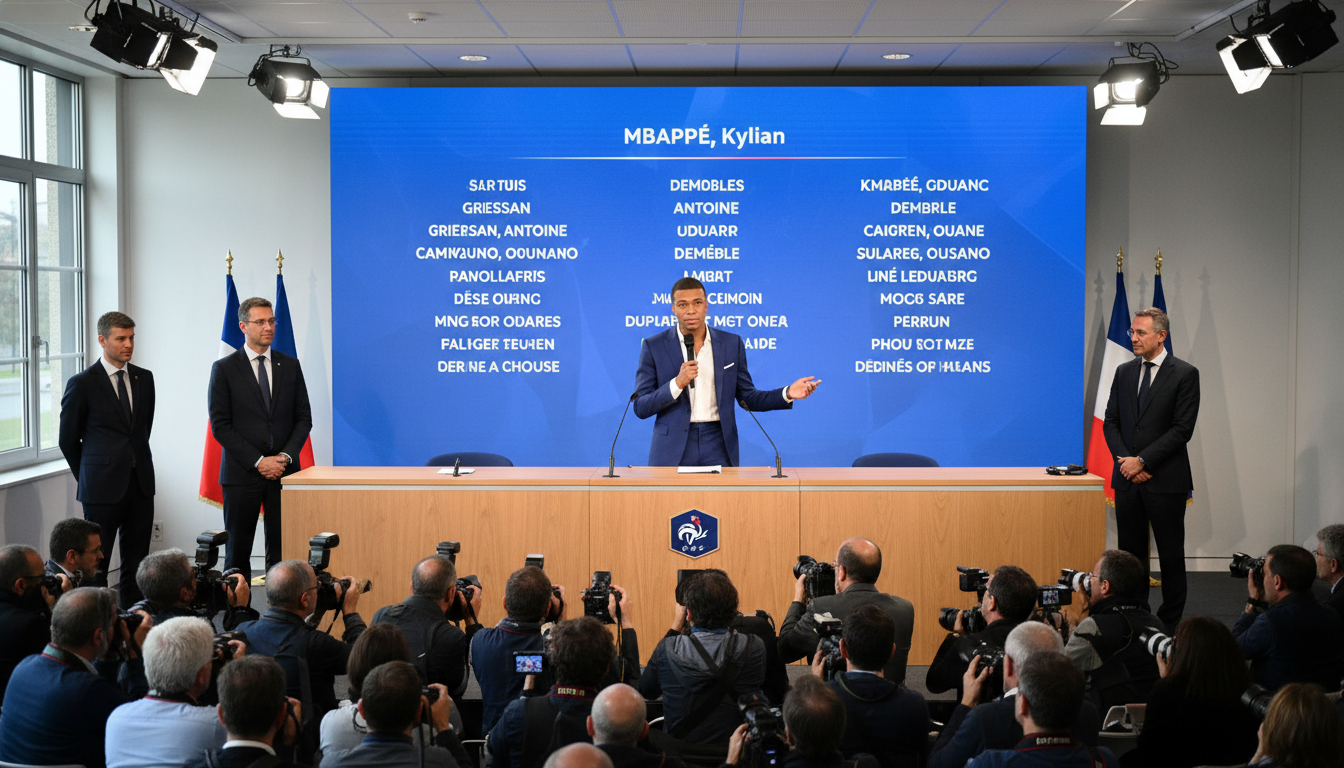
Deschamps names France World Cup squad with Mbappé and Dembélé leading attack
Deschamps names France World Cup squad: 26 players selected for 2026, led by Kylian Mbappé and Ousmane Dembélé, blending experience and youth in June.
France coach Didier Deschamps confirmed a 26‑player France World Cup squad for the 2026 tournament, announcing a list that balances established stars with promising youngsters. The roster is headlined by Kylian Mbappé, now at Real Madrid, and includes Paris Saint‑Germain winger Ousmane Dembélé among a group of attackers expected to carry France’s scoring burden. Deschamps’ selections span top European clubs and reflect tactical flexibility ahead of a group stage that will test the defending champions’ depth. The announcement completes France’s preparations for the June finals across the United States, Mexico and Canada.
Deschamps confirms core leadership and tactical balance
Deschamps has opted for experience in key positions while reserving spots for rising talents who impressed during the qualifying cycle and domestic seasons. The coach, who previously won the World Cup as a player and as a manager, kept trusted figures in the spine of the team to preserve tactical continuity. Several midfield and defensive selections signal a preference for players able to shift between possession phases and high‑pressure transitions. The mix aims to offer both control and counterattacking threat depending on opponents.
Attack anchored by Kylian Mbappé and Ousmane Dembélé
France’s forward line is built around Mbappé, whose club form and big‑game experience make him the natural focal point of the attack. Dembélé’s inclusion adds pace and wide creativity, while the squad also carries several younger wingers and strikers to supply options off the bench. Manchester City’s Ryan Cherki, Crystal Palace’s Jean‑Philippe Mateta, Bayern Munich’s Michael Olise and Inter Milan’s Marcus Thuram are among attackers who provide different profiles. Deschamps therefore has a versatile front line capable of playing through the centre or exploiting wide channels.
Midfield combines veteran presence with emergent energy
In midfield, Deschamps named a blend of seasoned campaigners and emerging talents to manage games across 90 minutes and in knockout scenarios. N’Golo Kanté returns to the international fold after a spell abroad, bringing renowned defensive instinct from his time at Fenerbahçe. Adrien Rabiot’s experience and Aurélien Tchouaméni’s midfield control offer additional balance, while Warren Zaire‑Emery represents the dynamic youth movement at Paris Saint‑Germain. Roma’s Manu Koné adds box‑to‑box ability, giving France options to tailor midfield structure against different opponents.
Defensive depth spans Premier League, La Liga, Bundesliga and Saudi Pro League
Deschamps assembled a defensive unit with players from Europe’s top leagues and the Saudi Pro League, reflecting wide club representation and depth across central and full‑back roles. The list includes established centre‑backs such as Ibrahima Konaté and Dayot Upamecano, alongside ball‑playing defenders like Jules Koundé and William Saliba. Lucas and Theo Hernández provide attacking width from the full‑back positions, while younger options such as Malo Gusto and Maxence Lacroix increase competition for starting places. This mix is intended to cover different match scenarios, from high defensive lines to more compact setups.
Goalkeeping choices and club representation at a glance
France’s goalkeeping contingent features Mike Maignan from AC Milan as the first‑choice option, supported by domestic league goalkeepers from Lens and Rennes. Deschamps’ selection balances proven shot‑stoppers with keepers accustomed to the pressures of top‑flight European football. Across the full squad, players represent a wide array of clubs — from Real Madrid and Paris Saint‑Germain to Liverpool, Arsenal, Bayern Munich, Barcelona and Inter Milan — underscoring the national team’s deep connections to elite club football. That club diversity also ensures tactical familiarity with a range of systems and opponents.
Group stage challenge against Norway, Senegal and Iraq
France will open its World Cup campaign in a group that features Norway, Senegal and Iraq, presenting contrasting styles and tactical tests. Norway’s direct play and physical approach will likely challenge France’s defensive coordination, while Senegal’s pace and athleticism will pose threats on transitions. Iraq, as a less familiar opponent at this level, could present tactical unpredictability that Deschamps’ side must prepare for meticulously. The group demands immediate focus and a flexible game plan to secure top placement and a favorable path into the knockout rounds.
The squad announcement closes a chapter of speculation and opens the countdown to France’s title defence on the global stage. Deschamps’ balance of established leaders and emerging prospects aims to preserve tactical stability while injecting fresh energy into the squad. The coming weeks will be crucial for final preparations, as France fine‑tunes formations and fitness ahead of the tournament kickoff in June.
