
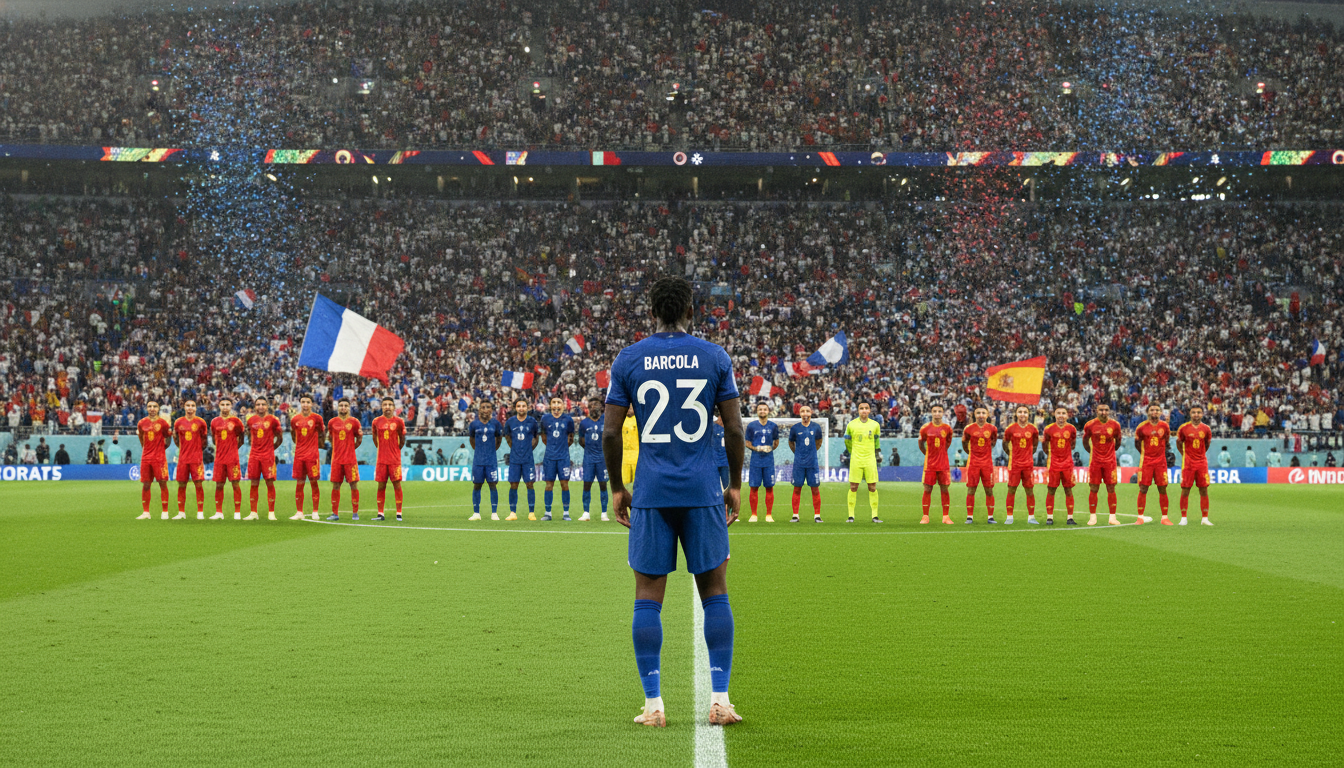
France vs Spain World Cup 2026: Barcola to start on France’s left in Dallas
France vs Spain World Cup 2026 semifinal in Dallas sees Bradley Barcola promoted to the starting left wing while Pedri is named on Spain’s bench again.
France have named Paris Saint-Germain winger Bradley Barcola in the starting XI for the World Cup 2026 semi-final against Spain in Dallas, with coach Didier Deschamps opting for pace on the flank instead of Désiré Doué. The change, confirmed by sources close to the French camp, reflects a tactical choice to counter Spain’s young wide threat Lamine Yamal with acceleration and directness. Spain, in turn, will proceed with Unai Simón in goal and a back four that has conceded just one goal so far in the tournament. Pedri is on the bench for a second consecutive match, underscoring coach Luis de la Fuente’s preference for a slightly different midfield balance in the knockout phase.
Deschamps selects Barcola to exploit space on Spain’s left
Didier Deschamps has chosen Barcola over Désiré Doué for the starting left wing, prioritising speed and direct running in wide areas. Barcola, the PSG winger, is expected to stretch Spain’s defense and create space for France’s central attackers through vertical plays and quick transitions. Coaching staff judged that both youngsters from Paris Saint-Germain offer comparable defensive coverage, but Barcola’s pace gives France an added option against the talented Spanish full-backs. The decision signals France’s intent to use width and counterattacks as a principal tool against Spain’s possession-based approach.
Pedri sidelined as Spain tweak midfield options
For Spain, Pedri is listed among the substitutes for the second straight match after being a regular starter earlier in the tournament. Manager Luis de la Fuente has entrusted Fabián Ruiz with a starting role in central midfield, while Rodri remains the primary defensive anchor. Pedri’s recent minutes have included a substitute appearance in the quarter-final against Belgium when he replaced Ruiz in the second half. The move to keep Pedri on the bench suggests Spain are prioritising a sturdier midfield balance to withstand France’s pace and physicality.
Spain’s defensive unit remains largely intact and disciplined
Unai Simón will start in goal behind a backline of Pedro Porro, Pau Cubarsí, Aymeric Laporte and Marc Cucurella, a defence that has conceded only once so far in the tournament. That lone goal came in the quarter-final defeat of Belgium, illustrating the unit’s recent solidity. Spain’s defenders are expected to focus on maintaining compact lines and denying through-balls to France’s attackers, while allowing their full-backs to support the attack selectively. The cohesion in Spain’s back four will be a decisive factor if France seek to exploit wider channels with Barcola.
Midfield dynamics hinge on Rodri’s shielding and Fabian Ruiz’s control
The midfield battle is likely to be won or lost in the duel between Rodri’s shielding duties and Fabián Ruiz’s ball progression. Rodri will be tasked with breaking up France’s forward moves and protecting the defensive line, while Ruiz is expected to orchestrate possession and feed runners from midfield. Alex Baena and Dani Olmo provide additional options to link play and press the French midfield when out of possession. Spain’s ability to combine control and intelligent pressing could blunt France’s counterattacking threat and create opportunities for their own advanced players.
Wingers and front line set up show contrasting styles
Spain will rely on 19-year-old Lamine Yamal for width and pace on the right flank, with Mikel Oyarzabal leading the line after scoring four goals in the tournament so far. France’s choice of Barcola on the opposite flank sets up a direct contrast of styles: Yamal’s trickery and close control against Barcola’s speed and vertical intent. Dani Olmo will operate as the link between Spain’s lines, seeking to exploit pockets of space created by Yamal’s runs. The matchup between PSG’s youngster and Spain’s prodigy is likely to attract attention as a key subplot of the semifinal.
Tactical implications and what a win would mean for either side
A French victory would send Didier Deschamps’ side into the World Cup 2026 final with a blueprint that favours counterattacking speed and pragmatic selection choices. For Spain, overcoming France while managing without Pedri in the starting XI would validate Luis de la Fuente’s tactical shift toward midfield robustness and selective attacking risk. The outcome in Dallas will hinge on which team imposes its rhythm: France through quick transitions and wide pace, or Spain through possession control and defensive discipline. Coaches on both sides have weighed their options and delivered lineups designed to neutralise the other’s primary strengths.
Both teams arrive in Dallas with clear tactical plans and a mix of youthful talent and experienced heads, setting the stage for a tightly contested World Cup 2026 semifinal. The chosen lineups suggest a clash of approaches that will be decided by moments of individual brilliance or collective organisation on the field.
