
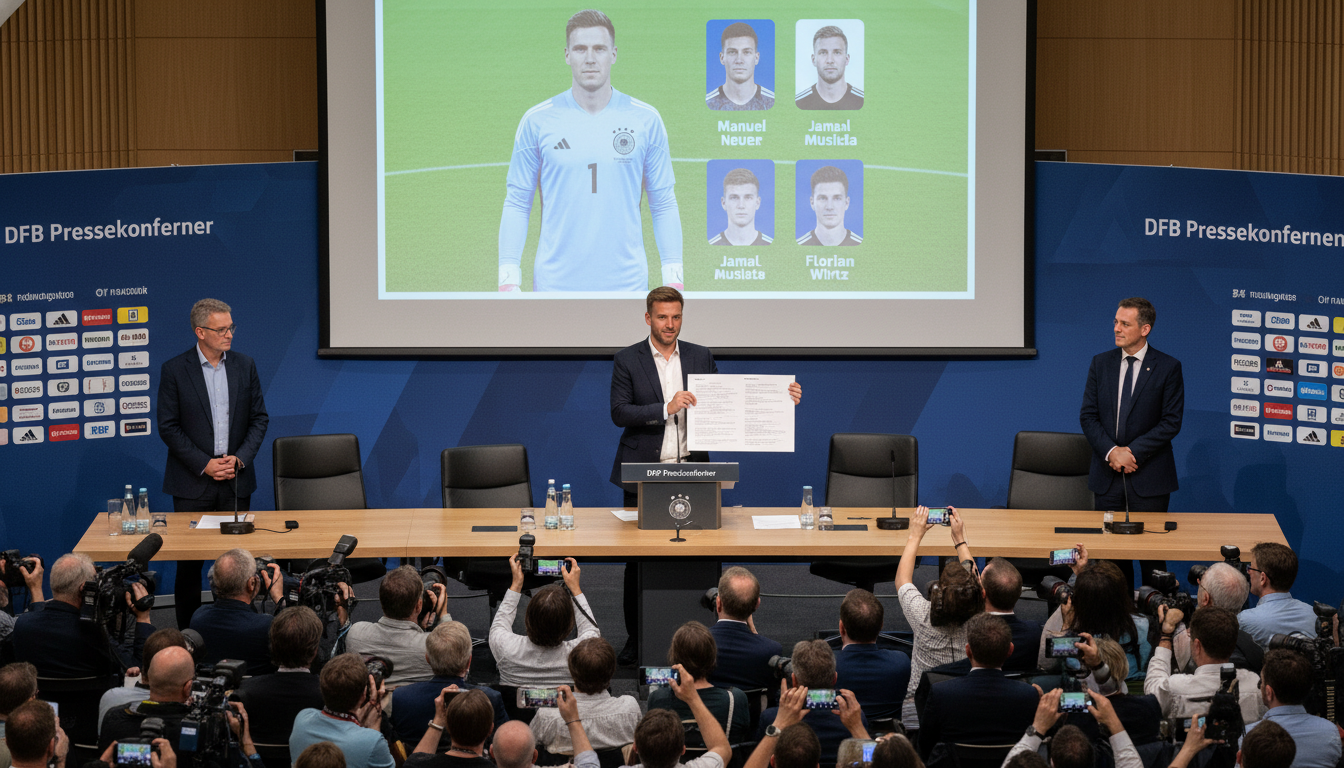
Germany World Cup squad: Nagelsmann blends youth and experience as Neuer returns for Group E campaign
Nagelsmann names a 26-man Germany World Cup squad mixing youthful attacking talent and veteran leadership, with Musiala, Wirtz and Manuel Neuer set to spearhead Group E ambitions. Eyeing knockout rounds.
Germany announce 26-man World Cup roster
The German Football Association confirmed a 26-player squad that combines established internationals with several rising stars ahead of the tournament. The selection restores Manuel Neuer to the national team and keeps Joshua Kimmich as captain, signalling a balance between experience and fresh attacking options. Germany enter the competition ranked eighth by FIFA and carry the weight of four World Cup titles and recent disappointment from two early exits.
After back-to-back group-stage exits
Germany suffered shock eliminations at the group stage in 2018 and 2022, outcomes that prompted a reassessment of squad dynamics and tactical approach. Julian Nagelsmann, who took charge in September 2023, has sought to rebuild confidence and cohesion, overseen improved qualifying form and a spirited showing as Euro 2024 hosts. The coaching staff say restoring Germany to consistent contention is the priority ahead of the June fixtures.
Vital young forwards and creative midfielders
At the centre of the team’s promise are Jamal Musiala and Florian Wirtz, two attackers whose creativity can change games individually. Musiala has flashed world-class skill and was a standout at Euro 2024, though he endured a serious leg and ankle injury in a club competition that has limited his minutes this season. Wirtz, after a challenging start following his move to Liverpool, has begun to regain form and offers tactical versatility across the frontline.
Lennart Karl, the 18-year-old Bayern prospect, provides another direct attacking option and has already made headlines with early goals at club level. His dribbling and low centre of gravity have drawn high praise, and coaches see him as a dynamic option off the bench or as part of a fluid attacking unit. The squad’s mix is intended to give Nagelsmann multiple ways to break opponents down.
Manuel Neuer returns and leadership dynamics
Neuer’s decision to reverse his international retirement and join the squad was among the most notable selections, giving Germany a goalkeeper with vast tournament experience. Nagelsmann named the 40-year-old as first-choice behind him and cited Neuer’s influence on team morale and ability to produce decisive moments. Kimmich retains the captaincy role, maintaining continuity in leadership while integrating Neuer’s experience back into the dressing room.
The goalkeeping choices also include Oliver Baumann and Alexander Nubel, but Neuer’s return reshapes defensive planning and set-piece organisation. Coaches will weigh Neuer’s match-readiness against the need to manage minutes across a monthlong competition.
Tactical questions and striking options
Despite strength in midfield and creativity, Germany enter the tournament without a guaranteed world-class out-and-out striker, a concern Nagelsmann must address. Niclas Fullkrug’s form fell away at club level and he was not selected, while Nick Woltemade earned a place after showing adaptability in a deeper attacking role. Kai Havertz can operate as a false nine, and the squad contains versatile forwards who can rotate to exploit specific match-ups.
Midfield looks more settled with Joshua Kimmich, Leon Goretzka and Aleksandar Pavlovic among the options to shield the defence and link play. The coaching staff may favour a double pivot or a more progressive midfield set-up depending on opponents, meaning rotation and tactical tweaks are likely through the group stage and beyond.
Group E fixtures and the pathway to the knockouts
Germany open their Group E campaign against Curaçao on June 14, followed by matches with Ivory Coast on June 20 and Ecuador on June 25. Curaçao’s appearance marks the smallest nation to reach a World Cup, while the Ivory Coast return after a long absence and will pose athletic and technical tests. Ecuador finished strongly in their qualifying section and are noted for defensive organisation, making them a potentially tricky opponent in the final group match.
On paper Germany will be expected to reach the knockout rounds, but form, fitness and match management will determine whether they progress comfortably or face a tougher route. Nagelsmann has emphasised that each opponent requires full focus and that early momentum will be critical to avoid the surprises of the past two tournaments.
Germany’s 26-player list presents options across all areas of the pitch, with the coaching staff aiming to harness the blend of youthful impetus and tournament-hardened veterans. The squad’s success will hinge on fitness returns, how quickly dynamic attackers re-find top form, and whether Nagelsmann can find a reliable scoring solution up front.
Public expectations are high and the team’s preparation will be monitored closely as the opening whistle approaches, with Germany determined to convert potential into sustained performance at the World Cup.
