
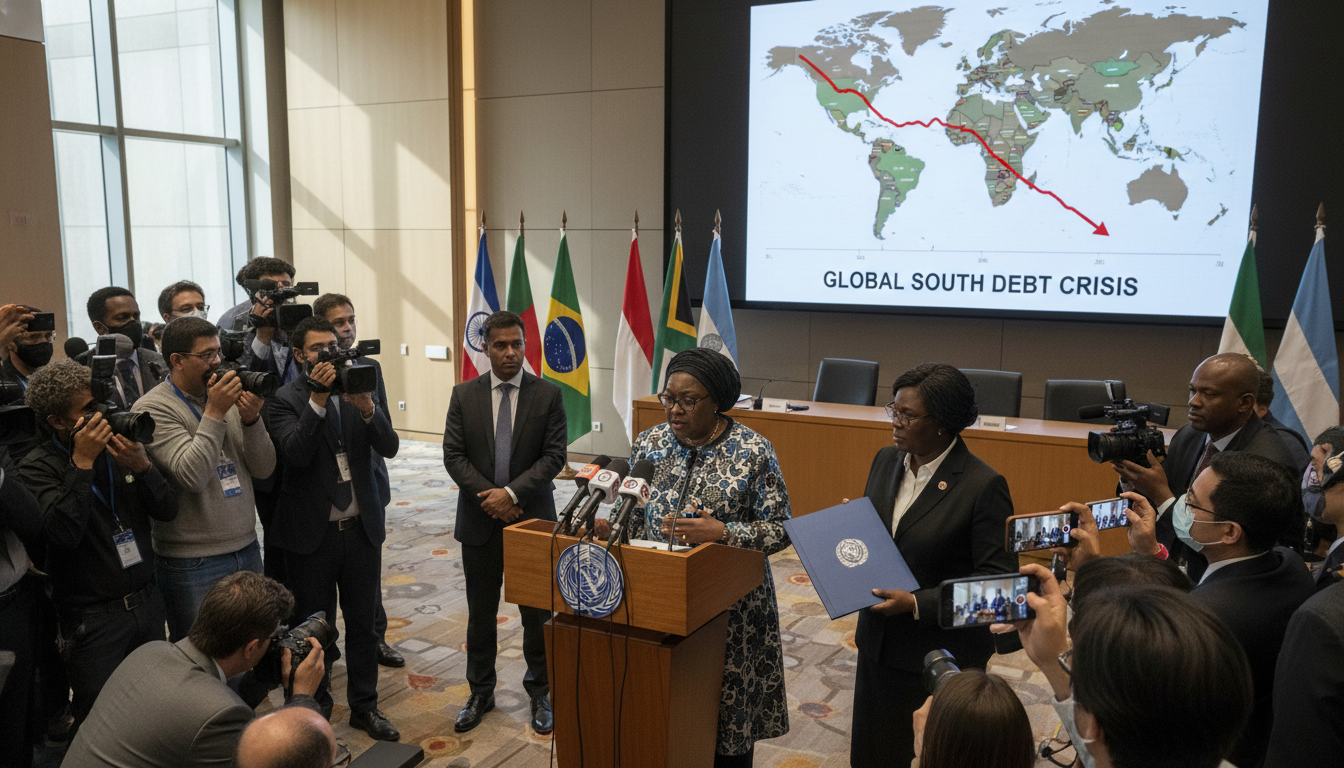
Global South debt crisis deepens as Iran war and rising costs strain 44 countries, report finds
2026 report warns Global South debt crisis deepens amid Iran war; 44 countries face severe external debt burdens and activists call for radical restructuring.
A new 2026 debt report by German campaign group erlassjahr.de and aid agency Misereor warns that the Global South is facing a deepening debt crisis intensified by the war in Iran. The report finds that 44 countries now carry very high external debt burdens, with many more facing elevated or latent risks. Analysts say rising energy and food prices, together with higher borrowing costs, are eroding fiscal space and threatening public services.
Report highlights scale and classification of debt burdens
The study classifies 44 nations as carrying very high external debt burdens and identifies 25 additional countries with high burdens. A further 15 states are described as at risk of becoming overburdened if pressures continue to mount. The classifications are based on ratios of debt service to state revenues and other fiscal indicators that measure how quickly a country’s income is diverted to repay external creditors.
The report links the recent deterioration to geopolitical shocks, notably the war in Iran, which has amplified volatility in commodity markets. Increased energy and food prices, along with higher global interest rates, are cited as the primary drivers shrinking government budgets across many low- and middle-income countries.
Angola and Senegal among the hardest hit
Misereor’s analysis highlights Angola as one of the most acute examples, where roughly 60 percent of state revenues are now consumed by interest payments and principal repayments to foreign creditors. Senegal is cited as another severe case, with about 39 percent of government income directed toward servicing debt obligations. For context, the report notes that comparable figures in advanced economies such as Germany are near 2 percent.
Those levels, the report argues, leave governments with little fiscal room to invest in essential services. Education, health and infrastructure budgets are being squeezed as debt service crowds out public spending, according to campaigners and development experts who contributed to the study.
Regional conflicts and market shocks compound fiscal strain
Authors say the war in Iran has intensified existing vulnerabilities by pushing up fuel and food costs and by increasing borrowing costs for many fragile economies. The report also points to conflict-driven disruptions and widening risk premia as factors making refinancing more expensive and debt rollovers more precarious. Lebanon is singled out as a country already in default, where the economic fallout from regional instability has driven livelihoods to the brink.
Experts warn that such shocks have knock-on effects beyond immediate price rises, including inflation, currency depreciation and lower investor confidence. These channels combine to deepen balance-of-payments pressures and make standard policy responses — like austerity or devaluation — both socially damaging and less effective.
Private creditors and aid cuts intensify problems
The report criticises the growing role of private creditors who charge high interest rates and impose onerous terms that increase the likelihood of prolonged crises. It also documents reductions in official development assistance from some donor countries, which further narrows financing alternatives for vulnerable states. Together, these trends elevate the risk that restructurings will be incomplete or repeatedly delayed.
Previous debt restructurings in countries such as Ghana and Sri Lanka are cited as examples where relief proved insufficient to secure long-term fiscal sustainability. Campaigners argue that piecemeal approaches and voluntary creditor agreements have often left debtor nations saddled with unsustainable obligations within a few years.
Calls for binding restructuring mechanisms and greater debtor participation
Misereor and erlassjahr.de are calling for a fundamental overhaul of the international financial architecture to provide predictable, fair and enforceable debt relief. The groups urge the introduction of mandatory mechanisms for debt cancellation in cases of clearly unsustainable burdens, alongside stronger participation by debtor countries in decision-making processes. They say richer nations, including Germany, should support binding rules rather than rely on voluntary goodwill.
Development finance experts quoted in the report emphasize that equitable debt relief is not a charitable gesture but a necessary component of international economic cooperation. They argue that without credible, rules-based tools for cutting debts and managing crises, cycles of vulnerability and dependency will persist and deepen.
A shift to mandatory, transparent restructuring processes would also aim to reduce reliance on expensive private finance and prevent the shifting of risk back onto public budgets in poor countries. Campaigners stress the need for international coordination to ensure that relief measures are comprehensive and do not simply redistribute burdens among different creditors.
The international community faces a choice between maintaining the status quo of ad hoc restructurings and moving toward enforceable frameworks that prioritise development and fiscal stability. As pressures mount from commodity shocks and regional conflicts, advocates say timely action is essential to prevent public services from being hollowed out and to restore a sustainable path for the most affected countries.
