
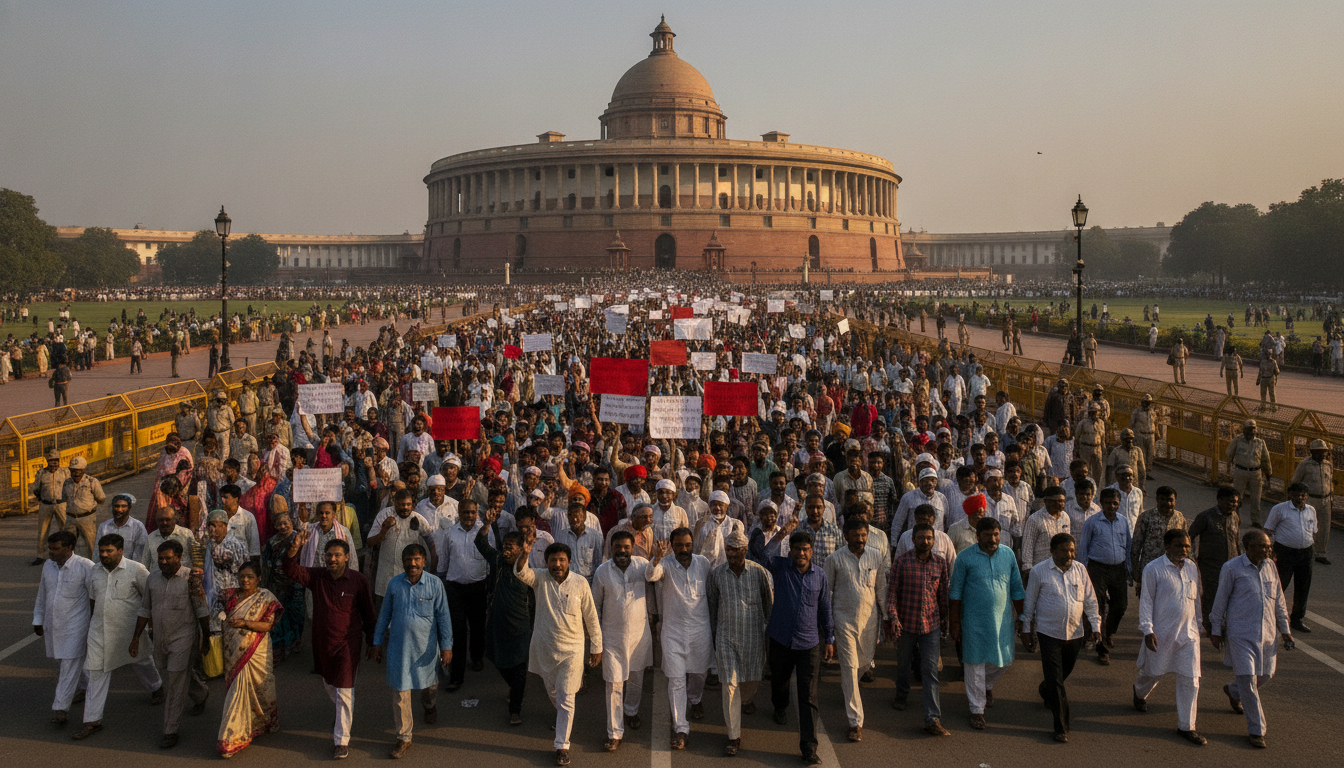
Mass protests in New Delhi over exam leaks demand education minister’s resignation
Thousands marched in New Delhi over exam leaks, calling for Education Minister Pradhan to resign after entrance scandals that disrupted millions of students.
India’s capital saw one of its largest recent demonstrations on Monday as thousands of protesters marched from Jantar Mantar toward the seat of government to demand accountability for a series of exam leaks that forced millions of students to retake high‑stakes entrance tests. The rally, centered on calls for the resignation of Education Minister Dharmendra Pradhan, grew after the forcible hospitalisation of activist Sonam Wangchuk, who has been on a prolonged hunger strike. Police warned that unauthorised gatherings would be stopped, setting the stage for a tense confrontation between demonstrators and authorities.
Crowds converge at Jantar Mantar and push toward Parliament
Many demonstrators assembled early at Jantar Mantar, a site long associated with permitted protests in New Delhi, before moving toward the vicinity of Parliament. Organisers said the turnout was driven by widespread anger over the mishandling of national entrance examinations and recent heavy‑handedness toward protest leaders. Authorities, meanwhile, reiterated they would act to prevent unauthorised marches and maintain public order.
Demand for resignation of Education Minister Pradhan
Protesters held the education minister directly responsible for the management of national exams and demanded his immediate resignation. The campaign intensified after a decision affecting more than two million applicants to a major medical entrance exam was announced in May, when authorities declared the results void following allegations of leaked test papers. Demonstrators argued that systemic failures — not isolated incidents — underlay the crisis and warranted ministerial accountability.
Sonam Wangchuk’s hunger strike and hospital transfer spark outrage
The protests swelled after police removed Sonam Wangchuk from the protest site and transferred him to a hospital, citing a court order for medical care. Wangchuk, a prominent education and climate activist from Ladakh, has been fasting for weeks demanding the minister’s resignation. His family and supporters have described the removal as an enforced detention and filed a court petition alleging unlawful abduction, while Wangchuk’s wife said he still hoped to participate in the march despite being in hospital.
Students and families recount long‑term consequences
Participants described how the exam leaks have had severe personal and financial consequences for students and their families. Many students invest years and considerable funds in tutoring and preparation for competitive exams seen as gateways to professional careers or government employment. Some candidates said cancelled results and forced re‑tests derailed plans for higher education and professional advancement, and Indian media have reported extreme distress among affected students, including cases of suicide.
Political response and law‑and‑order stance
The central government has so far declined to accede to protesters’ demands and has cautioned against illegal assemblies. Education Minister Pradhan dismissed the protesters with strong language, referring to them as “the B‑team of terrorists,” while a national spokesperson for the ruling party said protests were permissible if they complied with legal requirements. Officials also noted that arrests related to the exams were under way and that investigations would proceed through the established legal process.
Rise of a new youth movement and broadening protest base
A grassroots movement known as the Cockroach Janta Party, formed in response to disparaging remarks about unemployed youth, has emerged at the forefront of the campaign for accountability over the exam leaks. Founded only months ago, the group has tapped into widespread frustration among young people facing limited economic mobility and intense competition for scarce opportunities. Activists say the movement has attracted a diverse cross‑section of students, educators and parents who see the scandal as emblematic of deeper governance failures.
The demonstrations have ignited debates about the shrinking space for dissent in India, a concern raised by critics who point to a pattern of tightened controls on protests and the use of stringent laws against activists. Observers say the response to the exam leaks and to high‑profile protest tactics such as hunger strikes will be closely watched for what it signals about the government’s tolerance for dissent and its willingness to confront administrative failures.
With legal petitions pending over the hospitalisation of Sonam Wangchuk and ongoing criminal probes into those accused of facilitating the leaks, the standoff is likely to continue in the near term. Protest organisers say they will press on until their core demand — ministerial accountability for the exam scandals — is met, while authorities emphasise public safety and adherence to the law as they manage demonstrations in the capital.
