
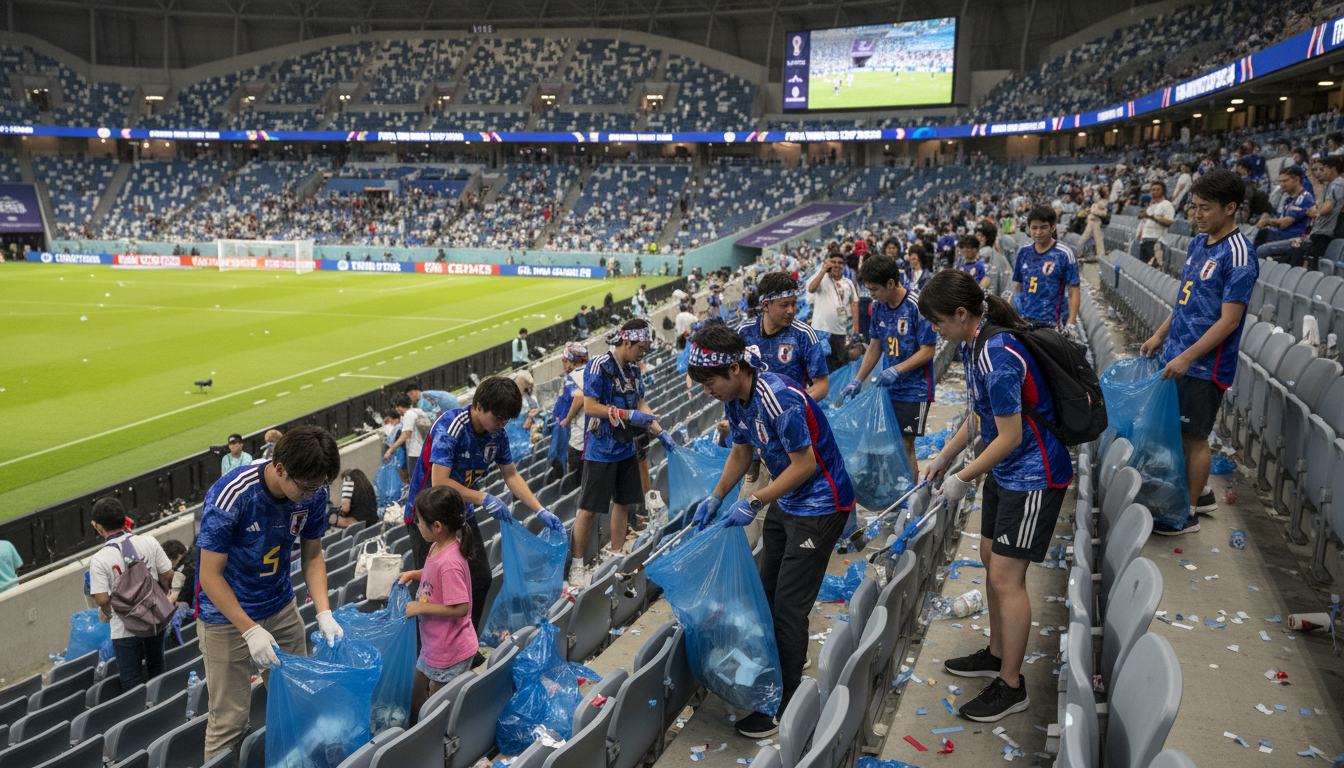
Japanese Fans Cleaning Stadiums: Tradition from Schools to World Cup Pitches Set to Return in 2026
Japanese fans cleaning stadiums turn a school-taught habit into a World Cup tradition, expected to reappear as Japan prepares for matches in June 2026.
Japan’s football supporters are again drawing attention for cleaning stadiums after matches, a practice rooted in early education that has become a recurring World Cup image. The phenomenon — described as Japanese fans cleaning stadiums — first captured international notice at France 1998 and has recurred at global tournaments, with observers expecting the behaviour to continue during Japan’s June 2026 group-stage fixtures. Officials and academics say the gestures reflect long-standing social norms rather than temporary publicity stunts.
Early schooling and daily cleaning routines
Children in Japan commonly learn to clean their classrooms and school grounds from a young age, with cleaning duties often integrated into the daily schedule. This practice trains successive generations in shared responsibility for public spaces and inculcates the expectation that users help maintain order where they gather.
Because many primary schools do not employ full-time custodial staff, pupils and teachers allocate time for communal cleaning, which reinforces the habit into adulthood. Educators and social scientists note the repetition of these tasks embeds practical skills and social norms about care for shared environments.
Words and proverbs explaining the behaviour
The practice is often linked to a Japanese proverb, “Tori ga tatsu ato wo nigosazu,” literally “the bird does not soil the place it leaves,” which is commonly rendered as “leave things as you found them.” Experts say the phrase encapsulates the cultural preference for minimizing disturbance and keeping communal spaces tidy.
Koichi Nakano, a professor of political science and history at Sophia University, told news agencies that fans behave in ways they were taught from childhood. Anthropologists point to such idioms as shorthand for broader attitudes about public conduct and mutual respect.
World Cup moments: 1998 to Qatar 2022
The image of Japanese fans tidying stands first gained wide exposure at the 1998 World Cup in France, when spectators were filmed picking up litter after matches. That early display has since been repeated at subsequent tournaments and international fixtures, reinforcing the association between Japanese supporters and post-match cleanup.
At the 2018 World Cup in Russia, Japanese players cleaned their dressing room and left a handwritten thank-you in Russian after exiting the tournament. In Qatar 2022, supporters were photographed leaving multilingual thank-you notes attached to bags of collected trash, demonstrating a consistent pattern of courteous conduct at major events.
Academic perspectives and cultural context
Scholars caution against romanticising the behaviour while acknowledging its roots in everyday socialisation. Barbara Holthus, deputy director of the German Institute for Japanese Studies in Tokyo, described the practice as the result of different upbringing and social norms rather than an exceptional national virtue.
Sociologists emphasize the concept of meiwaku — avoiding causing trouble or inconvenience to others — as central to understanding why many Japanese people treat public cleanliness as a matter of courtesy. This mindset, academics argue, explains why fans may feel a personal responsibility to tidy stadiums after use.
Public infrastructure and practical incentives
Practical factors also support the custom: public trash bins are relatively scarce in many Japanese cities, encouraging people to carry waste home and dispose of it there. The low number of street bins reduces maintenance costs and helps limit vermin, creating an infrastructure that dovetails with personal habits.
Event organisers and stadium operators have noted the positive optics and practical benefits of spectators helping clear litter, although officials also point out that organised waste management remains the responsibility of venue staff. Local authorities have used such displays to promote civic pride and reinforce waste-reduction campaigns.
Football culture, the J.League and fan identity
Observers link the ritual more strongly to football than to other sports, suggesting the professionalisation of the J.League since its 1993 founding shaped fan culture over three decades. William Kelly, a scholar of Japanese anthropology, has proposed that sustained engagement with club culture helped cultivate organised, community-minded supporter groups who carry those norms to international matches.
Fans themselves often describe the clean-up as a gesture of gratitude toward host venues and fellow supporters, reinforcing a communal identity that travels with national teams. Media attention has turned the tradition into a point of national pride, prompting some Japanese fans to perform the ritual more visibly when cameras are present.
Japan’s tidy approach to leaving stadiums as they found them has become a recurrent image at global tournaments, blending school-taught discipline, cultural norms about not inconveniencing others, and practical habits shaped by public infrastructure. As Japan prepares for its matches in June 2026, the sight of supporters gathering litter and leaving thank-you notes is expected to return to World Cup narratives and continue prompting discussion about how culture shapes behaviour at major sporting events.
