
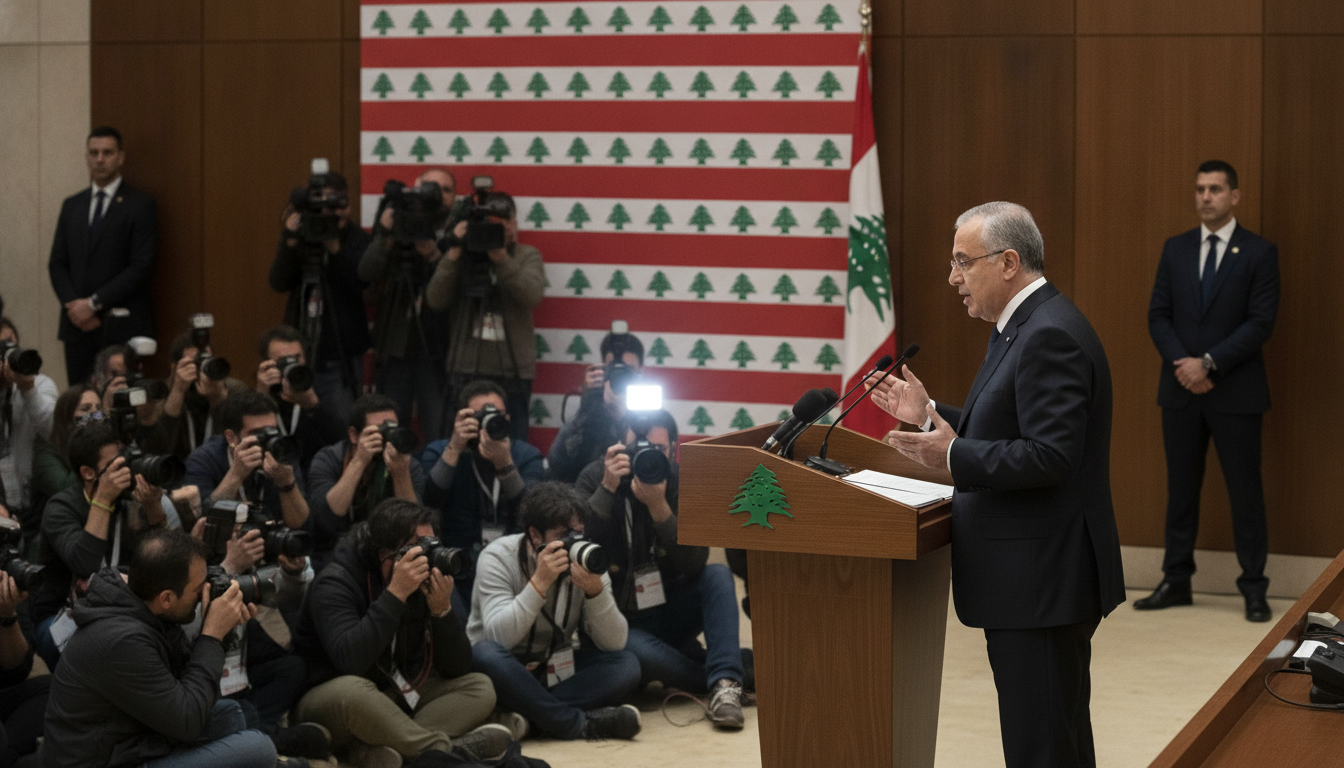
Lebanon’s Sovereignty at Forefront: Prime Minister Nawaf Salam Rejects Any Territorial Concessions
Lebanon’s PM Nawaf Salam vows to defend sovereignty, reject any territorial concession and restore state authority while ensuring the monopoly of arms.
Lebanon’s Prime Minister Nawaf Salam delivered a firm declaration affirming his government’s commitment to defending Lebanon’s sovereignty and rejecting any compromise on its territory. His remarks emphasized a coordinated plan to “restore the state” by combining comprehensive reforms with a reassertion of state authority across the country. The pledge places Lebanon sovereignty at the center of the government’s policy priorities and signals a renewed focus on institutional consolidation.
Prime Minister’s Statement on Sovereignty
Salam framed his remarks as an unequivocal stand against any attempt to cede Lebanese land or dilute national control. He said the government would not bargain over “a single inch” of Lebanese soil, underscoring the symbolic and legal weight of territorial integrity. The language was pointed and intended to reassure domestic and international audiences of the government’s resolve.
The statement also sought to clarify the administration’s approach to sovereignty as both territorial and institutional. By linking sovereignty to the restoration of state institutions, Salam positioned administrative reform and security policy as mutually reinforcing objectives. This framing sets expectations for concrete measures to strengthen the central government.
Roadmap to Restoring the State
Salam outlined a multi-pronged roadmap for what he called the “process of restoring the state,” which he said requires integrated reform. He emphasized that restoring state authority would not be achieved through isolated actions but through systemic changes in governance and public administration. The plan, as described, prioritizes policy coherence and enforcement of state institutions at all levels.
The prime minister called for broad reforms ranging from anti-corruption measures to public sector restructuring. He argued that only a functioning state apparatus can enforce laws uniformly and maintain public services. The strategy aims to rebuild citizen trust in state institutions as a foundation for lasting sovereignty.
Security and Weapons Monopoly Pledge
A central element of Salam’s remarks was a clear security message: the monopoly of weapons must be held by legitimate state forces. He affirmed there would be no tolerance for parallel armed actors operating outside state control. The pledge reflects longstanding debates over disarmament and the role of non-state armed groups in Lebanon’s security landscape.
Salam stressed that the state must be the sole authority to decide on war and peace, a statement that implicitly addresses both domestic and regional security dynamics. The emphasis on exclusive state decision-making authority aims to eliminate ambiguity over who can legally use force. Implementing this will require careful coordination with security agencies and political stakeholders.
Implications for Lebanese Institutions
If acted upon, Salam’s proposals could reshape the balance between central institutions and localized power structures. Strengthening the state’s capacity to deliver services and enforce laws would likely involve bolstering the judiciary, security forces, and administrative bodies. Officials have signaled that institutional reforms will be phased and tied to measurable benchmarks.
Experts note that legal and operational steps will be necessary to translate rhetoric into practice, including legislative changes and budgetary commitments. Reasserting state authority also entails ensuring that ministries have the resources and independence to execute policies. The government will face the practical challenge of aligning short-term stabilization with long-term reform.
Regional and Diplomatic Context
Salam’s emphasis on sovereignty arrives amid a complex regional environment that affects Lebanon’s security calculus. Neighbouring developments and diplomatic pressures have historically influenced Beirut’s internal debates over territory and armed groups. By publicly asserting Lebanon’s territorial integrity, the prime minister also sent a diplomatic message to regional actors and partners.
Observers say the speech could be aimed at reassuring international supporters while appealing to domestic constituencies demanding stability. Maintaining a consistent diplomatic line on sovereignty may help Lebanon attract technical assistance and political backing for institutional reform. However, translating international goodwill into concrete support will require detailed policies and credible timelines.
Domestic Political Response and Next Steps
Reaction among Lebanon’s political factions is expected to vary, with some parties welcoming the emphasis on state authority while others will press for guarantees on security transitions. Salam’s government will need to engage in consultations across the political spectrum to build consensus for any enforcement measures. The coming weeks are likely to see negotiations on specific reform steps and security arrangements.
The administration signalled that operational details and legislative proposals will follow the prime minister’s declarations. Officials will face pressure to produce clear timelines and accountability mechanisms to monitor progress. How quickly the government can move from rhetoric to action will determine whether the pledge to uphold Lebanon sovereignty gains traction.
Lebanon now faces the test of turning declarations into policy and practice, balancing domestic political realities with the urgent need to reinforce state institutions. The government’s next moves on security consolidation, legal reform and institutional strengthening will be watched closely at home and abroad.
