
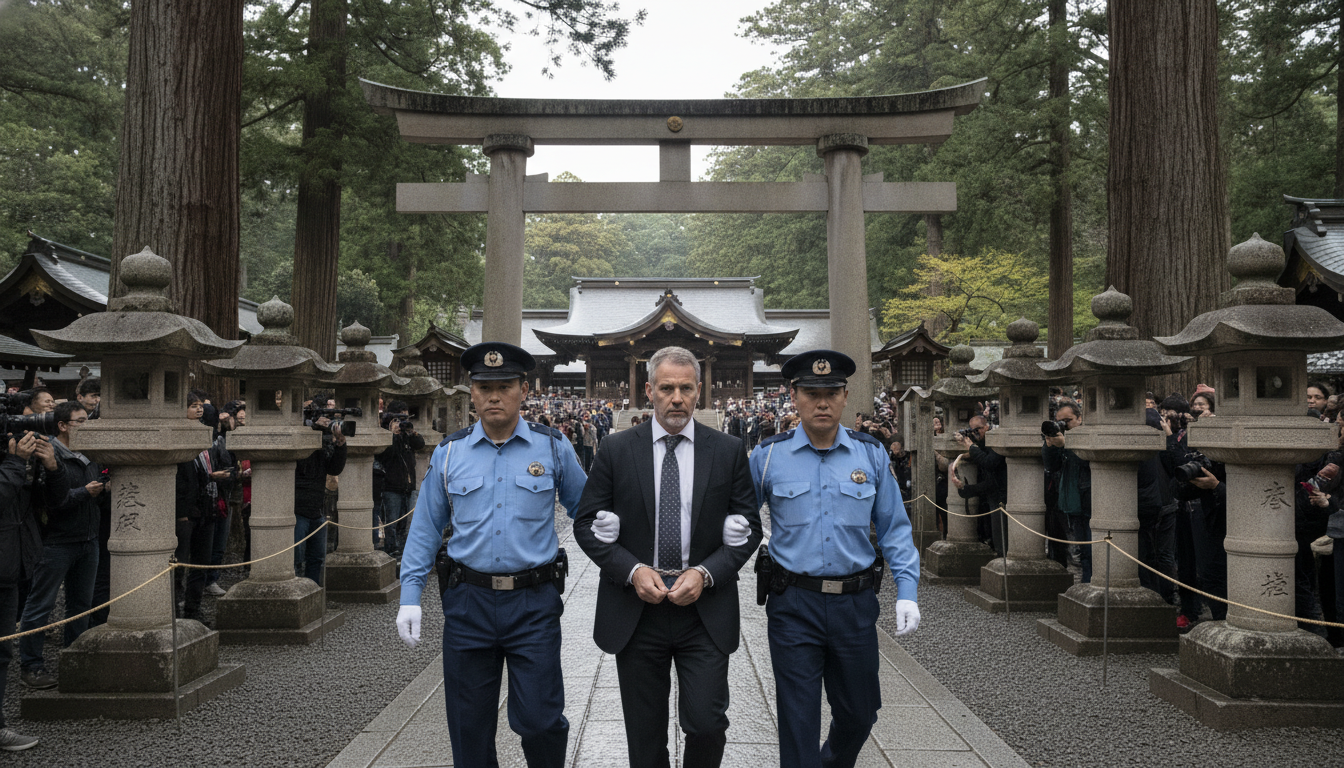
Manhattan doctor sentenced in Japan to 18-month suspended term for vandalizing ancient shrines
Manhattan doctor sentenced in Japan to an 18-month suspended prison term after a Chiba court found him guilty of smearing oil on a thousand-year-old Buddhist temple and a centuries-old Shinto shrine. The verdict closes more than a decade of litigation and a rare extradition from the United States following incidents that took place in 2015. The sentence was suspended for three years, and the ruling emphasized the cultural loss produced by the acts.
Chiba court hands down suspended 18-month sentence
Judge Yoko Sugiyama of the district court in Chiba delivered the verdict and imposed an 18-month prison term that was suspended for three years. In her ruling the judge highlighted the historical and cultural value of the damaged sites and said prioritizing one’s own religious beliefs to commit the act “warrants severe condemnation,” according to public broadcaster NHK.
The court cited Dr. Masahide Kanayama’s admission of guilt and his pledge never to repeat the offense as factors in suspending the sentence. It remains unclear whether he will return to the United States following sentencing, and his legal team did not immediately respond to requests for comment.
Details of the damage at Naritasan Shinsho-ji and Katori Jingu
Japanese authorities said oil was smeared on wooden pillars at the main entrance of the Naritasan Shinsho-ji Temple in Narita, leaving visible blackish stains. At the nearby Katori Jingu Shrine in Katori, investigators reported oily liquid on wooden poles, stairs and a donations box; shrine officials said some stains were hard to see unless examined closely.
Both sites hold deep historical significance: Naritasan Shinsho-ji is a thousand-year-old Buddhist temple and Katori Jingu traces its foundation back to 643 B.C. Court documents and statements from temple and shrine officials underlined the cultural harm caused by the contamination of irreplaceable wooden structures.
Admission, motive and statements from the defendant
Dr. Masahide Kanayama, a 63-year-old physician who has practiced in Manhattan for nearly three decades, acknowledged during trial that he had damaged the sites. He told the court that he poured oil because he believed he was being guided by the Holy Spirit, a claim the court described as a “misconception,” according to NHK’s reporting.
Court filings and previous interviews show Dr. Kanayama presented his faith as central to his life and work. He has said that when guided by faith, his surgical practice becomes a way to serve God, and he founded a nonprofit, International Marketplace Ministry, that promotes prayer and personal relationships with God in daily life.
Extradition battle and timeline of legal proceedings
Japan requested Dr. Kanayama’s extradition from the United States in 2016, triggering a prolonged legal battle that lasted more than a decade. The defendant repeatedly sought to block the transfer, but a federal judge’s ruling in February cleared the way for extradition and he was subsequently arrested on a flight to Japan on March 4.
The extradition and subsequent trial mark an uncommon instance of cross-border cooperation in prosecuting cultural-property crimes involving a national who was also a long-term resident abroad. Japanese officials have emphasized that the request was a matter of law enforcement, while the defendant’s lawyers argued that religious discrimination played a role in targeting their client.
Evidence presented by investigators
Prosecutors relied on a combination of surveillance footage from the temple and shrine, car rental and flight records, and online material to link the incidents to Dr. Kanayama. Authorities also referenced YouTube videos from 2012 in which a man they identified as Dr. Kanayama discussed anointing shrines with oil for religious purposes.
Police in Chiba Prefecture say the combination of physical evidence and digital records provided a clear trail that led investigators to the defendant. Temple and shrine custodians supplied damage reports and photographic evidence documenting the oily stains and their effect on wooden surfaces.
Responses from officials and community stakeholders
The Japanese consulate in New York stated that the extradition request was strictly a law-enforcement matter and not motivated by political or religious considerations. Shrine and temple officials expressed relief that the case reached a legal conclusion and reiterated the importance of protecting cultural heritage sites from deliberate harm.
Legal observers noted the case raises questions about the boundary between religious conviction and criminal conduct, particularly when actions damage communal cultural assets. Advocacy groups for cultural preservation described the ruling as affirmation that religious belief does not excuse destruction of protected heritage.
The sentencing brings formal legal closure to a case that began with damage reported in 2015 and unfolded over years of investigation, international legal contest, and a trial that included the defendant’s candid admission. The suspended term and multi-year probationary period leave open questions about accountability and restitution but underscore that courts will weigh both cultural harm and the defendant’s statements when imposing punishment.
