
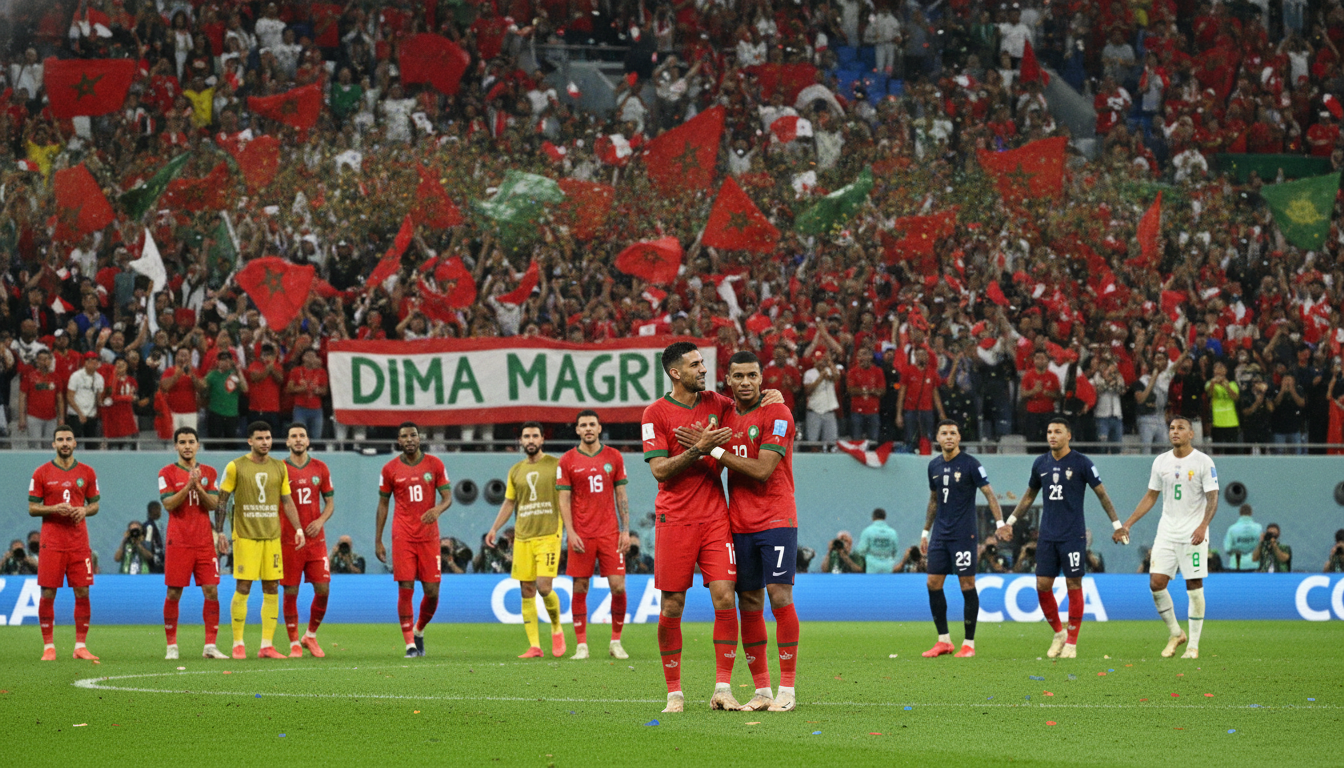
Morocco at World Cup 2026: Atlas Lions exit in quarter-finals after 2-0 loss to France
Morocco at World Cup 2026 suffered a 2-0 quarter-final defeat to France, ending the Atlas Lions’ deep run while underlining sustained progress on the world stage.
Despite the loss, Morocco’s performance in World Cup 2026 reinforced the team’s status as a rising force in international football and extended a sequence of historic achievements that began at the 2022 tournament.
Match decisive moments: France seals quarter-final win
France produced the breakthrough moments that decided the quarter-final, with Kylian Mbappé opening the scoring and Ousmane Dembélé adding a second to secure a 2-0 victory for Les Bleus.
Morocco competed bravely but was visibly affected by key absences and a mid-match reshuffle that unsettled its usual defensive balance.
Injury setbacks and tactical adjustments
The Atlas Lions began the tie without defender Shadi Riad, whose absence forced coach Walid Regragui to alter defensive roles and deploy right-back Noussair Mazraoui in a central position.
Those changes left Morocco more exposed in transitional phases and limited its ability to sustain forward pressure, particularly after the team lost its most prolific attacking outlet, Ismail Saibari, to fitness concerns.
Road to the last eight: disciplined defence and decisive penalties
Morocco reached the quarter-finals after a tense round-of-32 encounter with the Netherlands that finished 1-1 after extra time and was decided 3-2 on penalties in favour of the Atlas Lions.
That win echoed Morocco’s tactical discipline from the previous World Cup, with a compact defensive shape and clinical mentality in shootouts helping the team advance to the knockout stages for a second consecutive tournament.
Yassine Bono cements reputation in World Cup history
Goalkeeper Yassine Bono again produced decisive moments, including a penalty stop during the France match, adding to his record of four penalty saves across World Cup play and shootouts.
Bono’s repeated success from the spot places him among an elite group of tournament goalkeepers and highlights his central role in Morocco’s recent international achievements.
Public and media response: pride mixed with critique
Reactions in Moroccan and regional media were divided after the defeat, with many outlets praising the squad for departing the tournament “with their heads held high” and others questioning the team’s attacking fluency in the most important moments.
Analysts who were critical pointed to the impact of absences and a lack of alternative attacking combinations late in the match as key reasons Morocco could not overturn the deficit.
Historic milestones and what they signify for Moroccan football
Morocco became the first Arab nation to reach the knockout rounds in two consecutive World Cups, a statistic that underscores the country’s sustained development at the national level.
This tournament marked Morocco’s third straight World Cup appearance, reflecting growing institutional stability in player development and international recruitment strategies.
Morocco’s consistent presence in the latter stages of the past two tournaments also reinforces its status as the leading representative of Arab and African football at global events.
The quarter-final exit to France closes this chapter of the World Cup but leaves a clear legacy: a national programme capable of producing disciplined, tactically adaptable teams that can challenge the sport’s traditional powers.
Moving forward, the federation faces choices about squad renewal, managing injuries to key players, and translating tactical resilience into greater attacking variety.
The Atlas Lions leave World Cup 2026 with their record improved and expectations raised, signaling that Morocco’s football project is not a one-off success but a maturing force with further ambitions on the world stage.
