
Senegal government reshuffle deepens rift as Sonko’s Pastef refuses to join new cabinet
Senegal government reshuffle: President Bassirou Diomaye Faye names Ahmadou Lo as prime minister; Ousmane Sonko’s Pastef refuses to join the new cabinet.
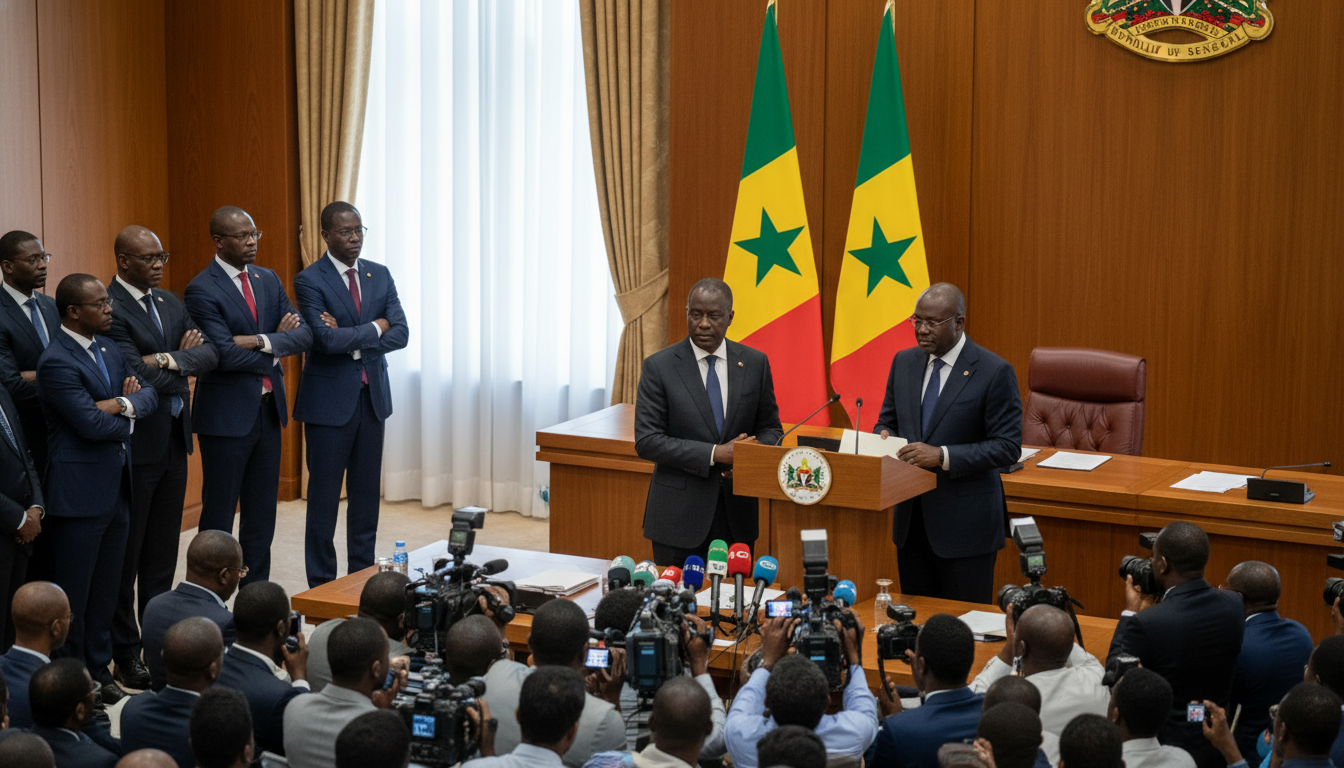
Senegal’s president announced a major government reshuffle on Monday, June 1, 2026, appointing economist Ahmadou Al Aminou Mohamed Lo as prime minister in a move that has further exposed fractures within the ruling movement. The transfer of power and the composition of the new Senegal government were aired live on national television, less than two weeks after Mr. Faye removed Ousmane Sonko from the premiership and dismissed the previous cabinet.
Opposition and allied lawmakers reacted sharply to the developments, with Sonko — now speaker of the National Assembly — declaring his party would not take ministerial posts in the new lineup.
Faye names new prime minister to address debt and governance
President Bassirou Diomaye Faye said he chose Ahmadou Al Aminou Mohamed Lo for his economic expertise and capacity to confront the country’s mounting debt challenges. The president presented Lo as a technocrat who can negotiate with international creditors and stabilise public finances.
Faye framed the appointment as a decisive step to restore economic confidence after months of political turbulence that have complicated policy continuity and investor sentiment.
Sonko and Pastef reject cabinet participation
Ousmane Sonko, who was dismissed from the premiership in mid-May, told supporters and posted on social media that Pastef would not be represented in the next government. Sonko said talks with President Faye on Monday produced “points of agreement” but also “points of disagreement,” leading to the party’s decision to stay out of the cabinet.
His declaration comes as Pastef — the party he founded in 2014 — holds a commanding majority in the legislature, a factor that intensifies the political standoff between the executive and its former allies.
New cabinet announced with notable absences from senior Pastef ranks
Prime Minister Lo read out a list of 30 ministers that included several Pastef members but also omitted a number of the party’s senior figures who served in the previous government. The mix signals an attempt by Faye to balance party representation with technocratic appointments and to sideline certain personalities who have become politically contentious.
Observers noted the selections reflect both continuity and change, with the administration seeking to maintain parliamentary backing while reshaping its executive team around economic management priorities.
Parliamentary dynamics shift as Sonko becomes speaker
In an unexpected turn, Ousmane Sonko was elected speaker of the National Assembly in a vote marked by a boycott from parts of the opposition. The parliamentary victory consolidates Sonko’s influence within the legislature even as he distances Pastef from executive power.
With 130 of 165 seats reportedly controlled by Pastef, the party’s decision to abstain from ministerial roles creates a situation in which the executive must govern without direct cabinet representation from the majority group in parliament.
Economic divisions shape policy choices and IMF posture
Economic policy remains a key fault line between Faye and Sonko, especially over engagement with the International Monetary Fund and the design of a loan programme. President Faye has signalled openness to IMF discussions as part of efforts to tackle debt, while Sonko has advocated for more sovereign approaches and resisted external conditionalities.
The differing stances raise questions about fiscal strategy, possible austerity measures, and how future negotiations with multilateral lenders will proceed amid political discord.
Regional and domestic stability concerns grow as political crisis endures
Analysts warn that the split between the presidency and Pastef could prolong uncertainty, complicate governance, and affect foreign investment and donor confidence. The standoff also increases the risk of parliamentary gridlock on critical reforms if cooperation breaks down between the executive and the legislature.
Civil society and business leaders are likely to press both sides for dialogue to prevent escalation, but with high emotions and competing political ambitions, a swift reconciliation is not guaranteed.
The coming weeks will test whether the new Senegal government can stabilize the economy while navigating a legislature dominated by a party that has chosen to remain outside the cabinet.
