
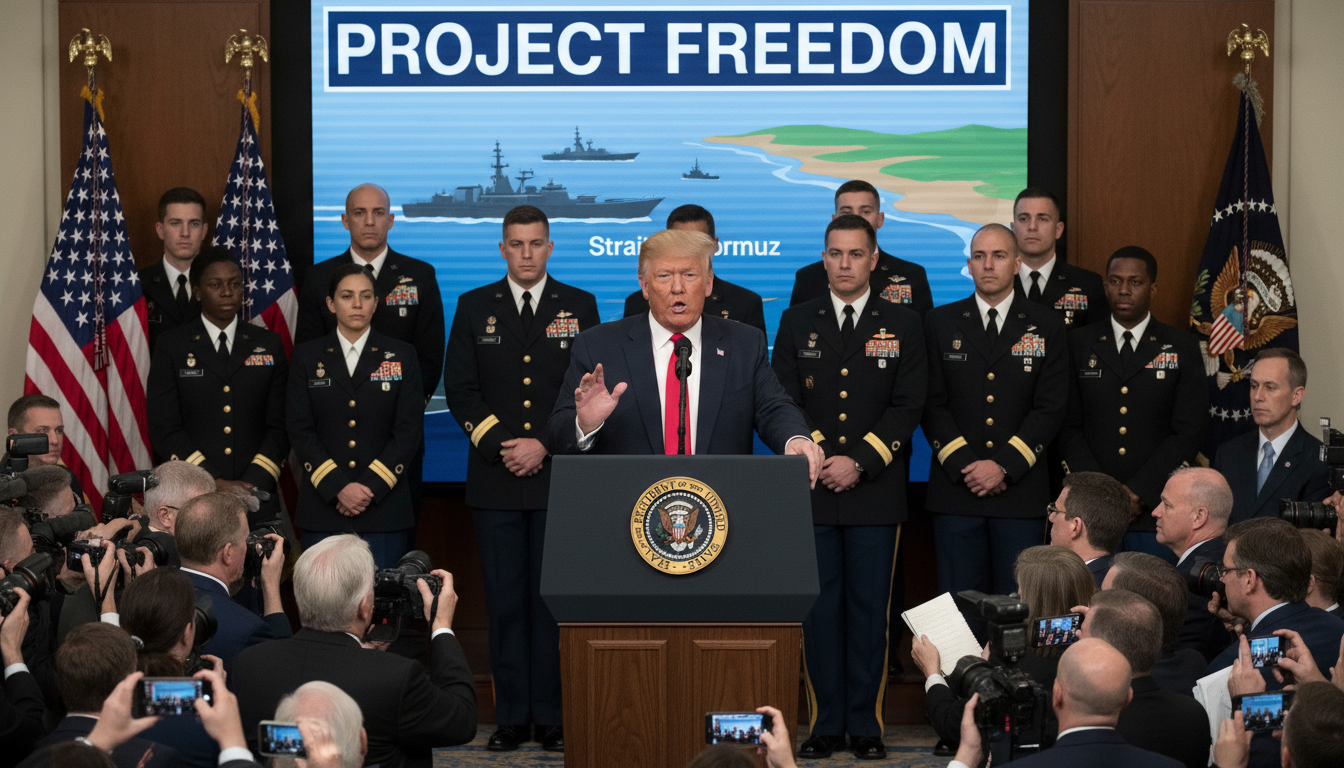
White House posts “I have all the cards” as Trump vows ship escorts through Strait of Hormuz
White House and President Trump signal new US campaign to escort commercial vessels through the Strait of Hormuz, drawing swift Iranian warnings and raising regional stakes.
US posts image of Trump with Uno cards
On May 3, 2026 the White House posted an image on X of President Donald Trump holding Uno cards with the caption “I have all the cards,” signalling Washington’s confidence in its campaign against Iran.
The post followed a separate message on Trump’s Truth Social in which he said US forces would begin guiding ships stranded around the Strait of Hormuz “by Monday,” framing the move as a protection mission.
Trump launches ‘Project Freedom’ to escort shipping
President Trump described the initiative as “Project Freedom,” saying US forces would ensure neutral commercial vessels could transit restricted waterways safely.
He cast the operation as a response to Tehran’s restrictions, saying the escorts would allow trading nations to “get on with their business” without interference from Iranian actions that have disrupted Gulf shipping.
Iran issues warnings and redraws maritime boundaries
Iran’s authorities immediately rejected unilateral action and warned that navigation in the Strait of Hormuz must be coordinated with its armed forces.
The Islamic Revolutionary Guard Corps released an expanded map defining broader eastern boundaries for the strait and said vessels must comply with IRGC transit protocols or face serious risks, including being stopped by force.
Claims of clashes and denials over drone strikes
State-linked Iranian media on Monday reported a US warship had been struck by two Iranian drones; US Central Command denied the claim.
Such conflicting accounts underscore the volatility of the situation, where rapid escalation at sea can be accompanied by competing narratives from both sides.
Economic leverage: sanctions and naval pressure
The United States continues to rely on a comprehensive sanctions regime that targets Iran’s banking, oil exports and international trade access, measures that Washington says are aimed at constraining Tehran’s strategic capabilities.
Since April 13, 2026 US forces have intensified naval operations aimed at limiting Iran’s ability to export oil and move goods, seizing or turning back vessels and imposing logistical strain on Tehran’s economy.
Iran’s strategic cards: the Strait, proxies and asymmetric weapons
Iran’s most consequential leverage remains its control of the Strait of Hormuz, a narrow passage that normally carries a significant share of global oil and LNG shipments.
By restricting or threatening to close the strait Tehran has forced global energy markets to reprioritise routes and insurers to reassess risk, amplifying economic pressure on many states.
Regional proxies and low-cost weaponry raise costs for Washington
Beyond maritime measures, Iran’s network of allied militias across the Middle East and groups such as the Houthis in Yemen provide Tehran with indirect means to disrupt shipping and target regional US interests.
Cheap, mass-produced drones and cluster munitions have proven to be cost-effective tools that can inflict outsized damage relative to their price, complicating US and allied efforts to neutralise threats at sea.
Experts question the extent of US strategic advantage
Strategists say America’s conventional military superiority — including carrier strike groups, long-range precision strike capability and regional bases — has not eliminated Iran’s ability to impose costs and create uncertainty.
Analysts note that heavy investment in platforms and interceptors does not automatically translate into decisive leverage when adversaries adopt asymmetric tactics that are harder and more expensive to counter.
Diplomatic backchannels and the risk of escalation
Trump indicated US negotiators were engaged in “very positive discussions” with Tehran that could lead to a breakthrough, but offered no details on terms or timelines.
Diplomacy may remain the only reliable way to de-escalate, yet both sides’ public posturing and military steps risk narrowing options and increasing the chance of miscalculation at sea.
The new US promise to escort ships through the Strait of Hormuz sets up a delicate test: whether maritime escorts will restore commercial flows or instead provoke tighter Iranian controls and further regional disruption.
