
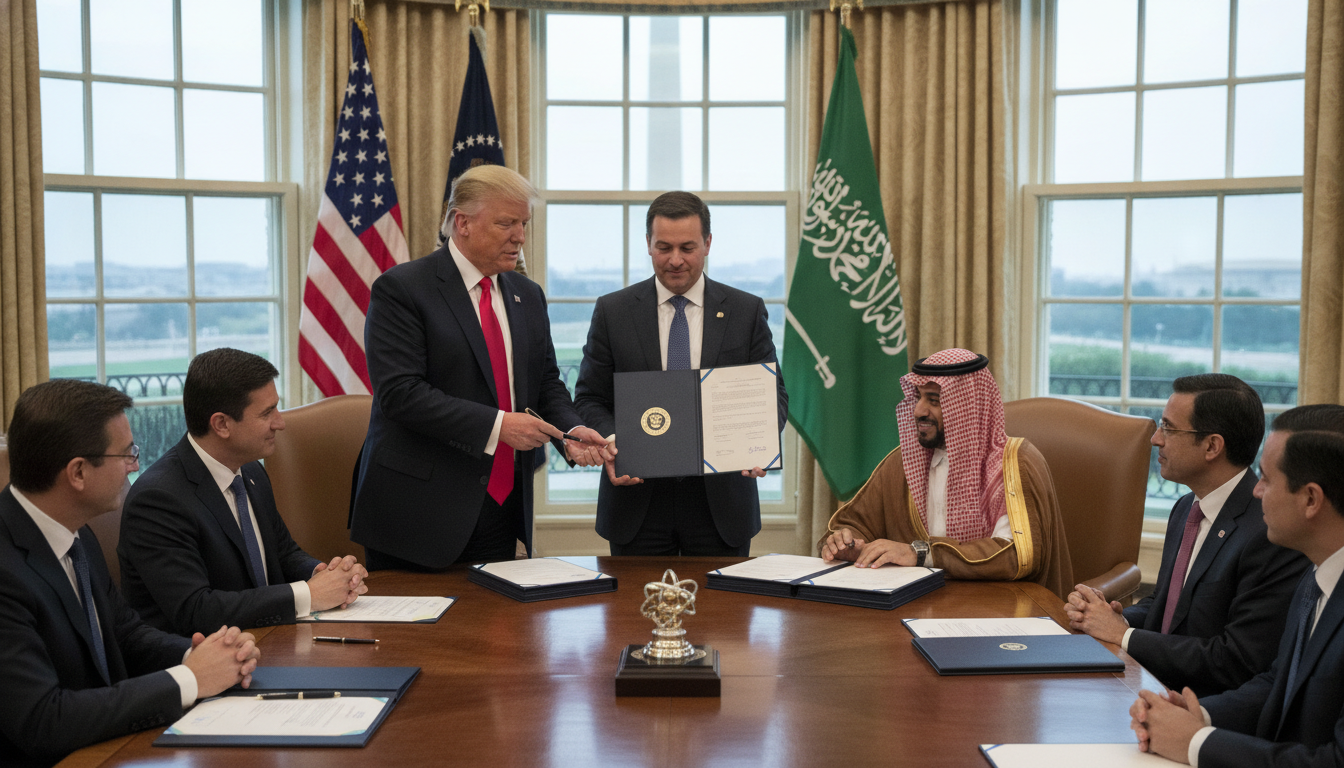
US approves US-Saudi nuclear agreement that could permit domestic uranium enrichment
US President approved a US-Saudi nuclear agreement that would allow Saudi Arabia to develop a civilian nuclear programme with domestic uranium enrichment, according to media reports.
The White House decision marks a major shift in longstanding U.S. non‑proliferation practice and, if advanced, would open the door for American firms to help build Saudi Arabia’s nuclear industry. Reports say the agreement — expected to be presented to Congress — would run for decades and include provisions that could permit enrichment after a joint study.
Agreement Would Allow Domestic Uranium Enrichment
The reported framework would be a 30‑year civilian nuclear cooperation accord that permits U.S. companies, including major suppliers, to assist Saudi Arabia with reactors and fuel cycle work.
A central element described in media accounts is a mechanism allowing Riyadh to pursue domestic uranium enrichment following a joint U.S.‑Saudi assessment, a step that departs from the stricter terms previously sought by some partners.
Enrichment at power‑reactor levels is a legitimate pathway to produce fuel, but the same technology can be scaled to higher concentrations used in weapons if oversight is absent.
Officials and analysts warn that providing a route to domestic enrichment — even for civilian energy — raises verification and strategic questions that must be resolved before construction and fuel work proceed.
US Administration Frames Strategic Rationale
Senior U.S. officials have argued the pact would preserve American leadership in the global nuclear market while keeping strategic influence over a pivotal Gulf partner.
Supporters say expanded civilian cooperation would deter rivals from filling the vacuum and promote the adoption of U.S. technology and safety standards inside Saudi Arabia.
The administration also cites Riyadh’s projected electricity growth and the kingdom’s plan to diversify its energy mix as reasons to pursue commercial nuclear ties.
Proponents contend that managed cooperation can balance commercial benefits, non‑proliferation commitments, and regional stability if robust safeguards are implemented.
Non‑proliferation Experts Raise Alarms
Non‑proliferation specialists and some lawmakers have criticised aspects of the reported agreement as falling short of the so‑called “gold standard” adopted by other Gulf partners.
That 2009 precedent included an explicit commitment not to enrich uranium or reprocess spent fuel, along with broad International Atomic Energy Agency inspection rights that some critics say may be absent in the new deal.
Analysts caution that bilateral guarantees are more fragile than multilateral verification measures and can be altered by changing political ties.
Former and current observers warn that forgoing the strongest verification protocols would set a precedent other countries might cite to justify looser controls.
Regional Security Implications and Iran Factor
Allowing Saudi enrichment carries significant regional security implications given Tehran’s nuclear history and Riyadh’s own statements about pursuing a deterrent if a rival acquires nuclear weapons.
Critics say the move risks eroding Washington’s public posture aimed at preventing Tehran from crossing nuclear thresholds and could complicate diplomatic pressure on Iran.
Gulf states closely monitor each other’s moves on sensitive technologies, and any perceived erosion of non‑proliferation norms could spur a cascade of demands for similar capabilities.
Policymakers in the region and beyond will be watching whether the agreement includes fast, intrusive verification measures to dispel concerns about diversion to military use.
Congressional Review and Political Roadmap
Under U.S. law, civilian nuclear cooperation agreements must be submitted to Congress for review, and lawmakers can seek to disapprove a pact through established procedures.
Media reports indicate the administration expects robust scrutiny from both parties, with critics urging Congress to block the arrangement unless stronger safeguards are added.
Some legislators and foreign officials have publicly called for the pact to require the International Atomic Energy Agency’s Additional Protocol and other multilayered checks as conditions for U.S. assistance.
The outcome in Congress will determine whether the agreement becomes operational and how closely the United States can bind Riyadh to long‑term verification commitments.
The decision to advance the US‑Saudi nuclear agreement represents a consequential recalibration of U.S. policy toward civilian nuclear cooperation in the Gulf.
As the proposal moves toward formal submission and debate, the details of safeguards, inspection rights and the exact conditions for any domestic enrichment will shape whether the accord reassures partners or deepens regional mistrust.
