
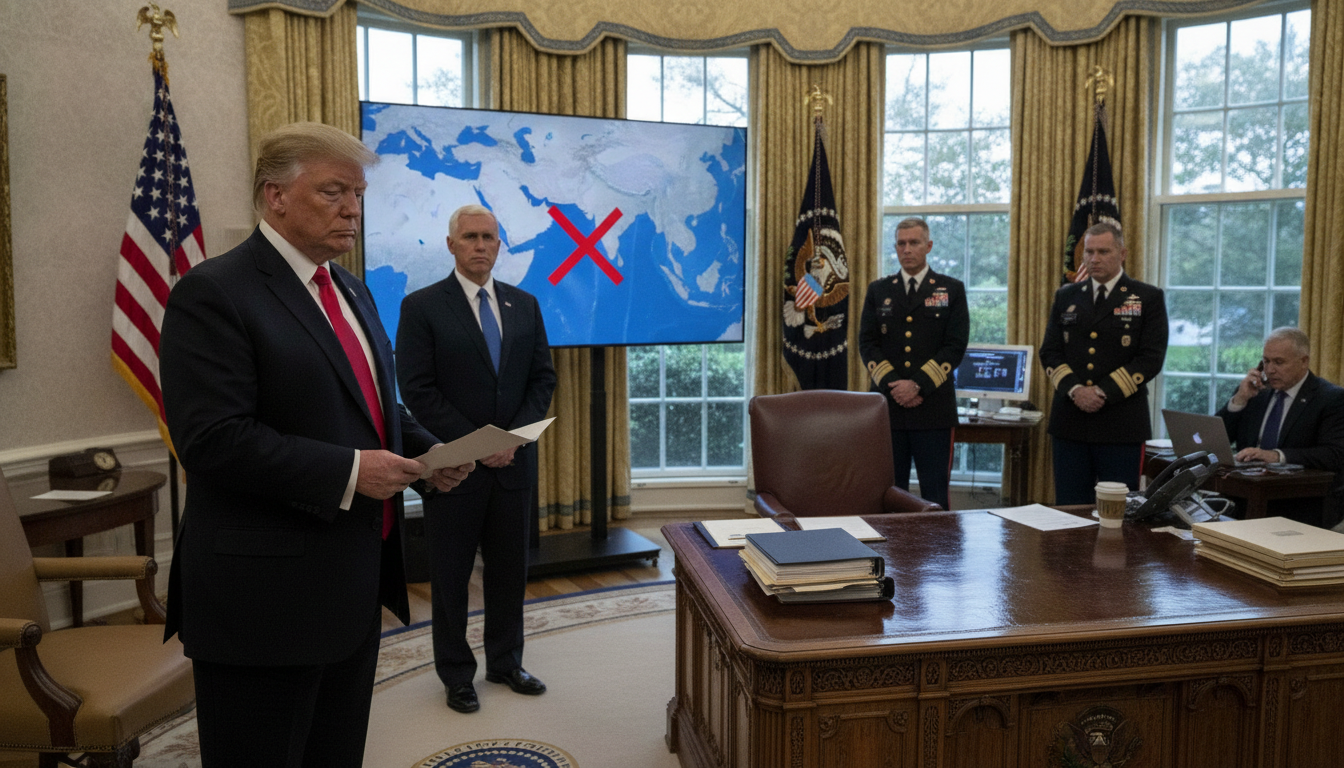
Trump Cancels Planned Strike on Iran as Gulf Mediators Push to Reopen Strait of Hormuz
Trump halted a planned strike on Iran after pleas from Gulf leaders; mediators aim to reopen the Strait of Hormuz to ease tensions and protect shipping.
President Trump on Saturday announced he had called off a potentially large-scale U.S. military assault on Iran, saying he would step back amid diplomatic outreach and regional appeals for restraint. The decision, posted on his social media account, also asserted that the “perimeters of a deal” had been reached to restore passage through the Strait of Hormuz, a strategic chokepoint that Iran has intermittently restricted. The move marks the second high-profile de‑escalation in as many weeks and underscores persistent uncertainty over how the conflict that began in late February will be resolved.
Trump withdraws threat after regional intervention
White House officials said Mr. Trump’s change of course followed messages from several Middle Eastern governments urging de‑escalation, with Saudi state media reporting a call from Crown Prince Mohammed bin Salman that emphasized dialogue. U.S. statements framed the halt as a response to diplomatic activity and to offers from third parties to broker arrangements for safe passage through the Hormuz waterway. Outside analysts cautioned that public threats followed by abrupt reversals risk undermining U.S. credibility even as they reduce the immediate risk of wider military confrontation.
Iranian officials made clear they would retaliate if struck, and Washington’s leaders appear to have weighed those warnings against the likely humanitarian and strategic consequences of striking critical Iranian infrastructure. Former U.S. officials and security analysts told reporters that attacks on energy or power facilities could produce civilian harm and invite forceful countermeasures, complicating efforts to secure a durable cease‑fire.
Qatar and Gulf states mediate talks on the Strait of Hormuz
Diplomats briefed on the negotiations said Qatar had taken a central role in shuttle diplomacy, coordinating discussions between Iran, the United States and Oman, and liaising with Saudi Arabia and the United Arab Emirates. Those diplomats, speaking on condition of anonymity because of the sensitivity of the talks, described ongoing efforts to craft an arrangement that would allow commercial shipping to resume through the Strait of Hormuz without immediate risk of interdiction.
The proposed framework under discussion reportedly focuses on operational guarantees and phased steps to de‑escalate maritime harassment, though diplomats cautioned that details remain fluid and trust is scarce. Gulf mediators have argued that reopening the strait is a shared regional interest and a pragmatic starting point for broader negotiations.
U.S. military posture and repeated cycles of escalation
Despite the diplomatic activity, U.S. forces have been reinforcing their presence in the region, dispatching additional bombers and fighters and preparing options for potential strikes. Mr. Trump had publicly threatened to “hit them very hard,” language that critics say created expectations of imminent large‑scale operations even as administration officials privately questioned the wisdom of further escalation.
U.S. military planners and some advisers warned that intensifying the campaign could rapidly deplete interceptors and missile defenses used to counter Iranian drones and rockets, leaving forward bases and allied forces more vulnerable. Those operational constraints contributed to a debate inside the administration over the risks and limited gains of a strike campaign focused on crippling Iran’s energy infrastructure.
Regional cost: energy, shipping and wider theatres of conflict
Iran’s throttling of traffic through the Strait of Hormuz has reverberated across global energy markets, raising fuel costs and prompting concern among import‑dependent economies. The waterway is one of the world’s most important conduits for oil and gas, and even intermittent disruptions have had an outsized effect on prices and shipping schedules.
The confrontation has spread beyond the Persian Gulf. Yemen’s Houthi forces, aligned with Tehran, moved to disrupt shipping in the Red Sea, and last week two gas tankers were damaged by an apparent drone strike near the Suez Canal. Such incursions have narrowed the number of secure maritime routes and intensified pressure on international supply chains and insurers.
Allies and partners recalibrate policy toward Iran
Saudi Arabia, which hosts significant U.S. forces, has experienced direct repercussions from Iranian‑backed strikes and has been active in urging restraint that preserves stability in the Gulf. Saudi officials, including voices close to the leadership, have favored limited calibrated responses combined with persistent pressure on Iran over a full‑scale campaign, according to regional commentators.
Israel, a co‑participant in the original offensive that began in late February, has largely stayed on the sidelines of recent attacks and appears to be seeking continued U.S. alignment before initiating broader operations. Israeli officials have expressed frustration at restrictions on target selection, particularly when it comes to Iran’s energy infrastructure, which some Israeli leaders see as a critical lever.
Cease‑fires and fragility of agreements
A cease‑fire signed by U.S. officials and Iran in late June raised hopes for a diplomatic path forward but quickly unraveled when Iran again used the strait to press bargaining positions. Military strikes and diplomatic accords have alternated without producing a durable settlement, leaving both sides in a standoff that regional mediators are trying to convert into sustained talks.
Diplomats say any durable agreement will require verifiable mechanisms to protect commercial shipping and a sequence of reciprocal concessions, but mutual distrust remains high. For now, the pattern of threats, limited military actions and last‑minute diplomatic interventions appears likely to continue unless parties agree to firmer guarantees.
The short‑term outcome of Mr. Trump’s cancellation is a lowered risk of immediate large‑scale U.S. strikes, but it does not resolve the underlying contest over Iran’s strategic behavior or the security of the Gulf’s sea lanes. Regional leaders and international mediators now face the task of translating tenuous talks into concrete steps that restore maritime traffic and reduce the chances of a new, broader military confrontation.
