
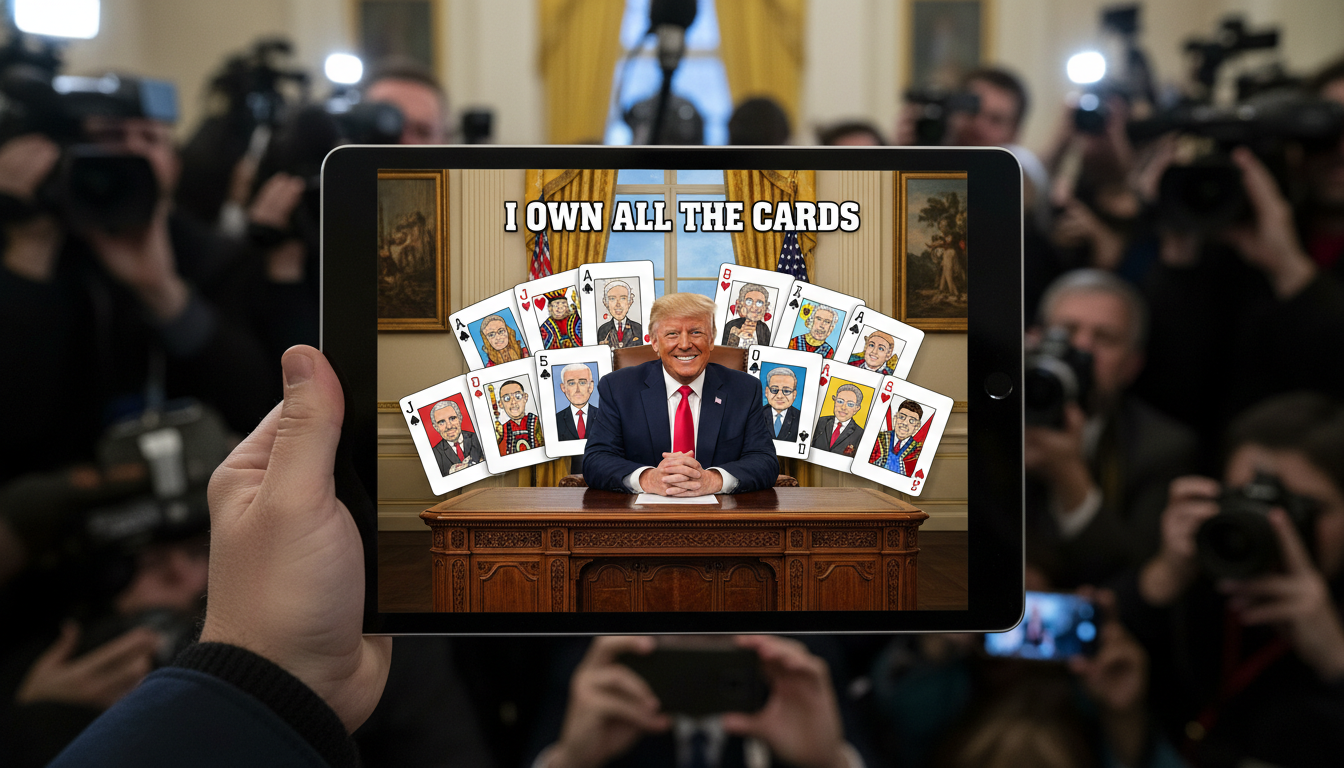
Trump Truth Social post features doctored composite image with caption “I own all the cards”
Trump posts doctored image on Truth Social saying “I own all the cards,” stirring debate over digital manipulation, campaign messaging and political symbolism.
Former president Donald Trump posted a doctored composite image on his Truth Social account accompanied by the phrase “I own all the cards,” in a move that quickly drew scrutiny and debate. The Trump Truth Social post, which superimposes elements to create a staged photographic scene, circulated widely across social platforms within hours of publication.
Post content and visible alterations
The image shared by Trump shows a digitally assembled scene that combines multiple photographs into a single frame, according to visual analysis by observers. The accompanying caption, translated in Arabic as “أنا أملك كل الأوراق”, was presented as a declarative political message meant to signal control and strategy.
Close inspection of the posted graphic reveals mismatched lighting and perspective between foreground and background elements, indicators commonly used to identify composite images. These visual inconsistencies prompted journalists, analysts and users to label the image as manipulated rather than a candid photograph.
How the image spread across platforms
After the original Truth Social upload, copies of the image were reposted across mainstream social networks and private messaging chains. Rapid resharing amplified the image’s reach and brought it to the attention of media outlets and fact-checking groups within a short timeframe.
The velocity of sharing underlines how quickly digitally altered content can transition from a platform post to widespread public discussion. Platforms that permit rapid redistribution face challenges in moderating derivative content once it leaves its source.
Political timing ahead of campaign events
Analysts noted the timing of the Trump Truth Social post amid ongoing political activity and campaign-related events. The phrase “I own all the cards” functions as a rhetorical device that signals confidence and strategic advantage, a message likely aimed at supporters and undecided voters alike.
Political advisers typically use visual messaging to crystallize themes for key audiences, and this post aligns with a narrative of control that campaigns often cultivate. The choice to publish a composite image rather than a straightforward photograph suggests an emphasis on symbolism over documentary accuracy.
Immediate reactions from opponents and commentators
Opponents and independent commentators seized on the post to criticize the use of altered imagery in political communication. Critics argued the image undermines trust in public messaging and contributes to a broader problem of manipulated visual material in politics.
Supporters, by contrast, framed the post as assertive political theater and defended its rhetorical purpose. Media commentators called for clearer disclosure when images are intentionally staged or digitally altered to avoid misleading the public.
Fact-checking and misinformation concerns
The incident prompted several independent fact-checking entities to investigate and publish assessments of the image’s authenticity. Fact-checkers highlighted the need for transparency when public figures use altered visuals, particularly during high-stakes political campaigns.
Experts on digital misinformation warned that stylistically convincing composites can be mistaken for genuine photos, increasing the risk that voters may draw erroneous conclusions. The episode underscores ongoing debates about platform responsibility and the tools available to verify multimedia content quickly.
Legal and ethical questions for campaign communications
Legal experts say that while altered imagery is not inherently unlawful, intentional dissemination of materially misleading content could attract scrutiny under certain campaign or advertising regulations. The standards vary by jurisdiction, and enforcement typically depends on demonstrable intent to deceive or on specific statutory prohibitions.
Ethically, political communicators are increasingly being urged to mark or label creative materials to help audiences distinguish between documentary evidence and crafted political messaging. Observers noted that greater transparency would help preserve public trust without restricting legitimate political expression.
The Trump Truth Social post has become a focal point in a wider conversation about how visual media is used in modern campaigns and the responsibilities of platforms, creators and public figures. As the image continues to circulate, journalists, fact-checkers and platform operators will likely keep monitoring the fallout and assessing the broader implications for political communication.
