
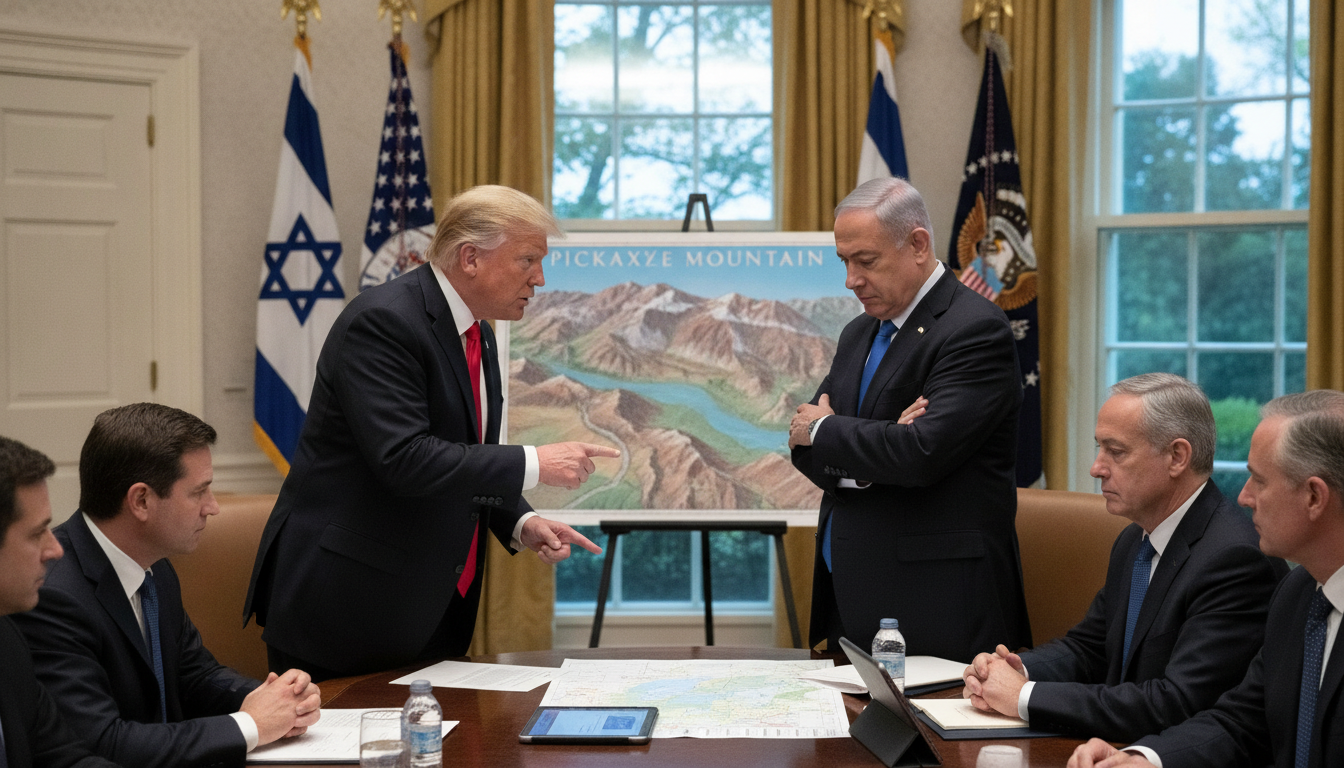
Trump-Netanyahu meeting marked by White House tension over Iran intelligence
Trump expressed frustration with Netanyahu ahead of their White House meeting over Israeli disclosures about Iran’s alleged nuclear site and US policy stance.
President Donald Trump voiced visible frustration with Israeli Prime Minister Benjamin Netanyahu hours before the Trump-Netanyahu meeting at the White House, saying he did not need to be briefed publicly on alleged Israeli intelligence about Iran’s underground sites. The comments, made to Fox News, came as both leaders prepared to meet in the Oval Office amid a fraught diplomatic push with Tehran. The exchange highlights strains between Washington and Jerusalem even as the two governments continue close security cooperation.
Tense Remarks Ahead of Oval Office Meeting
Ahead of the meeting, Mr. Trump pushed back on reports that Mr. Netanyahu planned to present new intelligence about a location described in US and Israeli media as “Pickaxe Mountain.” He questioned why such material would be announced publicly rather than shared directly with the US president. In the interview the president also suggested Netanyahu may be seeking to keep Washington engaged in the confrontation with Iran.
White House aides sought to downplay any long-term rupture, noting that despite the sharp exchange the core alliance and US military support for Israel remain intact. Officials in both capitals framed the visit as an opportunity to coordinate strategy rather than to air differences in public.
Dispute Over ‘Pickaxe Mountain’ Intelligence
The immediate point of contention was reporting that Mr. Netanyahu intended to discuss alleged intelligence on an underground Iranian nuclear facility known in some accounts as Pickaxe Mountain. Mr. Trump said he already understood the situation and criticised the public disclosure, asking why the information was announced to the world rather than handled confidentially. He emphasised that, in his view, the matter was “not a big problem,” while also warning that the United States had options should diplomacy falter.
Israeli officials have maintained a hard line on Iran’s nuclear activities, insisting on measures to prevent Tehran from advancing its civilian or military nuclear capabilities. The dispute over how to present and share intelligence reflects broader questions about timing, credibility and the political consequences of public accusations.
Diplomatic Push and Threats to Iran
The meeting comes amid a renewed push for diplomacy with Iran after recent escalations that brought the two countries to the brink of larger conflict. Mr. Trump has signalled readiness to negotiate but repeatedly warned that failure of talks could trigger further military action, including strikes on sensitive sites and infrastructure. That stance mirrors Israel’s long-standing insistence on preventing Iran from developing a nuclear weapons capability.
A memorandum of understanding earlier this year temporarily reduced hostilities by reopening shipping lanes and lifting naval restrictions, but that framework has since unraveled. President Trump described current efforts as a diplomatic initiative supported by military pressure, a dual approach intended to compel Iran back to the negotiating table.
Domestic Political Pressures in Washington and Jerusalem
Both leaders face domestic headwinds that shape their engagements. In the United States, the conflict with Iran has become increasingly unpopular with segments of the public and some Republican lawmakers, complicating Washington’s calculus. Within Israel, Mr. Netanyahu is seen by analysts as sensitive to declining popularity abroad and at home, pressures that could influence how forcefully he pushes the US toward military options.
Media coverage in the US has portrayed Mr. Netanyahu as an influential actor on American policy toward Iran, a perception that has heightened scrutiny of the bilateral relationship. Trump and his aides have at times criticised Israeli positions, even as the administration has maintained robust military and diplomatic ties with Jerusalem.
Defense Budget Talks and Military Integration
On Capitol Hill, lawmakers have been considering a defence package that includes deeper integration of US and Israeli military capabilities, a measure that has already cleared the House. The proposed budgetary measures reflect longstanding strategic cooperation and would formalise aspects of joint planning and logistics. Supporters argue the integration enhances deterrence and interoperability against shared threats.
Critics caution that closer military ties could entangle the United States more directly in regional campaigns and complicate diplomatic options. The White House faces the dual task of reassuring partners while preserving its own freedom of action should negotiations with Tehran collapse.
Netanyahu’s Public Position Ahead of Visit
Mr. Netanyahu offered a measured public posture in the run-up to the meeting, saying he wanted to hear President Trump’s plan for addressing Iran and acknowledging the US leader’s authority to decide the next steps. He reiterated his government’s refusal to accept any civilian nuclear programme in Iran and framed that objective as non-negotiable. Analysts expect the prime minister to balance a firm stance on Iran with an effort to counter perceptions that he is pressuring Washington into new military operations.
Netanyahu’s remarks on American television emphasised deference to Washington’s strategic choices while underscoring Israel’s security red lines, a calculated approach intended to maintain influence without overtly dictating US policy.
The Trump-Netanyahu meeting underlined persistent frictions that can surface even between long-standing security partners, as well as the competing domestic and strategic pressures that both leaders must manage.
