
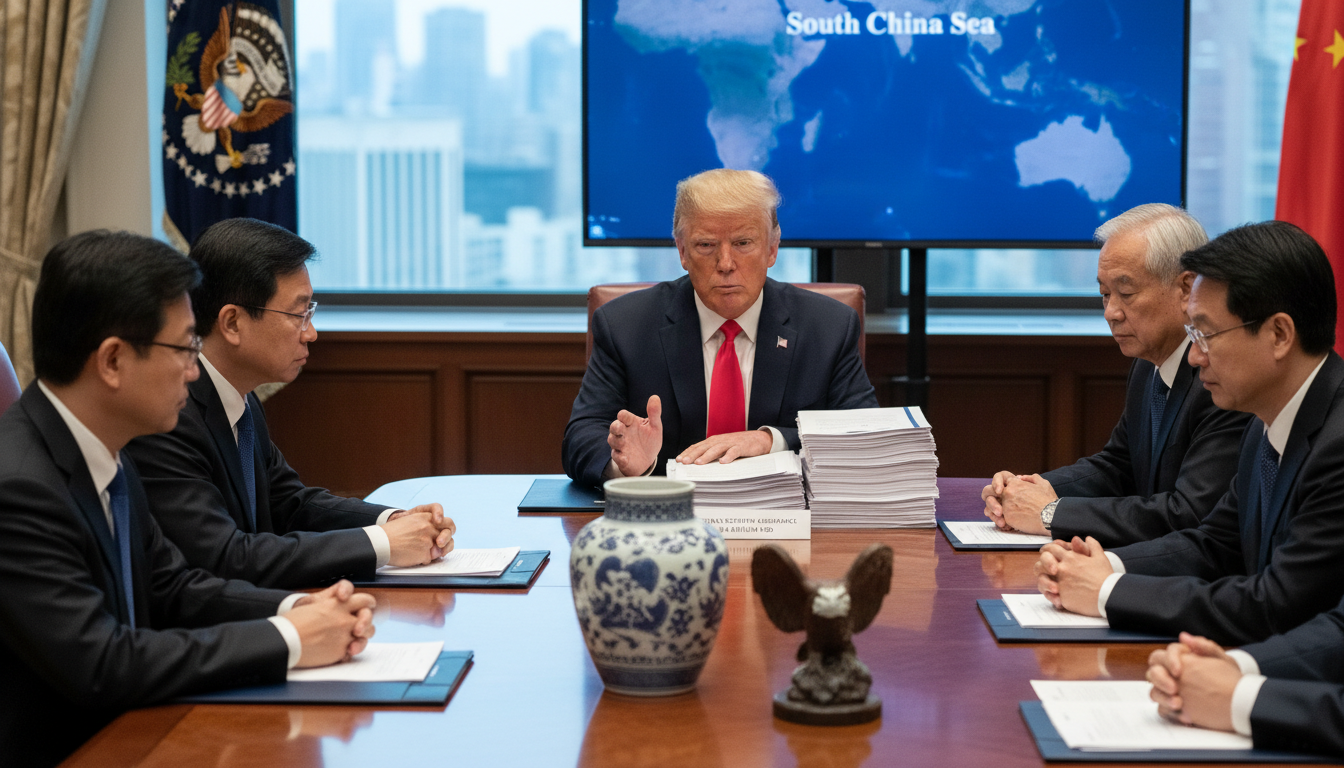
Trump Calls Taiwan Arms Package a “Negotiating Chip” in Talks with Beijing
U.S. president says approval of the $14 billion Taiwan arms package “depends on China,” raising questions over the timing and reliability of American military support. (150–160 characters)
President Donald Trump said he is withholding approval of a $14 billion Taiwan arms package and described the sale as a “negotiating chip” in discussions with Chinese leader Xi Jinping, injecting fresh uncertainty into U.S. security commitments to the island. The comment came after a summit in Beijing and follows months of lobbying in Taipei for American missiles, air-defence systems and anti-drone equipment. The president’s remarks reverberated through Washington and Taipei, where officials had been awaiting a formal sign-off that would bolster Taiwan’s defensive posture.
Trump Frames Approval as Conditional
President Trump told reporters that his decision on the Taiwan arms package “depends on China,” signaling that the sale could be used to extract concessions in broader trade and economic talks. His description of the weapons deal as a useful bargaining tool contradicted earlier assurances from some U.S. officials that arms transfers to Taiwan would not be subject to negotiations with Beijing. The remark on Air Force One, recorded during the Beijing visit and aired later, set off immediate concern among lawmakers and regional partners.
Taipei Seeks Reassurance After Delay
Taiwan’s presidential office moved quickly to calm domestic anxieties, saying U.S. policy toward security in the Taiwan Strait remains unchanged and expressing gratitude for continued American support. Taipei has been preparing to absorb the proposed $14 billion package, which would complement an $11 billion sale approved previously and follow a domestic parliamentary allocation of roughly $25 billion for two U.S. weapons packages. Still, Taiwanese officials and politicians face growing unease as the timing of approval becomes uncertain.
Xi Warns of Risk to Bilateral Ties
During the Beijing talks, Xi Jinping emphasized that the Taiwan issue is the most sensitive element of China-U.S. relations and warned of serious consequences if it is mishandled. The Chinese leadership has consistently condemned any high-level contact between U.S. officials and Taiwan and frames Taipei’s policies as a driver of cross-strait tensions. Analysts noted that Xi’s message appeared to have resonated with Mr. Trump, who said the summit deepened his understanding of the issue.
Political Fallout in Taipei
Mr. Trump’s comments are likely to complicate the domestic agenda of Taiwan’s president, Lai Ching-te, who has advocated for increased military spending and acquisitions from the United States. Some members of Lai’s own party withheld unanimous support for the special funding package, citing concerns about the balance between foreign purchases and investment in locally produced systems such as drones. Opposition politicians quickly seized on the delay as evidence that Taipei’s strategy risks overreliance on Washington.
Economic and Strategic Leverage Explained
Analysts warned that Beijing could retaliate if it perceives a U.S. move it dislikes, for example by scaling back purchases of American agricultural goods or restricting exports of critical high-tech inputs such as rare earth elements. Conversely, the prospect of a planned state visit by Xi to the United States later this year gives Beijing leverage to trade economic or diplomatic concessions for restraint on Taiwan-related steps. Observers cautioned that using the Taiwan arms package as a bargaining chip may yield short-term diplomatic gains but could undermine the perceived reliability of U.S. security commitments in the Indo-Pacific.
Bipartisan Concern in Washington
A bipartisan group of U.S. senators had urged against turning Taiwan support into leverage in negotiations with China, arguing that it would weaken deterrence and signal unpredictability to both allies and adversaries. Foreign policy experts from a range of institutions expressed alarm that conditioning arms sales on unrelated commercial or political outcomes risks eroding long-standing U.S. policy norms. Eurasia Group’s China director warned that withholding the package indefinitely could be a deliberate tactic to secure economic concessions from Beijing, a prospect that has raised alarm among Taiwan’s partners.
While Mr. Trump also revived long-standing criticisms of how Taiwan developed its semiconductor industry, suggesting Taiwan should “cool it” regarding actions that could escalate tensions, Taipei maintained that China’s military pressure is the primary destabilizing force in the region. The coming days and weeks are likely to determine whether the $14 billion Taiwan arms package will be approved, withheld as leverage, or become the subject of new congressional and diplomatic maneuvering.
