
Tuapse oil refinery fire raises health fears after reported Ukrainian drone strike
Tuapse oil refinery fire rages after reported Ukrainian drone strike; residents fear toxic smoke as emergency crews battle flames and authorities monitor air.
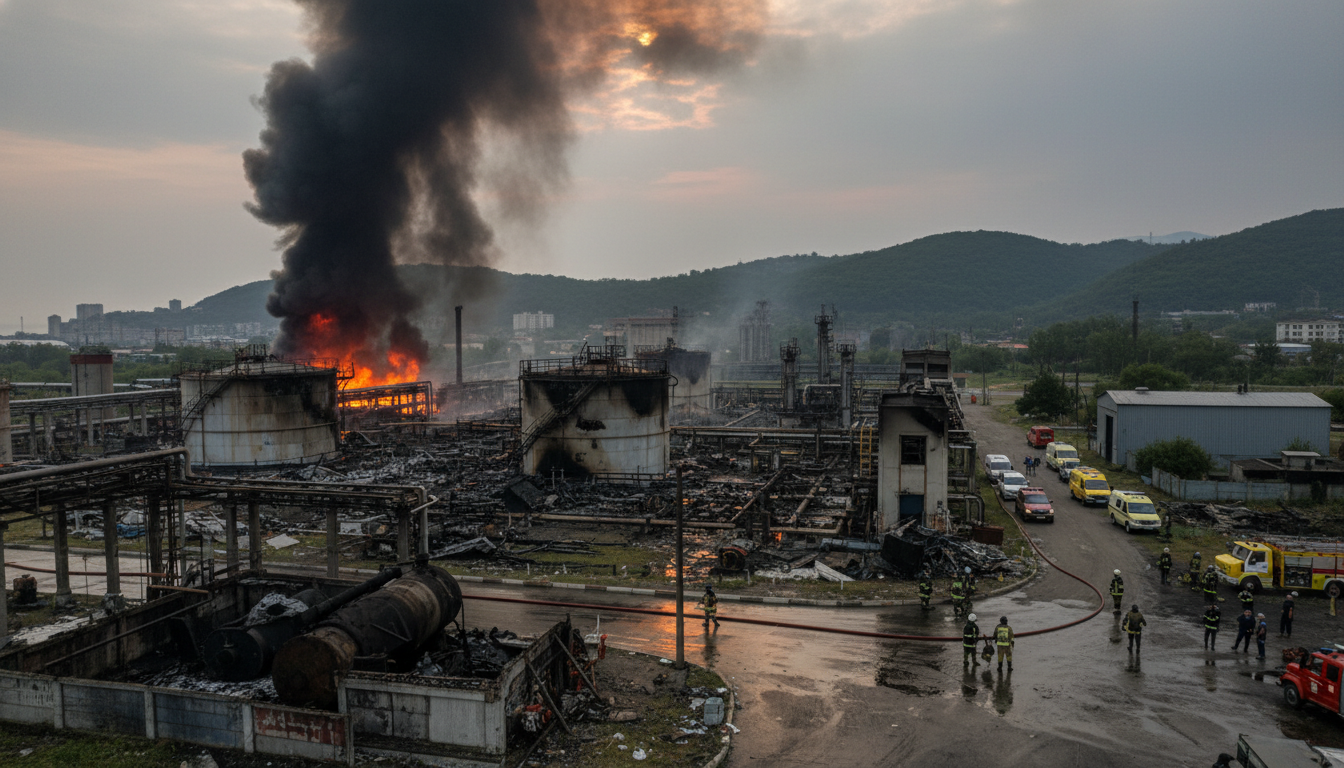
The Tuapse oil refinery fire has burned for days after what officials described as a Ukrainian drone strike, prompting alarm among residents over toxic smoke and potential contamination. The blaze, which began on April 22 and remained active on April 24, 2026, has sent thick plumes across the Black Sea coastal town and triggered emergency responses. Local people say they are concerned about immediate health effects and longer-term environmental damage as authorities assess air and water quality.
Fire at Tuapse refinery enters multi-day emergency
The blaze at the oil refinery near Tuapse continued into its third day as firefighters worked to contain multiple burning tanks and ruptured pipelines. Thick black smoke spread downwind, reducing visibility and increasing anxiety among residents in low-lying coastal districts. Officials said efforts were focused on preventing the fire from reaching additional storage units and on securing fuel lines to limit further explosions.
Residents reported hearing several large blasts after the initial strike and seeing roofs and façades dusted with ash-like residue. Emergency services established a safety perimeter and advised people to stay indoors where possible while air monitoring teams moved into affected neighbourhoods. The ongoing nature of the incident has left many unsure when normal activity can resume.
Local residents describe health and safety concerns
People living in Tuapse described symptoms consistent with smoke exposure, including sore throats, coughing and headaches, and some sought medical attention as a precaution. Parents said they were particularly worried for children and older residents with chronic respiratory conditions, urging authorities to provide clear guidance on protective measures. Community calls for distribution of masks and bottled water increased as anxiety grew over possible airborne toxins.
Local schools and businesses in the vicinity temporarily reduced operations or closed to limit public exposure to the smoke. Social media posts and neighbourhood groups documented the spread of smell and soot across residential areas, amplifying demands for transparent updates from health and emergency officials. Many residents requested immediate air-quality data and longer-term plans for environmental testing.
Authorities attribute the blaze to a Ukrainian drone attack
Russian officials stated that the refinery was struck by a drone launched from Ukrainian-controlled territory, an assertion echoed by regional spokespeople describing a targeted strike on fuel storage infrastructure. State statements framed the incident within the context of ongoing hostilities, while urging calm as containment measures proceeded. Independent verification of the strike’s origin remained limited in the immediate aftermath.
The attribution has prompted heightened security measures in the wider Krasnodar Krai region, with checkpoints and maritime patrols reported near the coast. Officials said investigations were under way to document damage, collect forensic evidence and determine the exact sequence of events leading to the fire. International agencies and independent monitors were not immediately reported as participating in the on-site probe.
Emergency services and containment operations
Firefighting crews from regional brigades and private refinery teams coordinated to fight the inferno, employing foam, water cannons and remote-controlled equipment to approach hazardous areas. Commanders said they prioritized protecting storage tanks that remained intact and cooling adjacent units to prevent a chain reaction. Specialized teams worked in rotation due to heat and smoke exposure, with some personnel receiving treatment for exhaustion and mild smoke inhalation.
Authorities also mobilised environmental response units to capture runoff and prevent contaminated water from entering local drainage systems and the Black Sea. Barriers and absorbent booms were deployed where possible, and work continued to seal cracked pipes and isolate damaged sections of the refinery. Emergency briefings were held periodically to update the public and to coordinate medical services and civil defence measures.
Environmental monitoring and potential contamination risks
Experts warned that large refinery fires can release a complex mix of pollutants, including volatile organic compounds, particulate matter and combustion by-products that pose short-term and long-term health risks. Air-quality monitoring stations were set up around Tuapse to measure levels of fine particulates and noxious gases, while water samples were collected from nearby coastal waters and municipal supplies for analysis. Officials said results would be published when validated, though residents sought more immediate transparency.
Authorities emphasised the need for systematic soil and seafood testing given the region’s proximity to fishing areas and coastal agriculture. Environmental groups called for independent oversight of the testing process and for long-term health surveillance of affected communities. Analysts noted that the environmental impact will depend on the type and quantity of oil burned and on how quickly containment and remediation measures are implemented.
Regional and diplomatic fallout
The incident has already generated political and diplomatic reactions, with regional leaders condemning the attack and calling for heightened defensive measures along critical energy infrastructure. The attribution to a cross-border drone strike is likely to amplify existing tensions and could prompt increased security coordination at state and regional levels. International commentary was cautious, with several capitals urging restraint and calling for independent verification of the facts.
Local industry stakeholders warned of disruptions to fuel distribution networks if damage to the refinery limits processing capacity, potentially affecting supplies in adjacent regions. Market impacts and broader economic consequences will hinge on the extent of structural damage and on how rapidly replacement storage and distribution channels can be activated.
Emergency crews continued containment work through the night, and officials pledged to release validated air and water quality readings to reassure the public. The situation remained fluid, with residents and authorities awaiting clearer information on both the immediate health risks and the steps required for environmental recovery.
