
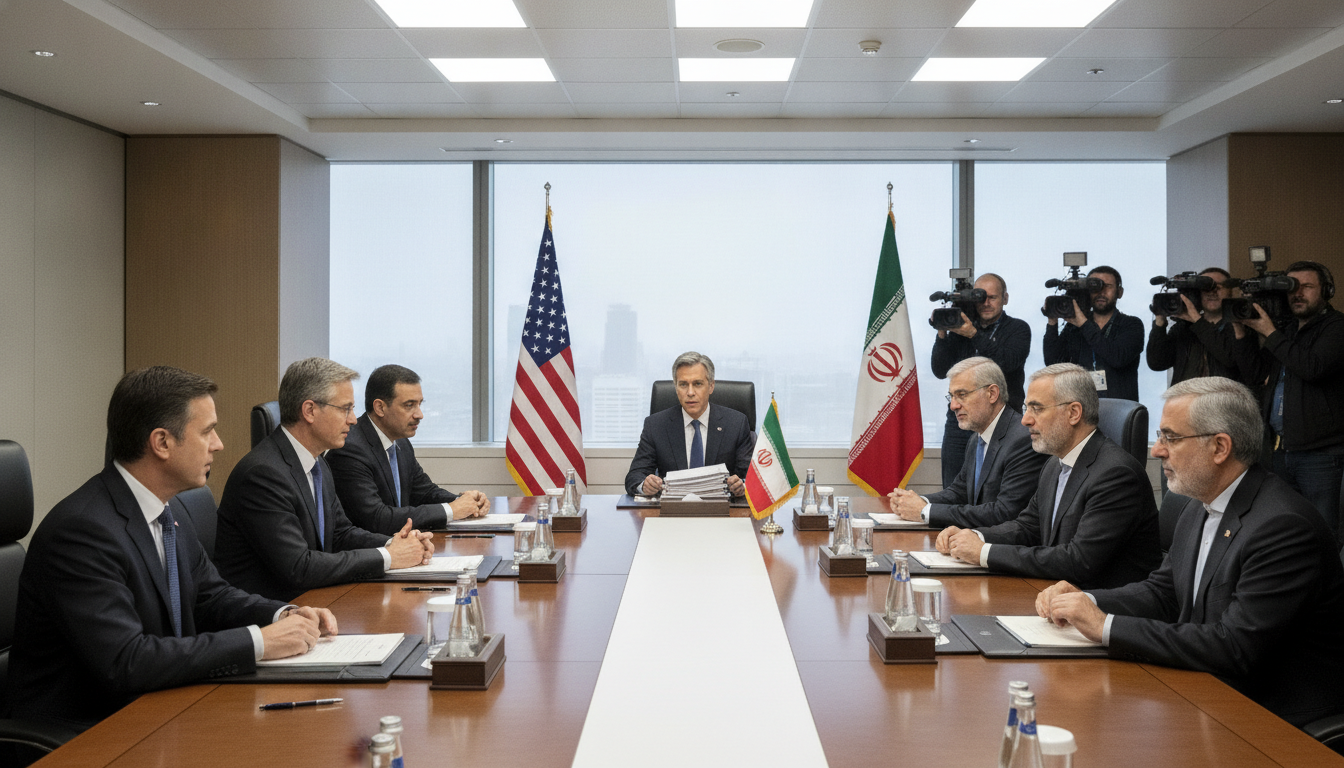
U.S.-Iran negotiations open in Switzerland with 60-day push to end the war
U.S.-Iran negotiations opened in Switzerland on Sunday, launching a 60-day effort to secure a permanent settlement that focuses on Iran’s nuclear program, sanctions relief and regional maritime rules.
The talks opened with a narrow timeline and broad agenda as diplomats from Washington and Tehran seek a comprehensive agreement to end active hostilities and stabilise the region. U.S.-Iran negotiations will concentrate on the nuclear file while also addressing the release of frozen assets, a proposed $300 billion reconstruction fund, maritime transit through the Strait of Hormuz and the future of Iran’s missile capabilities. Delegations warned that the Israel-Hezbollah conflict in Lebanon and other regional flashpoints could quickly complicate or derail progress.
Swiss talks begin with 60-day negotiation timetable
The negotiating teams arrived in Switzerland under terms that set an initial 60-day window to produce a broader framework for a lasting settlement. Diplomats described the time limit as aggressive but necessary to keep momentum and to force early decisions on sequencing and verification. Both sides face domestic political pressure that makes concessions difficult, increasing the importance of rapid diplomatic momentum in the opening weeks.
The timetable places a premium on resolving how and when measures will be implemented, with sequencing emerging as a central dispute. Officials from both capitals indicated that compromises over who moves first—unfreezing assets or implementing security commitments—will shape the likelihood of meeting the deadline.
Sanctions relief and frozen assets dominate bargaining
One of the most contentious items on the table is the unfreezing of billions in Iranian funds and the lifting of sanctions that have weighed on Tehran’s economy. Iranian negotiators have made immediate access to frozen assets a top priority, framing it as essential for economic recovery after sustained isolation and recent conflict. U.S. officials view financial relief as their principal leverage and have signalled it will be carefully conditioned and phased.
Disagreement persists over chronology: Tehran seeks early release to stabilise its economy, while Washington and allies insist on verifiable Iranian steps in return. Negotiators will need to craft precise triggers and safeguards to balance urgent economic demands with Western concerns over compliance and regional behaviour.
Structure and controversy around the $300 billion reconstruction plan
The preliminary framework references a proposed $300 billion reconstruction fund intended to mobilise private and sovereign investment for rebuilding in Iran. U.S. political leaders indicated the American government will not be a direct financier of the fund, opening the door for Gulf states, Asian investors and private firms to participate. Planners expect the vehicle to favour private investment commitments rather than serve as a formal reparations mechanism.
Designing the fund raises sensitive political and legal questions, including governance, transparency and how capital flows would be conditioned on verified progress. Diplomats said that some investors have already signalled interest, but building a credible, multilateral mechanism will require detailed negotiation and guarantees to reassure contributors.
Strait of Hormuz transit remains a strategic bargaining chip
The status of the Strait of Hormuz, a vital artery for global energy shipments, is explicitly on the agenda and is expected to feature prominently in the talks. The interim agreement reportedly prevents Tehran from imposing tolls on commercial traffic for at least 60 days, while leaving a longer-term solution to follow-up talks with regional partners. That provisional arrangement means the strait could become a bargaining chip after the initial timeline lapses.
Analysts warned that any hint of future fees or restrictions would intensify international scrutiny and could be used by Iran to extract concessions on unrelated points such as access to frozen funds. For that reason, negotiators are under pressure to craft clear, enforceable rules that preserve uninterrupted passage and minimise the risk of coercive leverage.
Ballistic missile limits unlikely to produce strict caps
Limits on Iran’s ballistic missile programme are likely to be addressed only indirectly, if at all, in a final settlement, according to security experts close to the discussions. U.S. officials had previously sought substantial curbs on short-range systems, citing Israeli security concerns, but assessments during the conflict showed Iran retained much of its mobile launcher capability. Senior US leaders have signalled a pragmatic shift away from demanding outright elimination of Iran’s missile arsenal.
Given the technical and strategic complexity, negotiators may settle for loose commitments, transparency measures or gradual degradation of capabilities rather than hard numerical caps. Tehran regards its missile forces as a core deterrent, making strict, verifiable reductions politically and militarily improbable without an unprecedented shift in regional security arrangements.
Regional conflicts and domestic politics threaten progress
While negotiators are concentrating on technical issues, the broader security environment poses a constant risk to the talks. The Israel-Hezbollah confrontation in Lebanon, proxy activity across the Gulf and domestic political pressures in both countries could quickly shift priorities or harden positions. Observers say the success of the Swiss talks will depend as much on progress in de-escalating external violence as on the legal drafting of agreements.
Both sides will need to manage domestic audiences that view concessions with suspicion, meaning that public messaging and sequencing of deliverables will be closely choreographed. Diplomats acknowledged that a durable deal will likely require not only technical fixes but also parallel steps to reduce violence and build confidence across the region.
The next 60 days will test whether competing priorities—economic relief, security guarantees and regional politics—can be reconciled into an enforceable settlement. U.S.-Iran negotiations in Switzerland aim to translate a preliminary framework into specific, verifiable commitments, but success will depend on careful sequencing, third-party investment guarantees, and a simultaneous reduction in regional hostilities to create the political space for implementation.
