
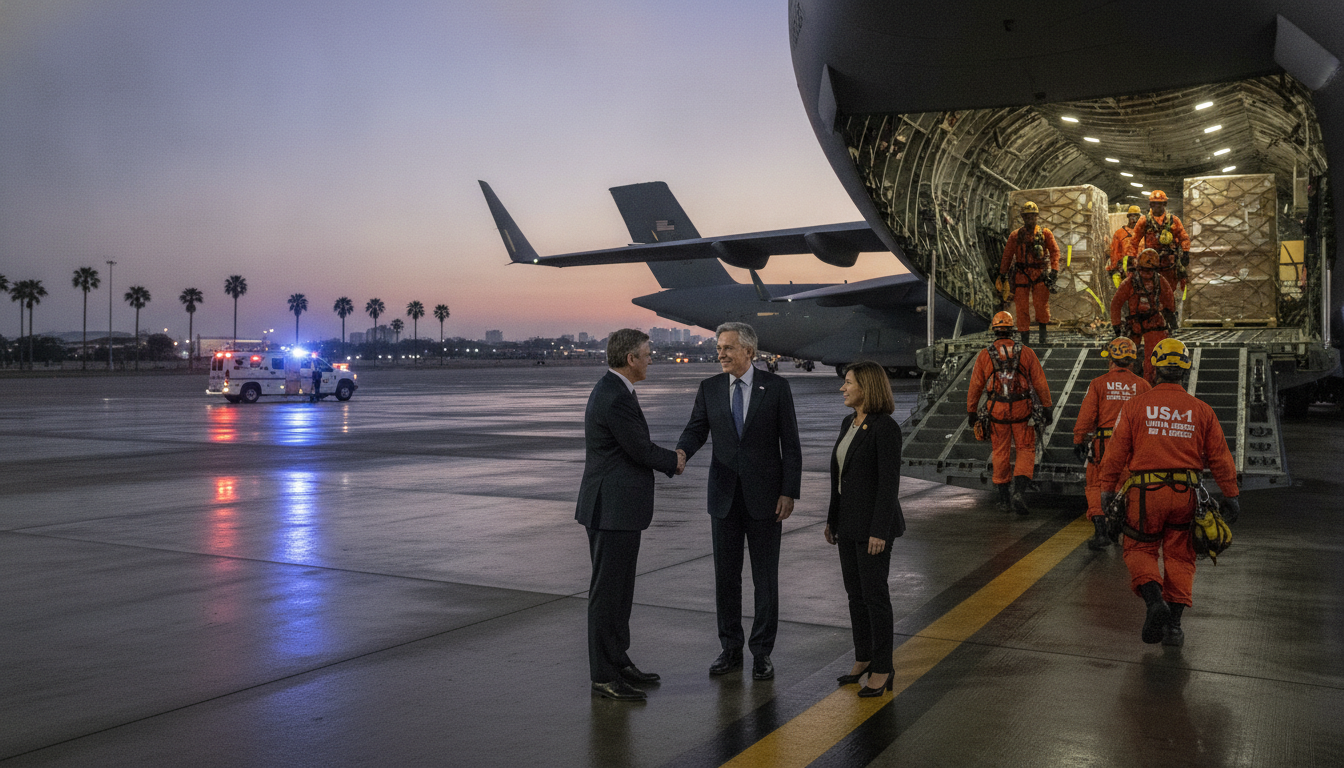
U.S. aid to Venezuela ramps up after quake as Washington deploys rescue teams
U.S. aid to Venezuela intensifies after deadly quake — Washington deploys search-and-rescue teams, commits $150M to relief partners and coordinates rescues.
The United States has launched a substantial humanitarian response after a devastating double earthquake struck Venezuela, officials said, blending immediate rescue operations with broader diplomatic engagement. U.S. aid to Venezuela includes deployed search-and-rescue teams, emergency funding to international partners and technical support such as overhead imagery to guide relief efforts. The response comes amid a fragile political transition in Caracas following the removal of Nicolás Maduro and ongoing talks between ruling-party figures and opposition representatives.
U.S. deploys search-and-rescue teams and technical support
Secretary of State Marco Rubio said Washington would mount a “whole-of-government” response, immediately sending specialized search-and-rescue units from Fairfax County, Virginia, and Los Angeles. Officials noted those teams were poised to assist with locating and extricating survivors trapped in damaged structures across the hardest-hit regions. U.S. personnel are also providing airborne imagery and other technical assets to help local authorities map damage and prioritize lifesaving missions.
Rubio and other administration officials warned that damaged airport infrastructure would complicate operations and require reliance on Defense Department assets to move equipment and personnel. The administration’s language reflected an urgency to establish secure logistics corridors while coordinating closely with Venezuelan authorities and international partners. Emergency communications and rapid assessments remain central to the initial phase of relief.
State Department organizes broader disaster assistance and funding
The State Department confirmed it had organized a disaster assistance response team of more than 250 personnel to support operations on the ground. The administration announced a combined allocation of roughly $150 million in immediate humanitarian assistance — $50 million directed to multiple aid organizations and $100 million to a United Nations humanitarian office working with Venezuela. These funds aim to support search-and-rescue, medical care, emergency shelter, and the distribution of critical supplies.
U.S. officials said additional non-governmental groups and interagency teams would be added as needs were identified, and that the initial funding would be channeled through established relief partners. The scale and speed of disbursement will be closely watched by both Venezuelan civil society groups and international relief coordinators, who have raised concerns about access and the capacity to reach remote or heavily damaged communities.
Political context: aftermath of Maduro’s removal and transition talks
The humanitarian response is unfolding against a charged political backdrop after the ouster and detention of Nicolás Maduro earlier this year. U.S. policymakers have framed aid as part of a broader effort to support Venezuela’s transition to democratic governance, saying relief operations could bolster civic stability and public confidence. Administration officials have signaled that assistance will accompany initiatives to rebuild institutional capacity and restore public services.
Observers caution that political dynamics in Caracas remain fluid. Delcy Rodríguez, serving as interim president, and dialogue between ruling-party figures and opposition representatives have produced limited rapprochement, including the recent release of some political detainees. Analysts say progress on political reforms will be essential to ensure that aid reaches intended beneficiaries without becoming entangled in factional power struggles.
Diplomatic and commercial ties shape relief and reconstruction options
Since early this year U.S. policy toward Venezuela has shifted from isolation to selective engagement, with Washington reopening its embassy in Caracas and easing certain sanctions to facilitate commercial and diplomatic interactions. The Treasury Department’s previous waivers allowing business with Venezuela’s national oil company have increased revenue flows, some of which U.S. officials say are being routed through monitored accounts to pay government workers and procure medical supplies.
These commercial openings have practical implications for reconstruction efforts, as access to energy infrastructure, logistics services and private-sector capacity will influence the speed of recovery. U.S. officials emphasized that humanitarian assistance is distinct from commercial interests, but critics in Venezuela and abroad have expressed concern that relief could be perceived as tied to economic or strategic gains.
Local response and international reactions to U.S. involvement
Venezuelan civic leaders and international analysts have offered mixed reactions to Washington’s involvement. Some see the U.S. response as a necessary and timely contribution to lifesaving efforts, while others worry about sovereignty and the optics of foreign forces operating in the country. Michael Shifter of the Inter-American Dialogue described the relief effort as an “opportunity” for the United States to demonstrate a broader humanitarian agenda beyond energy or commercial priorities.
On the ground, Venezuelan authorities and local NGOs are coordinating to integrate foreign teams into domestic operations, but logistical bottlenecks and questions about access to heavily affected neighborhoods remain. Humanitarian coordinators have underscored the need for transparent distribution mechanisms to prevent diversion of aid and to ensure assistance reaches the most vulnerable families.
Washington has also reported the removal of a small quantity of highly enriched uranium linked to Venezuela’s dormant nuclear program, an action U.S. officials said was undertaken with Caracas’ concurrence. That move was framed as part of broader efforts to reduce security risks while facilitating technical cooperation on emergency management and public safety.
U.S. aid to Venezuela is now entering a phase that must balance urgent rescue operations with longer-term planning for recovery and political stabilization. Coordination among U.S. agencies, the United Nations, relief organizations and Venezuelan authorities will determine how effectively resources are used to save lives and rebuild critical infrastructure. The coming weeks will test whether humanitarian assistance can help de-escalate tensions and support a durable path toward reconstruction and restored civic institutions.
