
World Cup 2026 week-one statistics: more goals, fewer errors and standout individual marks
World Cup 2026 week-one statistics reveal higher scoring, a notable drop in match errors, landmark individual distances and speeds, and Messi equalling the tournament scoring record.
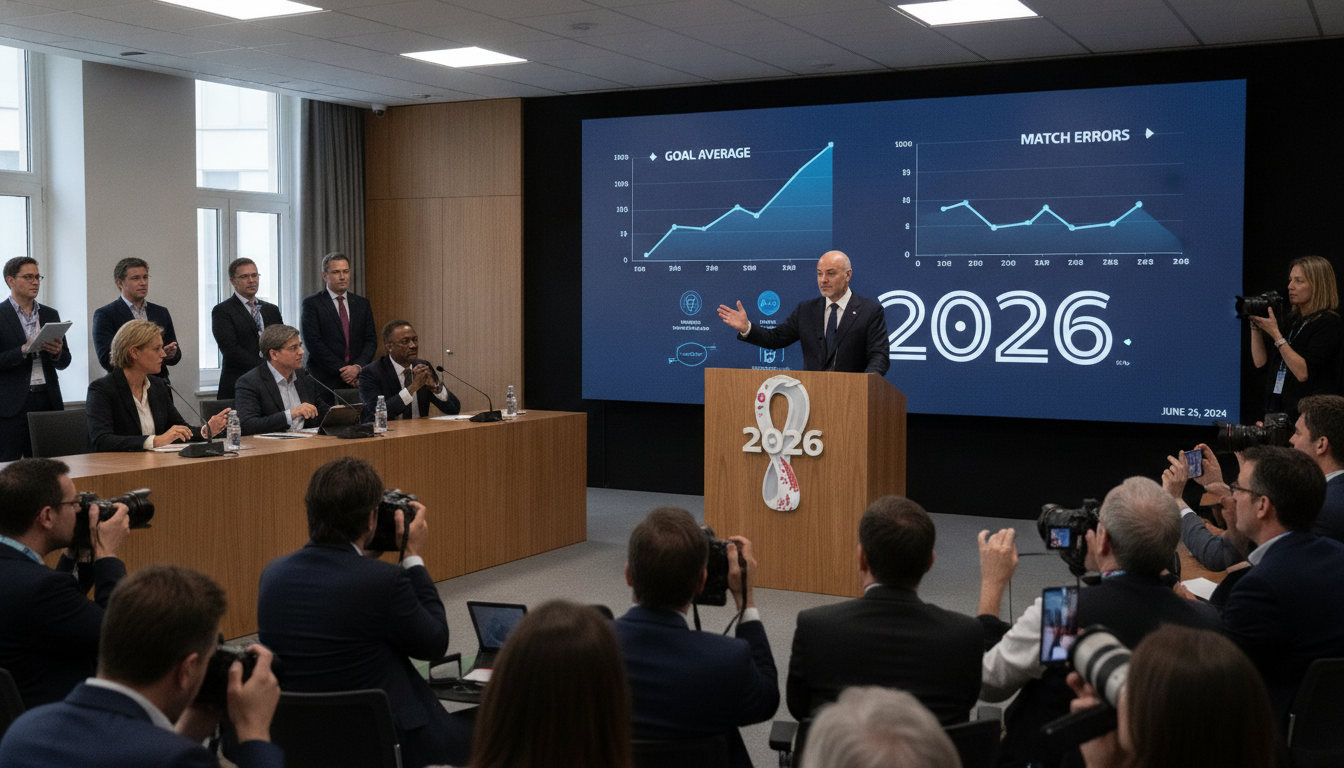
The opening week of World Cup 2026 produced a distinct statistical profile that has drawn attention across the tournament’s hosts in the United States, Canada and Mexico. Analysis published by Northern Global News, using data from researchers at Northeastern University, shows higher scoring rates alongside a measurable decline in average match errors during the group-stage opener.
Goals per game jump in opening round
The first week returned an average of 3.12 goals per match, a rise from the 2.56 goals recorded in the equivalent stage of the 2022 tournament. Analysts attribute much of the increase to the expanded format of World Cup 2026, which features 48 teams and a broader range of matchups in the group stage.
Brennan Klein, a data researcher involved in the study, highlighted that the expanded field naturally introduces more variance in scorelines and increases the overall volume of goal-scoring opportunities. That statistical shift has reshaped early tournament narratives as managers and broadcasters take note of the higher-scoring fixtures.
Average match errors fall amid wider VAR use
The study found the average number of player errors per match fell to 24.4, down from 27.7 in 2022 and 29.3 in 2018. Researchers say the reduction correlates with heightened scrutiny and the wider deployment of video assistant referee technology during matches.
Klein suggested that stricter post-play review and more conservative decision-making by players under VAR scrutiny are likely causes of the decline. Tournament officials have emphasised that technological oversight is intended to improve fairness, and early statistics suggest it may also be influencing on-field behaviour.
Jordan’s Noor Al-Rawabdeh logs longest distance in group play
One of the tournament’s standout individual physical performances came from Jordan’s Noor Al-Rawabdeh, who covered 8.1 miles (13.05 kilometres) in Jordan’s group-match against Austria. His sustained run included a key pass that set up Ali Alwan’s historic first World Cup goal for Jordan, a milestone in the nation’s tournament record.
The distance covered by Al-Rawabdeh ranks as the longest recorded by any player in the tournament’s group-stage matches so far. Data teams noted the performance not only for raw kilometres but for its direct impact on Jordan’s attacking output and historical achievement.
Australian Jordan Bos records top speed in first week
The fastest sprint recorded during week one came from Australian defender Jordan Bos, who reached 22.8 miles per hour (36.69 km/h) in Australia’s match with Turkey. Norway’s Erling Haaland posted a nearly identical top speed of 22.7 mph (36.53 km/h) in his nation’s fixture against Iraq.
Performance analysts noted that such elite top speeds are increasingly common with modern conditioning and tactical demands on wide and forward players. The close margins between recorded top speeds underline how small differences in acceleration and timing can separate match-changing plays.
Messi’s treble ties all-time World Cup scoring mark
Argentina’s Lionel Messi delivered a three-goal performance in the opening match of Group A, netting all three goals in the 3-0 victory over Algeria. The haul elevated Messi to 16 World Cup goals, matching the long-standing record previously held by Germany’s Miroslav Klose.
The achievement re-centres conversation on Messi’s legacy at successive World Cups and provides a headline statistic for the early tournament narrative. Analysts noted that Messi’s contributions also reflect Argentina’s tactical focus in group play and the player’s continued influence on the biggest international stage.
Croatia’s Dominik Livaković posts highest single-attack xG prevented
Croatia goalkeeper Dominik Livaković registered the highest single-attack expected-goals prevented metric during week one, stopping shots equivalent to 0.82 xG in a concentrated sequence against England. The measure, which estimates the likelihood of shot conversions, underscored Livaković’s role in limiting high-quality chances during his side’s fixture.
Data teams said the goalkeeper’s saves in the 55th minute were instrumental in keeping Croatia competitive in the match and showcased the increasing granularity of modern performance metrics. Such advanced measures are being used by coaching staffs and broadcasters to explain turning points within games.
Late drink breaks exceed three-minute guideline across fixtures
Tournament-wide monitoring recorded 48 water breaks across the 24 matches of the opening round, totalling 157.7 minutes and averaging 3.3 minutes per break. That average marginally exceeded the three-minute guideline commonly cited for such intervals, prompting operational notes from match organisers.
Officials are expected to review the timing and management of stoppages to align more closely with regulations while balancing player welfare considerations. Teams, broadcasters and fans will watch how these logistical elements are handled as the tournament progresses.
Northern Global News and Northeastern University emphasised that their week-one figures represent an initial snapshot of World Cup 2026 trends, with further analysis planned as group play continues toward the knockout stages.
Early statistics point to a tournament marked by higher scoring, tighter error control and notable individual physical and technical performances, all of which are shaping narratives as World Cup 2026 moves into its second week.
