
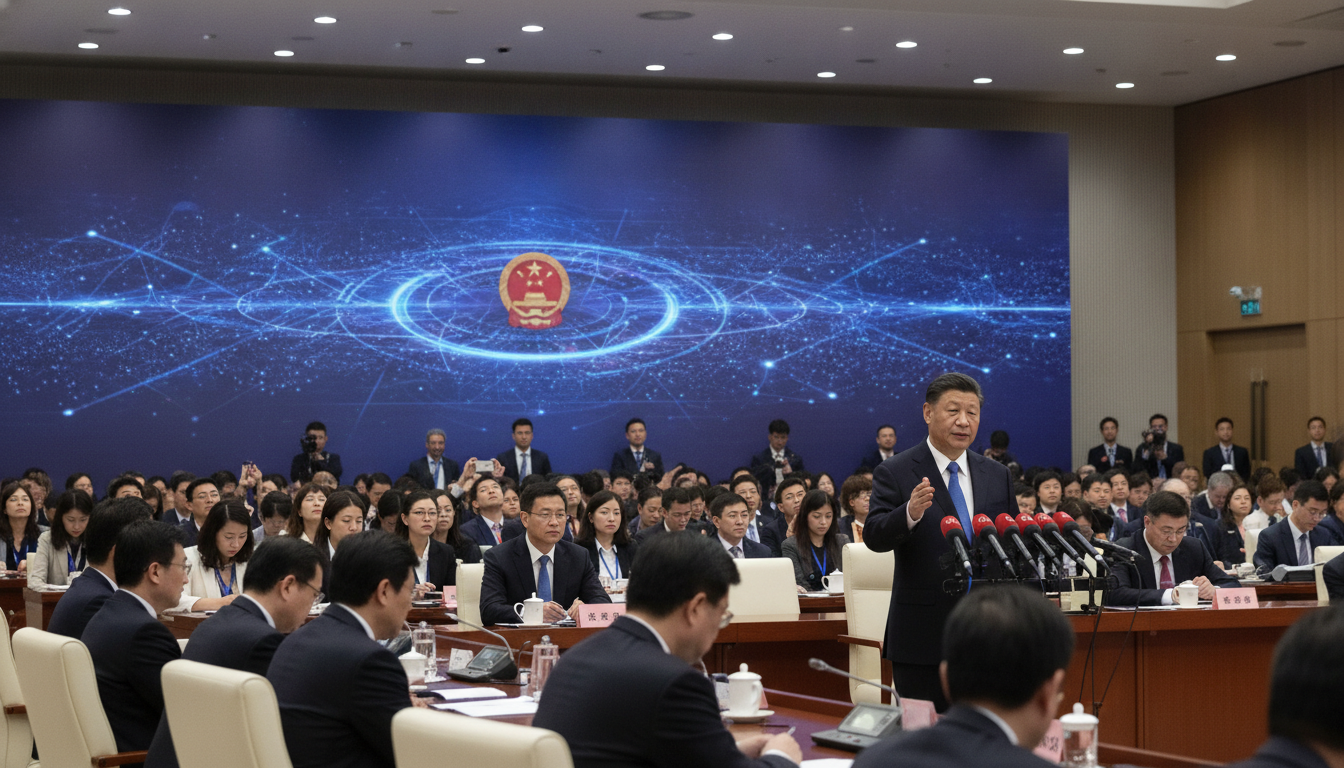
Xi urges international cooperation on AI at Shanghai summit
Xi Jinping calls for international cooperation on AI at Shanghai summit, pledging training for developing countries and urging human-centred safeguards.
Chinese President Xi Jinping used the opening of the World Artificial Intelligence Conference in Shanghai to call for stronger international cooperation on AI, warning against domination of the technology by a single country. He framed his remarks around a “people‑centred” approach and announced plans to expand AI partnerships with developing regions. The speech set out Beijing’s dual aim of accelerating domestic AI capacity while shaping global rules and access.
Xi’s keynote at the World Artificial Intelligence Conference
Xi delivered his keynote at the conference’s opening ceremony in Shanghai, addressing government officials, industry leaders and foreign delegates. He argued that AI development should be a collaborative international endeavour rather than the preserve of one state. The president emphasised that equitable access to AI tools and training is necessary to avoid creating new global injustices.
Commitments to developing countries and multilateral ties
In his address, Xi outlined initiatives to work with partners across Africa, Latin America, Asia and BRICS countries to expand AI capacity-building. He said China would offer cooperation in training, technology transfer and infrastructure support to broaden access. Officials framed the move as part of a wider diplomatic push to deepen technological ties with developing economies.
Human control and regulatory safeguards
Xi stressed the need for legal frameworks, technical monitoring and emergency response mechanisms to keep AI under human control. He warned against stretching national security concepts to justify exclusionary measures in the technology sphere. The speech called for shared standards to manage risks associated with military use, cybercrime and unchecked deployment of advanced systems.
China’s industrial strategy and data centre advantage
State-driven investments have positioned AI as a strategic pillar of China’s economic policy, from chip fabrication to large-scale data centres. Officials cited rapid growth in AI usage, with token consumption rising steeply in recent years as applications proliferate. Analysts note that China’s abundant and inexpensive electricity, along with vast data centre capacity, gives the country practical advantages in powering compute‑intensive AI operations.
Geopolitical friction and export controls
Xi’s appeal for cooperation comes amid existing tensions over technology trade and export controls imposed by the United States and the European Union. Western restrictions on advanced semiconductors and equipment remain a point of friction, and recent guidance from Washington has sought to tighten oversight of chip exports tied to companies with Chinese links. The Chinese leader explicitly criticised what he described as securitisation of technology policy, urging nations not to place unilateral security claims above collective progress.
Implications for global AI governance and markets
The president’s remarks are likely to intensify debate over how to govern an industry that spans commercial, civil and defence domains. China seeks to expand its footprint in AI services by offering lower-cost models and large-scale infrastructure, which has attracted users globally. Observers say Beijing’s proposals for multilateral engagement could reshape access to AI tools, especially for countries currently sidelined from leading-edge semiconductor supply chains.
China’s pitch to developing countries frames AI as an opportunity for shared growth, but it also raises questions about standards, data governance and long-term dependencies. Regulators and technology firms around the world will be watching whether proposed cooperation translates into concrete programmes and interoperable norms.
The summit in Shanghai highlighted both the competition and the interdependence that now define the global AI landscape, underscoring the urgent need for cross-border dialogue on safety, access and economic opportunity.
