
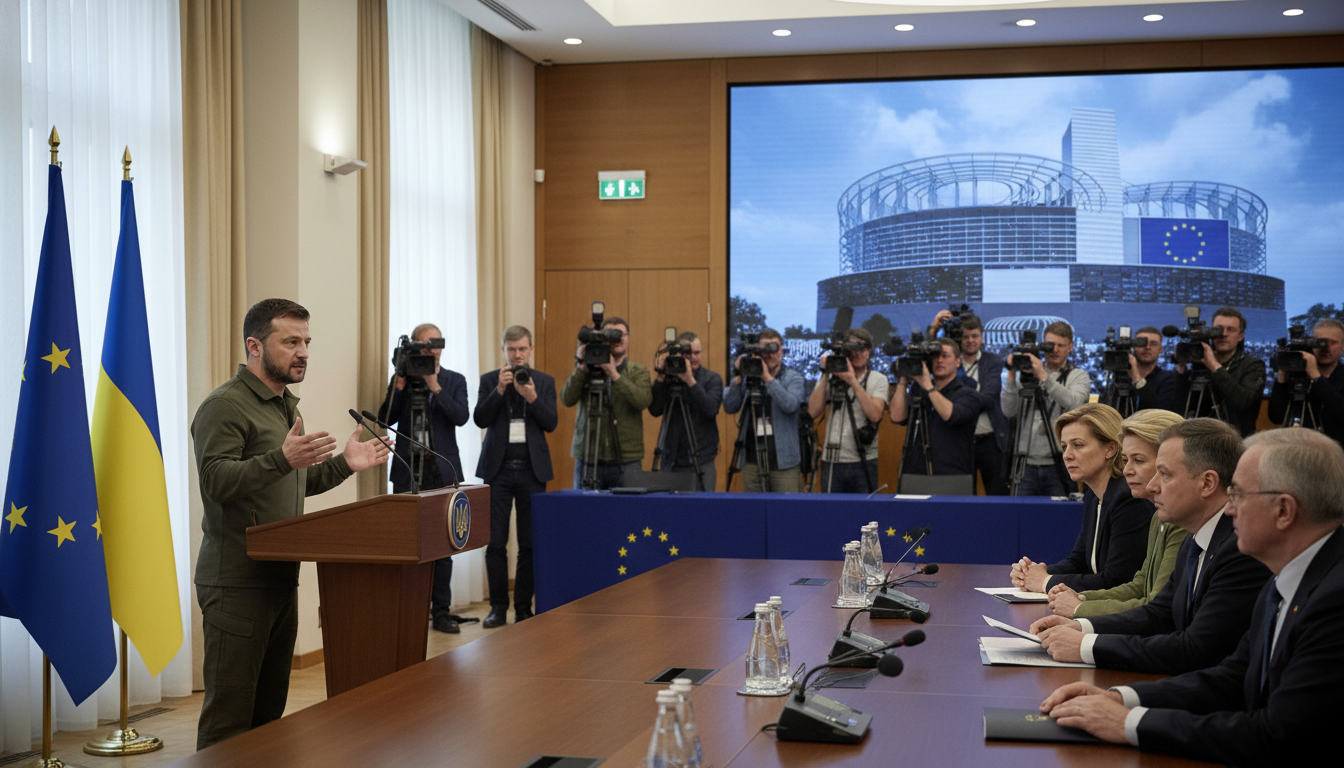
Zelensky Rejects German Plan for EU Associate Membership for Ukraine
Zelensky rejects German proposal for EU associate membership for Ukraine as ‘unfair’, urging full, meaningful accession and equal rights within the European Union.
Zelensky rebuffs German proposal
President Volodymyr Zelensky sent a blunt message to European leaders late Friday rejecting a German-backed plan that would grant Ukraine a form of EU associate membership without voting rights. He described the idea of Ukraine being present in the Union but denied a voice as “unfair” and said Kyiv seeks full and meaningful accession. The letter was addressed to European Council President António Costa, European Commission President Ursula von der Leyen and Cypriot President Nicos Christodoulides.
Outline of the German suggestion
The proposal — advanced publicly by German politician Friedrich Merz — envisions allowing Ukraine to attend EU meetings as a non-voting participant as a transitional step toward full membership. Merz framed the measure as a way to accelerate political alignment and potentially facilitate a path to end the four-year war, arguing participation could help integrate Kyiv into EU decision-making practices. Proponents say it would create a formal channel for dialogue without immediately altering voting dynamics inside the bloc.
Kyiv insists on full accession rights
In his letter, Zelensky rejected that phased approach and urged EU leaders to move toward “full and meaningful” accession rather than partial measures. He argued that being included without equal rights would leave Ukraine unable to defend its interests within institutions it is asked to help shape. The president framed the issue as one of principle, saying Ukraine has defended Europe and therefore deserves parity in treatment and rights within the Union.
Political context: Hungary and recent elections
Zelensky’s correspondence referenced recent political shifts in member states, saying that the removal of Hungarian Prime Minister Viktor Orbán — a vocal opponent of Ukrainian accession — after last month’s elections opened a window for progress in the talks. Kyiv sees the change in Budapest as reducing the risk of a unilateral veto on deeper integration and as an opportunity to re-energize stalled discussions. The letter presented that political development as a key reason to reject piecemeal approaches and press for full accession negotiations.
Legal and institutional implications
Allowing Ukraine to attend meetings without voting rights would raise legal and procedural questions for the EU’s institutions and treaties. EU decision-making on many matters requires unanimity or qualified majority voting among full members, which means a non-voting presence could be purely consultative. Legal experts and diplomats say such an arrangement would be unprecedented in scope and could require new agreements or ad-hoc mechanisms to define the privileges and limits of participation.
Diplomatic reactions and expected debates
The German proposal has prompted immediate debate in capitals across Europe, with member states weighing short-term diplomatic gains against long-term precedents. Kyiv’s outright rejection increases pressure on EU leaders to clarify whether they prefer an incremental engagement model or to commit to a full accession path. Officials in Brussels are expected to weigh the political practicalities, legal hurdles and the likely reaction of other partners before proposing a course that can secure broad support among member states.
Implications for the accession timeline
A move toward full accession would require a formal negotiation process that traditionally spans years and demands agreement on dozens of policy chapters. Kyiv argues the urgency created by the conflict and its contributions to European security justify an accelerated and meaningful timetable. Conversely, proponents of the associate framework contend that a staged approach could provide faster integration of key policy areas while preserving the integrity of EU decision-making for existing members.
Security and symbolic stakes
Beyond technicalities, the debate over EU associate membership for Ukraine carries strong symbolic weight for Kyiv and many of its Western backers. For Ukraine, membership is both a geopolitical anchor and a statement of shared values and mutual security commitments. For several EU capitals, the question tests how far the bloc is willing to adapt its enlargement model in response to an active conflict and the strategic recalibration that has followed.
Next steps in Brussels
European Council and Commission officials will now need to consult member states and assess the scope and impact of any proposed format for Ukrainian participation. Zelensky’s letter raises the political bar by asking leaders to choose between a temporary, non-voting arrangement and a commitment to full accession rights. The coming weeks are likely to see intensified diplomacy as Brussels seeks a formula that balances legal constraints, member-state concerns and Kyiv’s demands for equal treatment.
The debate over EU associate membership for Ukraine has shifted from abstract policy to a concrete test of European unity and values, with Kyiv making clear it will not accept symbolic inclusion without the substance of rights and representation.
