
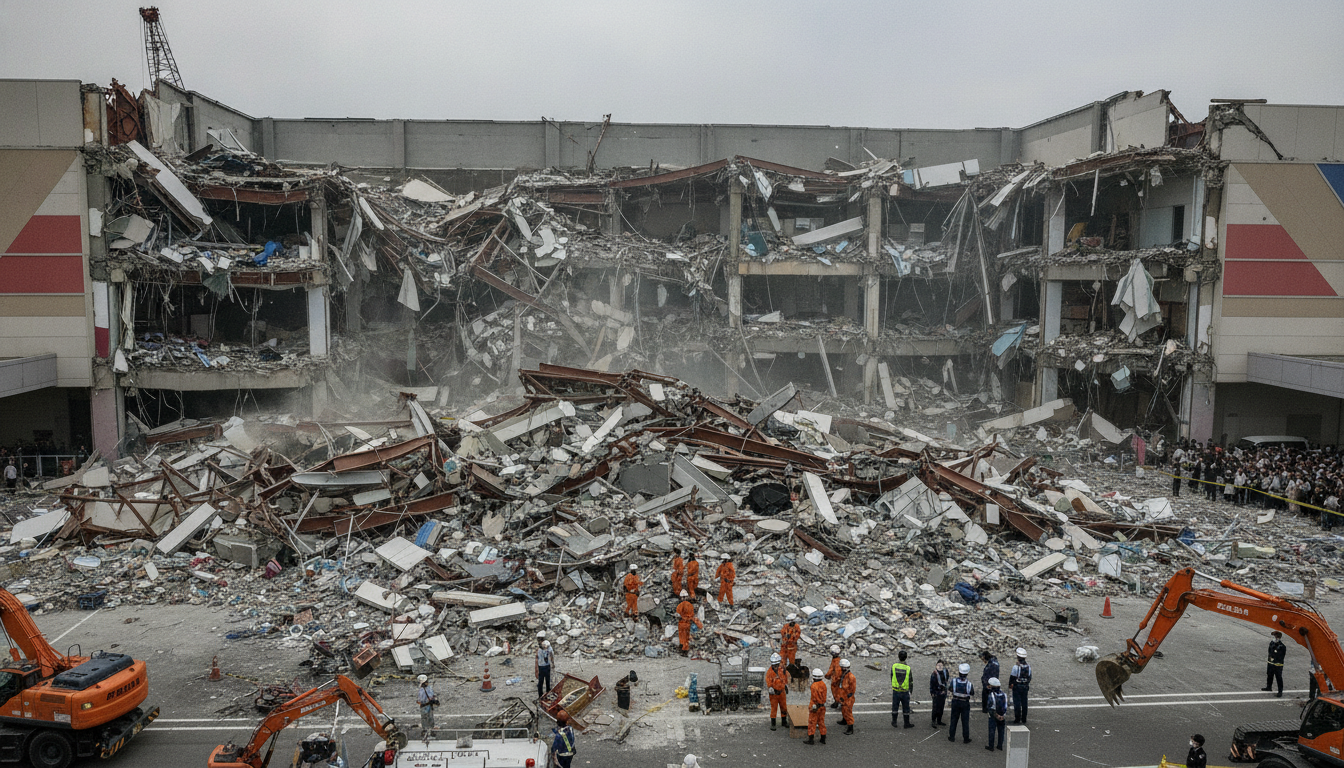
Kashima Aeon Mall collapse after 7.1 quake leaves shoppers trapped; rescue teams search amid suspected gas blast
7.1-magnitude quake collapses Aeon Mall in Kashima; four rescued, others missing as emergency crews search amid suspected gas explosion and mass evacuations.
A powerful 7.1-magnitude earthquake struck southwestern Japan and caused the partial collapse of the second floor of the Aeon Mall in the town of Kashima, authorities said, in an incident now known as the Kashima Aeon Mall collapse. Local fire and emergency officials reported that an unknown number of people remained trapped in the rubble after the collapse, with teams rapidly mobilising to reach survivors. National broadcaster NHK and other outlets reported that the collapse followed a blast thought to have been triggered by a gas leak inside the complex.
Initial response teams at the scene said four injured people were rescued and transferred to hospital, while the whereabouts of roughly ten others remained unknown. Search-and-rescue operations continued through the day as crews worked amid unstable debris and the lingering risk of secondary incidents. Officials cautioned that the full extent of the damage and the final casualty count remained under investigation as operations shifted between rescue and recovery.
Powerful quake flattens second floor of Aeon Mall in Kashima
Emergency services reported that the second floor of the shopping centre suffered a sudden structural failure after the quake, leaving large sections collapsed and blocking access to some stores. The collapse created pockets of debris where shoppers and staff could be trapped, complicating immediate rescue efforts. Photographs and eyewitness accounts described thick white smoke rising from the mall after a loud explosion was heard, adding to the urgency of the response.
Local fire authorities in Kumamoto prefecture coordinated initial entry and shoring operations to stabilise weakened structures before sending search teams into affected zones. Rescue crews used heavy equipment alongside manual extraction techniques to avoid triggering further collapses, while medical teams triaged the injured at nearby staging areas. Engineers and structural experts were expected to join assessments as soon as access and safety conditions allowed.
Rescue teams extract injured, dozens remain unaccounted
Kumamoto’s emergency response unit confirmed the evacuation and the transfer of four injured individuals to hospital, but emphasised that more people were still unaccounted for inside the mall. Response officials said that an exact figure for trapped persons was uncertain in the immediate aftermath due to the chaos of evacuation and incomplete store rosters. Teams continued to prioritise life-saving operations, focusing on areas where calls for help were heard and where rescuers detected signs of movement.
Search-and-rescue work proceeded under tight time pressure, with a mix of trained urban search teams, firefighters and volunteers combing through storefronts and corridors. Rescue commanders reported using thermal imaging and canine units where safe to do so, while coordinating with local hospitals to prepare for potential incoming casualties. Authorities urged the public to remain clear of the site and to follow official evacuation instructions to avoid hampering relief efforts.
Suspected gas leak and eyewitness accounts of explosion
Several witnesses told reporters they had smelled gas inside the mall shortly after returning to their shops following the earthquake alarm, and that a loud blast followed roughly an hour later. A 35-year-old shop owner interviewed by a national newspaper said he escaped after the initial earthquake warning and heard an explosion resembling a bomb, then saw a massive plume of white smoke rising from the complex. A mall employee speaking to television station TBS described colleagues detecting a strong gas odour before the blast, corroborating accounts of a possible leak.
Officials cautioned that the cause of the explosion remained under investigation and that reports of gas smell and blast sequencing were being examined by specialised teams. The presence of a suspected gas ignition added a hazardous-materials dimension to the rescue operation, necessitating additional precautions and delaying some entry points. Investigators from relevant agencies were expected to inspect utilities and the mechanical systems of the mall once the immediate search effort concluded.
Mass evacuations ordered across Kumamoto and Nagasaki prefectures
Japan’s Fire and Disaster Management Agency reported that more than 260,000 people were instructed to evacuate, primarily across Kumamoto and neighbouring Nagasaki prefectures, as authorities moved to secure populations in the quake-affected region. Emergency shelters were opened and local governments advised residents to avoid coastal and unstable inland areas until after structural inspections. The affected region lies roughly 900 kilometres southwest of Tokyo, making it one of the more distant major population centres to experience such a strong quake in recent years.
Officials emphasised that evacuation orders aimed to reduce risk to residents as aftershocks and infrastructure damage remained possible, and they urged evacuees to register at shelters so missing-persons lists could be updated. Power and gas services were subject to temporary suspension in some areas while technicians checked for leaks and damage, and transport services faced disruptions due to safety inspections and debris on roads.
Damage assessment, investigations and next steps for survivors
As daylight allowed a fuller appraisal of the scene, authorities began cataloguing structural damage across the commercial complex and surrounding blocks. Engineers were expected to conduct detailed surveys to determine which parts of the building could be safely re-entered and which required demolition or extended shoring. City officials and mall operators indicated they would coordinate to provide information to families of those inside and to the public as investigations proceeded.
Relief agencies and municipal bodies set up hotlines and information centres to assist displaced residents and to centralise updates on missing persons and hospitalised individuals. Local hospitals remained on high alert to receive additional casualties, and mental-health teams were deployed to support survivors and first responders affected by traumatic conditions at the site. Authorities also called for calm and patience as search teams methodically cleared areas to minimise the risk of further harm.
Search and rescue operations at the Kashima Aeon Mall site continued into the evening with crews working to locate anyone still trapped and to stabilise hazardous structures, while investigations into the suspected gas-related blast and the quake’s broader impact remain active.
