
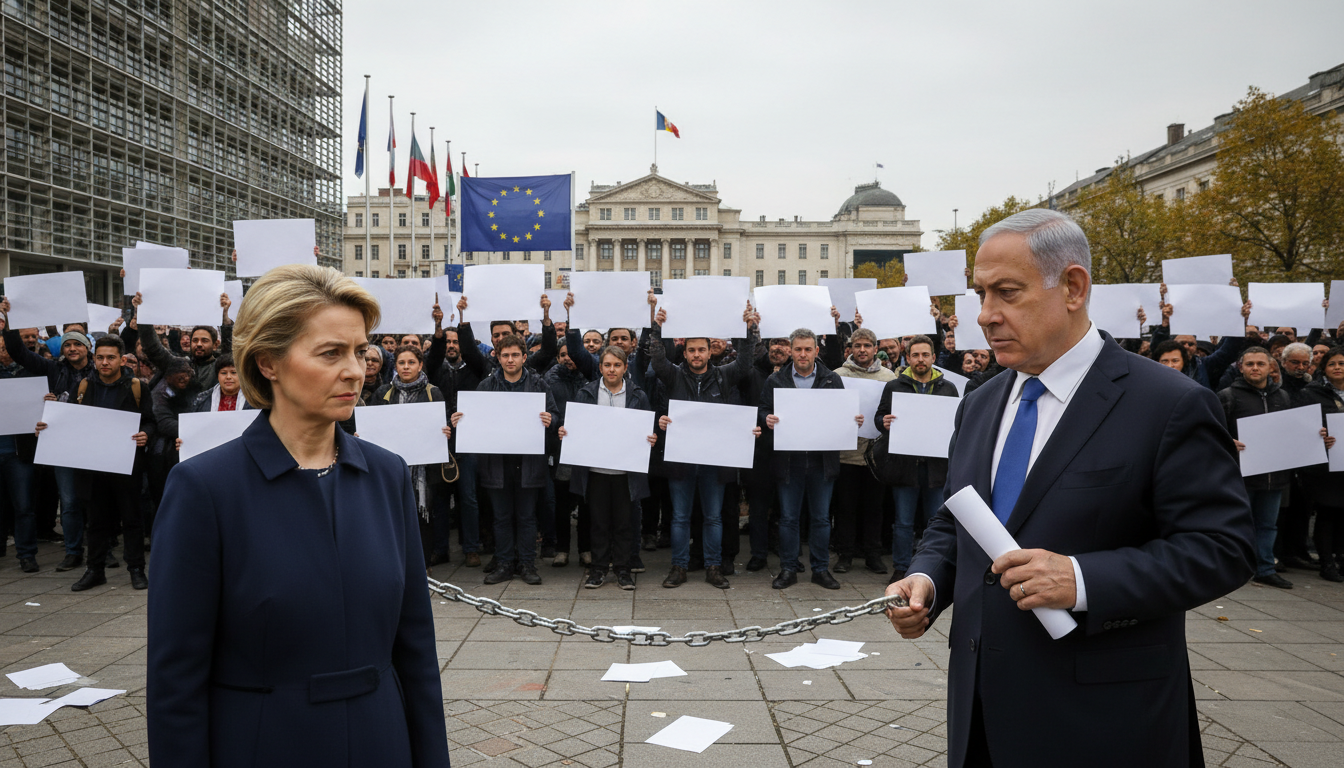
Israel’s new death penalty law ignites EU criticism and intensified calls to suspend the Association Agreement
EU states and rights groups voice alarm as Israel’s new death penalty law prompts concerns over Palestinian detainees and a vote at the Foreign Affairs Council on April 21
Israel’s new death penalty law has prompted sharp criticism from European officials and human rights organisations as preparations for implementation proceed, with national security figures reportedly arranging prison facilities and detention uniforms for Palestinian prisoners. The measure, cleared by parliamentary committees in recent weeks, has reignited debate over Israel’s obligations under international law and the future of the EU Israel Association Agreement.
Parliamentary approval and implementation steps
Reports from Israeli political circles say the bill moved through the Knesset National Security Committee and is advancing toward final parliamentary stages, with ministers and officials publicly discussing logistics related to carrying out sentences. National Security Minister Itamar Ben Gvir has been quoted in regional reporting as associating his office with preparations that include construction work at detention sites and new prison attire for Palestinian inmates.
Legal analysts warn that operational plans suggest the law is being prepared for practical application soon after approval, creating urgency among international observers and rights groups. Critics note that the law will be exercised within a system where military courts handle the vast majority of Palestinian cases and where conviction rates have historically been high.
European Union reactions and diplomatic language
The European Union responded to the legislation with statements describing the measure as deeply concerning and reiterating a broad opposition to the death penalty in all circumstances. EU spokespersons emphasised the bloc’s preference for adherence to human rights standards while also praising past Israeli commitments to international obligations in diplomatic language that some observers perceived as equivocal.
Several EU member states issued a joint expression of deep concern ahead of the final parliamentary vote but stopped short of announcing concrete punitive steps. That measured tone has drawn criticism from activists who say the bloc’s wording fails to confront the immediate human impact of the law on Palestinian detainees and their families.
Human rights bodies and international legal findings
Human rights organisations and UN bodies have highlighted the law as part of a pattern of measures that, they say, raise serious questions about compliance with international humanitarian law. Legal experts point to advisory opinions from the International Court of Justice issued in mid and late 2024 as framing concerns over alleged violations in occupied territories, and observers say those opinions are relevant to the current debate.
Advocacy groups have underscored a catalogue of actions by Israeli authorities that they characterise as violations of rights and humanitarian norms, citing restrictions on aid groups, forced displacements, and settlement expansions in occupied areas. Those claims have intensified calls for Europe to use legal mechanisms within the Association Agreement to hold Israel to its obligations.
European public pressure and the Justice for Palestine initiative
Public mobilisation across Europe has shifted the political landscape, with a mass petition under the European Citizens Initiative titled Justice for Palestine gathering over one million signatures according to campaign organisers. The initiative calls for the full suspension of the EU Israel Association Agreement and has been supported by numerous human rights and humanitarian organisations as well as former diplomats.
Campaigners argue that the volume of signatures and endorsements reflects growing impatience among European citizens with what they describe as inconsistent enforcement of human rights commitments. Policymakers in several capitals are facing increased domestic pressure to translate public sentiment into diplomatic action.
Moves toward suspension of the Association Agreement
Diplomatic sources and public statements indicate that the suspension of the EU Israel Association Agreement will be raised again at the Foreign Affairs Council meeting on April 21. Several member states are preparing to place the issue on the agenda and to press for concrete measures should the law be implemented without safeguards or accountability measures.
Supporters of suspension argue that withholding preferential trade and cooperation benefits would be a lawful tool to enforce the human rights clause embedded in the Association Agreement. Opponents caution that punitive steps could complicate humanitarian access and regional diplomacy, arguing for calibrated measures instead.
Concerns of detainee families and civil society voices
Families of Palestinian detainees and local civil society groups express fear and anguish as the law advances, describing the prospect of capital sentences as a new and immediate threat to relatives already detained under harsh conditions. Former detainees and relatives recount long histories of imprisonment and say the change in law compounds trauma and uncertainty for communities affected by mass arrests.
Civil society organisations in Europe and the Middle East are urging the EU and member states to pair public statements with targeted actions, including suspension of parts of the Association Agreement if necessary, increased scrutiny of military court proceedings, and stepped up humanitarian protections for civilians in occupied territories.
The debate over Israel’s new death penalty law has shifted from legal scrutiny to a broader political test of the European Union’s willingness to enforce its human rights commitments. With the Foreign Affairs Council meeting scheduled for April 21, EU capitals now face a decision that could define relations with Israel and reshape policy responses to allegations of rights violations in the region.
