
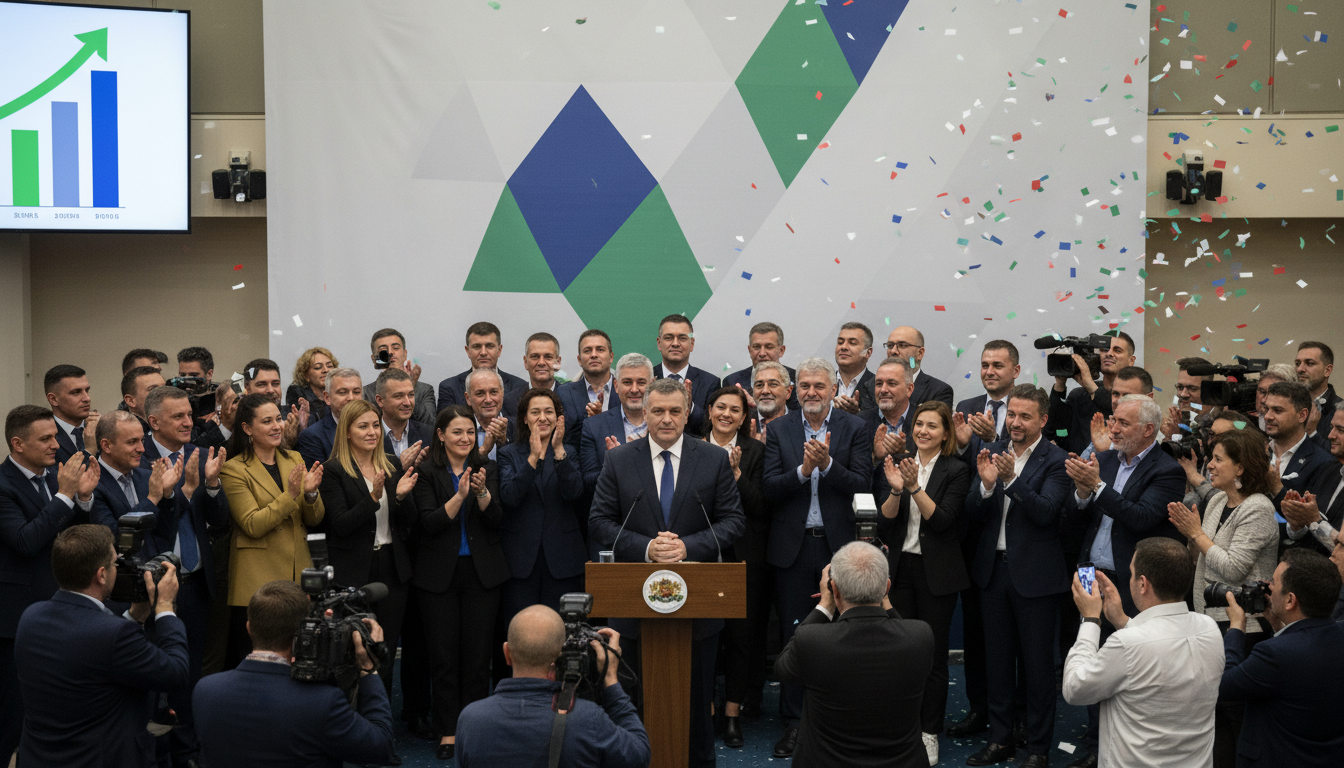
Rumen Radev’s Progressive Bulgaria Wins Decisive Victory in Bulgaria Election
Rumen Radev’s Progressive Bulgaria wins Bulgaria election, securing a parliamentary majority and prompting questions about EU, NATO and relations with Russia.
Rumen Radev’s Progressive Bulgaria secured a commanding victory in the Bulgaria election, delivering a clear parliamentary majority and positioning the former president to become prime minister. With nearly all ballots counted, official tallies show the centre-left coalition winning a plurality that translates into roughly half the 240-seat National Assembly. Voters framed their choice around promises to tackle corruption and end chronic political instability after years of short-lived governments.
Official results and seat projection
With 98.3 percent of ballots tallied, Progressive Bulgaria captured about 44.7 percent of the vote, a margin that far exceeded many pre-election forecasts. That share translates into an estimated 130 seats in the 240-member parliament, placing Radev’s bloc well ahead of main rivals. The centre-right GERB party and the reformist PP-DB alliance trailed with single-digit seat projections relative to the winner, underscoring the scale of the victory.
Radev’s political trajectory and campaign themes
Rumen Radev, a former air force commander who served nearly a decade as president, resigned earlier this year to contest the parliamentary vote. He ran as a self-styled outsider promising to dismantle what he described as an “oligarchic” model of governance and to root out entrenched corruption. The campaign addressed immediate economic pressures, including rising living costs, which featured prominently in voters’ concerns and drove higher turnout in many constituencies.
Foreign policy positions and ties with Russia
Radev’s approach to foreign policy has been a focal point of debate during the campaign and after the result. While he publicly condemned Russia’s 2022 invasion of Ukraine, he has opposed Ukraine-bound military support and advocated a more pragmatic, dialogue-driven relationship with Moscow. His call to restore trade links with Russia and his criticism of certain EU policies have prompted critics to label him pro-Russian, a characterization he disputes as political shorthand for pragmatic diplomacy.
European and NATO implications
The outcome has prompted scrutiny in Brussels and among NATO partners over Bulgaria’s future alignment on security and energy matters. Radev has signalled willingness to engage with pro-European forces on issues such as judicial reform, while also questioning aspects of EU strategy including rapid green transitions and the currency adoption process. European Commission leadership publicly reaffirmed Bulgaria’s place within the EU, even as analysts assess how the new government will balance national priorities with alliance commitments.
Domestic stability and coalition considerations
Bulgaria’s political landscape has been volatile since 2021, marked by successive administrations and repeated snap polls. The scale of Progressive Bulgaria’s win raises the prospect of a more stable governing majority, but Radev has indicated openness to partnering with smaller parties to ensure a durable administration. His camp has stated it will consider various options to form a regular government, a signal that some policy compromises or power-sharing arrangements remain possible despite the majority outcome.
Immediate priorities for a Radev administration
As prime minister-designate, Radev will transition from the largely ceremonial presidency to an executive role responsible for appointing a cabinet and setting the government agenda. Early priorities are likely to include anti-corruption measures, judicial reform efforts, and policies aimed at easing household financial strain. The new government will also inherit challenges related to energy security and regional diplomacy, tasks that will test both domestic credibility and international partnerships.
The result closes another chapter in Bulgaria’s prolonged cycle of political fragmentation and opens the first page of what could be a more consolidated era under Radev’s leadership. How his government balances domestic reform promises with sensitive foreign-policy choices will shape Bulgaria’s standing in the EU and NATO in the months ahead.
