
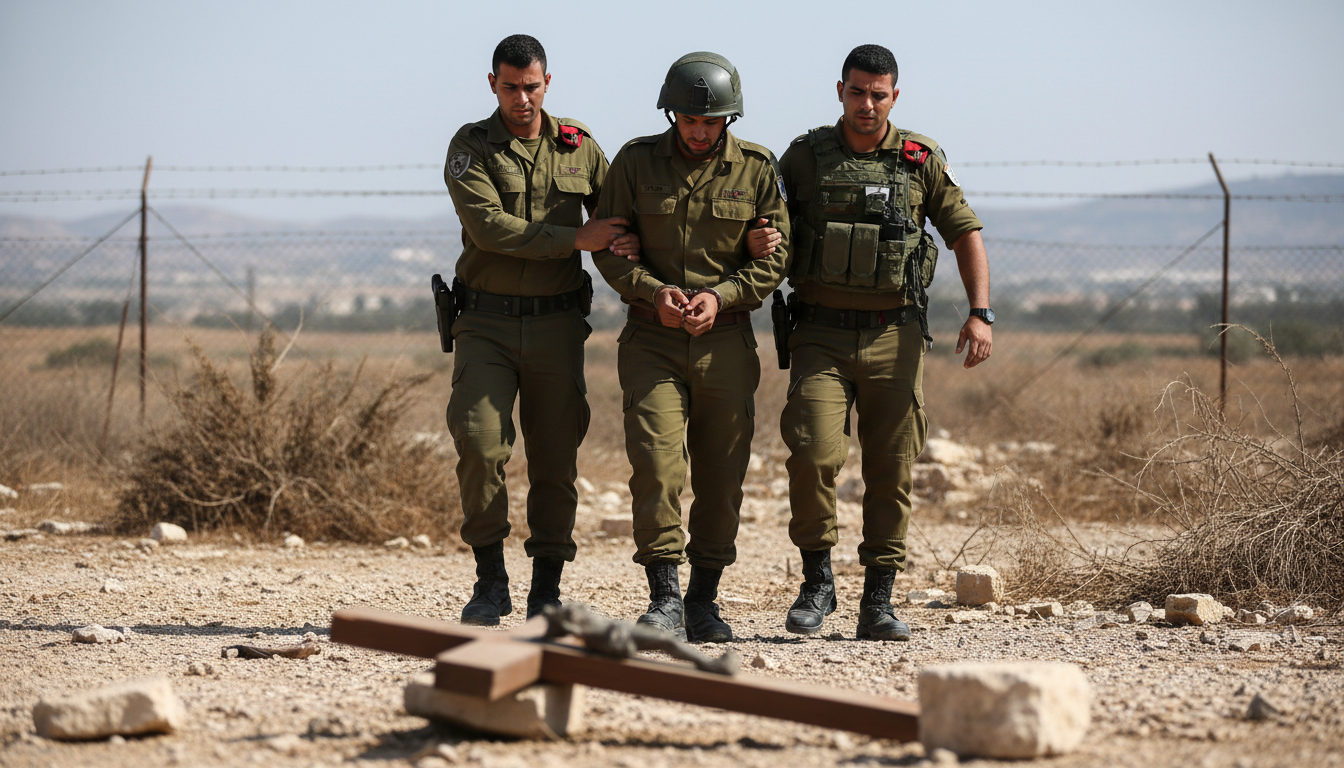
Israeli soldier filmed smashing Christian crucifix in southern Lebanon, detained amid international outrage
Footage of an Israeli soldier attacking a Christian statue in southern Lebanon with a sledgehammer sparks arrests and fresh questions over military accountability.
The release of video showing an Israeli soldier smashing a Christian crucifix in southern Lebanon has prompted Israeli authorities to detain the accused and his filmer, deepening concerns about the conduct of troops and the fate of Christian communities caught up in regional fighting. The footage, which spread widely on social media, forced a rare public response from Prime Minister Benjamin Netanyahu and drew condemnation from supporters and critics alike.
Video prompts swift detention of two soldiers
Israeli officials announced the arrest of the soldier seen in the footage and another serviceman who filmed the act, each jailed for 30 days pending investigation. Authorities also summoned six additional soldiers for questioning as part of the inquiry into the incident.
The prompt action contrasts with lengthy patterns of military probes that frequently exonerate personnel in other high-profile cases, a disparity now under intense scrutiny. Officials said the visible nature of the video made a public response unavoidable, even as critics argued accountability should be consistent in all alleged violations.
Prime minister reaffirms respect for all faiths
Prime Minister Benjamin Netanyahu publicly reiterated Israel’s stated respect for religious sites and communities after the footage circulated. His statement attempted to reassure domestic and international observers that such actions do not reflect official policy.
Yet observers pointed out that similar assurances have followed other incidents involving Christian and Muslim places of worship. The prime minister’s remarks came amid growing diplomatic fallout as images of the attack circulated across the West and eroded support among some Christian backers.
Experts say image matters for Christian supporters
Analysts warned that the graphic nature of the attack could erode support among Christian communities that have framed Israel as a protector of Judeo-Christian values. Senior fellows and regional experts noted that high-profile Christian supporters in the United States and elsewhere have been central to Israel’s diplomatic backing.
Yossi Mekelberg, a senior fellow at Chatham House, said visible and credible responses are important to preserve political relationships, particularly with influential Christian pro-Israel constituencies. Still, he emphasized that selective enforcement fuels accusations that the government treats certain violations differently.
Historical pattern of uneven accountability
Observers highlighted a broader pattern in which military investigations into abuses often conclude without criminal charges, even in incidents resulting in civilian deaths. Critics say the new detentions are notable precisely because they deviate from that trend.
The discrepancy has become more pronounced as wartime operations in Gaza and Lebanon have produced repeated reports of destruction to religious and civilian sites. Human rights advocates say the selective visibility of abuses — recorded and shared on social media — is shaping which cases receive formal scrutiny.
Impact on Palestinian Christians and religious sites
Christian Palestinians, who live alongside Muslim communities under occupation, have long reported harassment and threats to places of worship. Recent years have seen an uptick in incidents affecting both Christian and Muslim sites, according to interreligious monitoring groups.
Reports indicate that Easter and other Christian observances have become flashpoints in certain areas, with clerics and religious workers increasingly vulnerable to harassment. Analysts warn that attacks on Christian symbols risk widening fractures between Israeli authorities and international Christian constituencies.
Voices warn of broader political consequences
Security scholars and sociologists say incidents that target religious symbols can have outsized diplomatic effects, eroding support across political divides. HA Hellyer, a senior fellow at the Center for American Progress, observed that images of soldiers desecrating Christian symbols complicate efforts by defenders to portray Israel as culturally aligned with the West.
Prominent voices in civil society and academia argue that the broader pattern of targeting religious and civilian infrastructure must be addressed to prevent further alienation of international backers. They caution that isolated prosecutions will not silence concerns unless accompanied by systemic change in military oversight.
The investigation into the soldier and his accomplices is ongoing, and officials have yet to disclose whether formal criminal charges will be brought. The case will likely be watched closely by religious leaders, diplomats and rights organisations seeking to assess whether this response marks a durable shift toward consistent accountability.
