
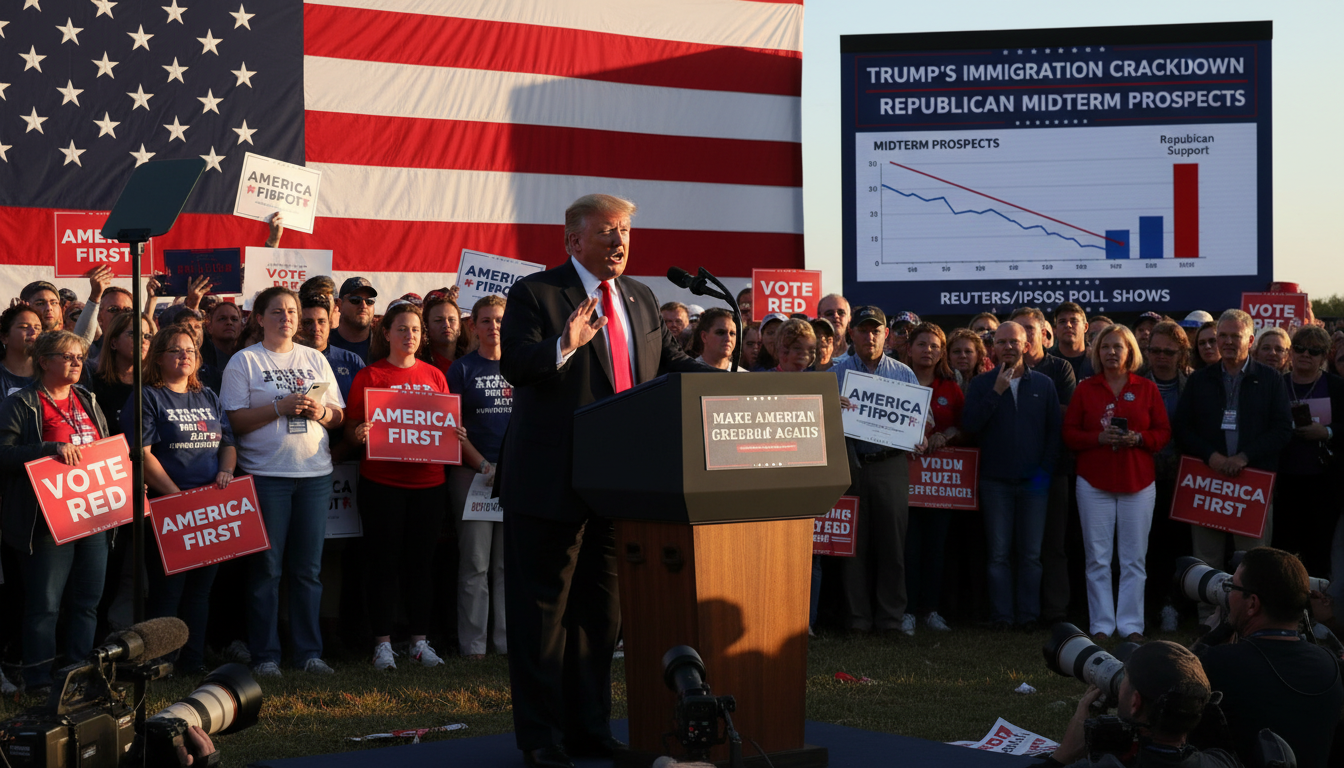
Trump immigration crackdown dents Republican midterm prospects, Reuters/Ipsos poll finds
A Reuters/Ipsos poll shows Trump immigration crackdown is reducing voter support for Republican candidates ahead of November’s midterms, with 52% now less likely to back a pro-deportation nominee.
The latest Reuters/Ipsos survey indicates that the hardline Trump immigration crackdown is casting a shadow over the Republican Party’s chances in the November midterm elections. The poll, conducted online over six days and concluding Monday, found a majority of respondents saying they would be less likely to support a candidate who endorses Mr. Trump’s deportation approach. Republican operatives and strategists are watching the numbers closely as the party prepares for a difficult fight to keep control of both chambers of Congress.
Poll headline figures and methodology
The poll sampled 4,557 U.S. adults and carries a margin of error of plus or minus two percentage points.
Respondents were asked whether they would be more or less likely to support a candidate who backs the administration’s deportation measures, and 52% said they were less likely to do so while 42% said they were more likely.
Survey organizers said the questionnaire was administered online over a six-day period that ended on Monday, and the sample was designed to reflect adults across the country.
Voter sentiment on enforcement and change
The Reuters/Ipsos data show a shift from initial public reactions following Mr. Trump’s 2025 inauguration.
Earlier polls in the weeks after the January 2025 swearing-in registered roughly 50% approval for the administration’s approach to immigration, but satisfaction has since slipped; only 40% of respondents in the current survey expressed approval of the administration’s handling of the issue.
One in four participants said current detention efforts had become less strict compared with the previous month, and 70% said a pivot toward less severe enforcement would be a positive development for the country.
Security incidents and enforcement tactics cited
The poll noted that the administration’s campaign has included the deployment of undercover federal agents across the country.
Survey responses were recorded against a backdrop of high-profile and sometimes violent enforcement operations, which the poll referenced as having resulted in the deaths of two Americans during enforcement activity. These developments appear to have influenced public perceptions of both policy tone and practical outcomes.
Political consequences for November’s midterms
Republicans face mounting challenges in preserving their majorities in the House and Senate, according to the poll’s implications.
Analysts and party officials warn that eroding voter appetite for strict deportation policies could depress support in swing districts and among moderate voters, complicating the GOP’s midterm campaign strategy. The issue is layering on top of other pressures, including the economic pinch from higher gasoline prices tied by observers to regional conflict dynamics.
Party response and strategic calculations
Republican lawmakers have largely rallied behind the president’s tough stance, with many endorsing stronger deportation measures as a means to shore up the party’s base.
But the poll suggests a potential misalignment between priorities of the GOP base and those of the broader electorate, where concern about enforcement methods and consequences appears to be growing. Political strategists are weighing whether candidates should emphasize immigration strictness, pivot to other issues, or attempt to moderate messages in competitive districts.
The Reuters/Ipsos findings offer a snapshot of public opinion that could influence campaign messaging and candidate positioning in the months ahead.
Public reaction to the Trump immigration crackdown is shaping both the narrative and the tactical choices within the Republican Party as it heads toward November. The poll’s numbers underscore a narrowing path for Republicans who rely on hardline immigration rhetoric to mobilize voters, and they present a signal that moderation or alternative policy emphases may be necessary in certain battleground districts.
