
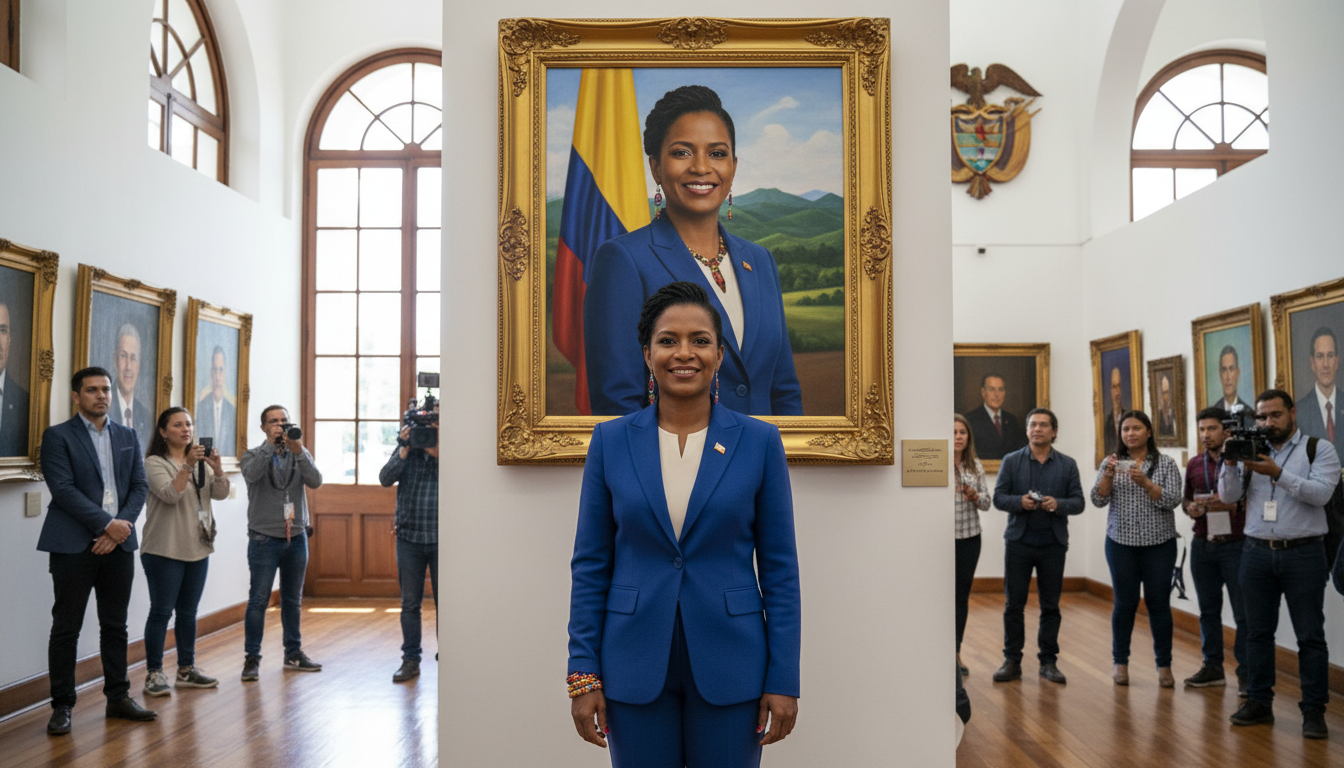
Francia Márquez to Become First Afro‑Colombian Portrait in Bogotá’s Vice‑Presidential Gallery
Colombia’s vice‑presidential gallery will add Francia Márquez’s portrait on August 7, 2026, breaking a century‑long pattern of white representation and spotlighting debates over race, power and political marginalisation.
Francia Márquez’s impending inclusion in the vice‑presidential portrait gallery in Bogotá marks a symbolic shift in Colombia’s official memory. The exhibition, housed in the vice‑presidential residence, has until now displayed only portraits of white officeholders dating back to the 1886 republic. Her addition on August 7, 2026, when President Gustavo Petro’s term ends, will formally register her as the first Afro‑Colombian vice president represented in that space.
Gallery reveals enduring racial homogeneity
The permanent display of vice‑presidential portraits sits at the heart of Bogotá’s historic administrative quarter and has drawn renewed attention for what it omits. Despite Colombia’s ethnically diverse population, the series of official images has reflected a monochrome history that excludes Afro‑Colombian visibility. Márquez’s forthcoming portrait therefore functions as both recognition and a prompt to reassess how the state records political leadership.
Public reaction to the gallery’s composition has been mixed, with advocates of greater representation welcoming the change while critics argue that a single portrait cannot redress deeper structural exclusion. The emergence of Márquez’s image in the residence will be a visible milestone, but activists stress that formal recognition must be paired with substantive policy shifts.
Tensions inside the administration
Francia Márquez has publicly described a strained working relationship with President Gustavo Petro, saying communication between them was limited for more than a year. She has criticised what she sees as restrictions on her authority and instances where responsibilities she sought to exercise were curtailed. Those tensions have fed wider debate over how vice‑presidential roles are defined and deployed within Colombia’s executive branch.
Observers say the dispute has been particularly visible around initiatives that touch on racial equality and institutional reform. Márquez’s detractors contend that political frictions are not unusual in coalitions, while her supporters argue they reflect an unequal distribution of power that hampered her capacity to deliver on campaign promises.
Campaign roots and environmental leadership
Márquez’s rise to national prominence began in Cauca, where she was born into the Yolombó mining community and became an organiser against illegal mining and environmental degradation. At 13 she began local advocacy, and in 2014 she led a mass march—about 350 miles to Bogotá—organized by roughly 80 women protesting pollution and displacement. Those actions helped propel her onto the national stage and framed her as a grassroots leader.
Her environmental work was internationally recognised when she received the Goldman Environmental Prize in 2018, an award that amplified her platform. Later electoral bids, including a presidential primary where she secured significant votes, positioned her as a key ally in the left‑wing ticket that won the 2022 election.
Ministry of Equality dispute and removal
One of the most contentious episodes of Márquez’s tenure involved the proposed Ministry of Equality, a flagship reform in the Petro platform. She says she spent two years attempting to build the new ministry amid budgetary and bureaucratic obstacles, only to be removed from its leadership shortly before it could consolidate. The decision to shift responsibility away from her reignited criticism that her role was being narrowed rather than empowered.
Márquez has framed the removal as emblematic of a broader pattern of exclusion, asserting that political and financial constraints prevented the ministry from fulfilling its mandate. Government spokespeople defended the reshuffle as a technical decision, but the public dispute highlighted competing visions for how equality policy should be implemented.
Allegations of racism and public scrutiny
Throughout her vice‑presidency, Francia Márquez has faced racist attacks in media and on social platforms, including derogatory cartoons and coordinated online harassment. She reports that scrutiny extended to her official travel and spending, with opponents publicly questioning the legitimacy of trips she made to bolster trade ties with African countries and safety‑related helicopter movements within Colombia. Márquez rejects portrayals that frame diplomatic and security measures as personal extravagance.
Legal recourse has yielded mixed results; at least one judicial decision absolved an accused online attacker on grounds related to proving intent, a ruling Márquez says she is pursuing on appeal. Her supporters argue that such outcomes underscore systemic gaps in addressing racialised hate speech.
Representation, population figures and political stakes
The question of how many Colombians identify as Afro‑Descendant remains contested. Official statistics have cited figures around 10 percent of the population, but leaders from Afro‑Colombian communities and some regional officials argue that the true number is substantially higher. Francia Márquez has offered her own estimate of Afro‑descendant Colombians that far exceeds the government count, reflecting wider disputes over census methods and visibility.
Political analysts say that Márquez’s ascent altered expectations about who could access high office in Colombia and across the region. Yet they also note that symbolic breakthroughs do not automatically translate into electoral strength; critics point to a lack of consolidated policy achievements as a reason her potential presidential prospects have not materialised.
Francia Márquez’s portrait entering the vice‑presidential gallery will be an unmistakable symbol of an evolving national narrative, but her tenure underscores the distinction between representational milestones and the deeper institutional changes required to broaden political inclusion and redress historical inequities.
