
US Navy secretary fired amid Pentagon shake-up over shipbuilding reforms
US Navy secretary fired amid slow shipbuilding reforms and an ethics probe, deepening leadership turmoil at the Pentagon and raising concerns over naval capacity and regional tensions.
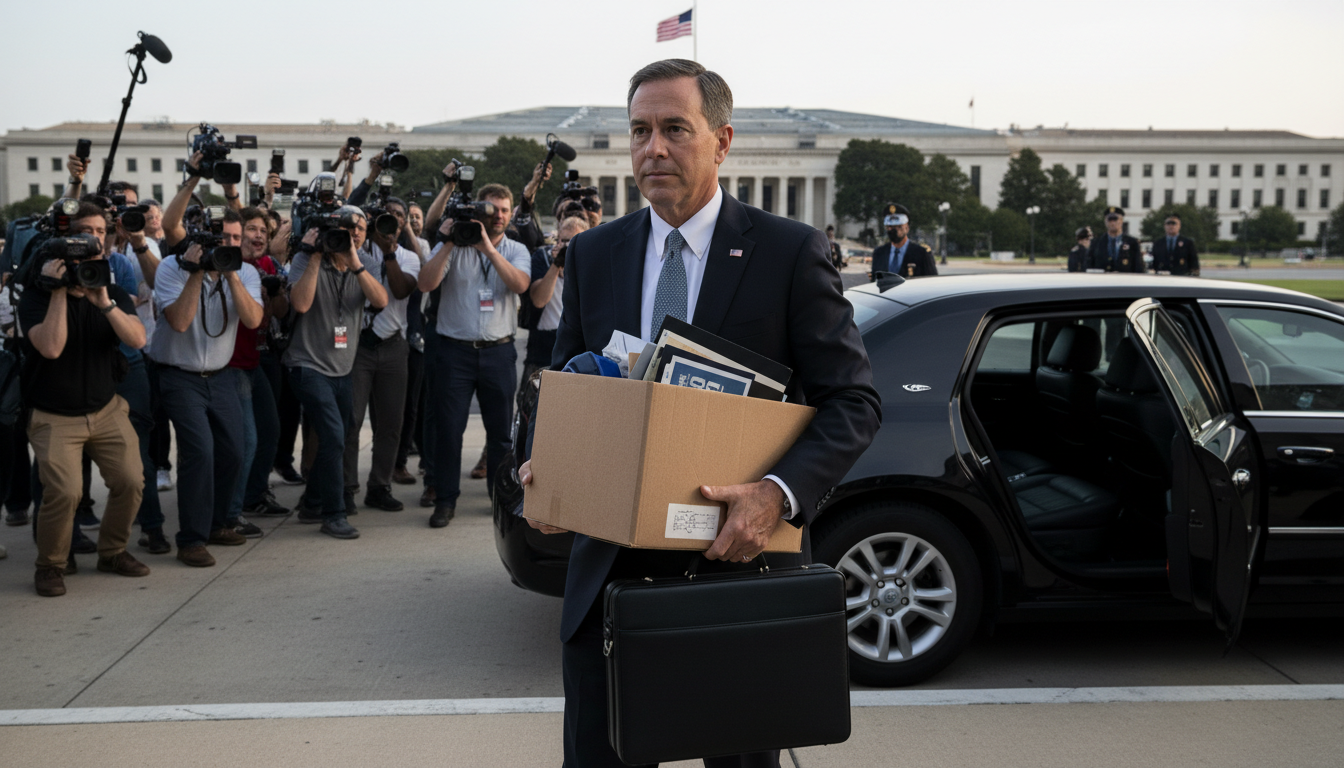
The US Navy secretary fired Wednesday has left his post effective immediately, the Pentagon said, in the latest personnel upheaval at the Defence Department. John Villan, a billionaire close to President Donald Trump, was removed amid disputes over the pace of shipbuilding reforms and an internal ethics inquiry. The announcement did not specify whether Villan resigned or was dismissed, and the department gave no public reason for his departure.
Pentagon statement and immediate transition
The Pentagon issued a terse statement saying Villan would leave “effective immediately” and named Deputy Secretary Hong Cao as acting secretary. The release offered no further explanation and did not indicate whether Villan had been asked to step down or chose to depart.
Two US officials speaking on condition of anonymity told Reuters that the decision followed growing frustration within the department over the pace of reform and strained relations between Villan and senior leadership. Those sources said the move is part of a broader pattern of rapid leadership changes across the Pentagon.
Allegations of slow shipbuilding reform
Officials cited slow implementation of reforms intended to accelerate naval shipbuilding as a key factor in the decision to remove Villan. The Biden-era industrial base had already struggled to keep pace with demand, and the current administration has pressed for faster delivery of surface ships and support vessels.
Pentagon leaders have repeatedly emphasized the need to expand fleet capacity quickly, arguing that a slower procurement tempo undermines broader strategic aims. Sources said frustration mounted as program milestones were missed and industry ramp-ups lagged behind targets.
Ethics inquiry and internal friction
One source pointed to an ethics investigation in Villan’s office as another element behind his exit, though details of that probe were not disclosed. Ethics reviews are typically confined to internal channels, and the Pentagon declined to comment on any ongoing investigations.
Observers also highlighted personal and political tensions between Villan and senior Pentagon figures, including Defence Secretary Pete Hejgsieth and his deputy, Steve Feinberg. Those strained relationships, officials said, complicated efforts to build consensus on procurement and strategy.
Wider pattern of Pentagon leadership turnover
Villan’s departure follows a string of high-level changes across the US military leadership this year, underscoring a period of substantial turnover at the Pentagon. In recent months the department has seen removals of senior officers, including the chief of the Joint Chiefs of Staff and other service chiefs, officials noted.
Earlier in April, Secretary Hejgsieth dismissed Army Chief of Staff Randy George without public explanation, a move U.S. officials tied to tensions within the senior leadership. Analysts say the rapid churn raises questions about continuity in strategy and policymaking at a time of increasing global risk.
Impact on naval strategy and regional operations
The shake-up comes as the United States increases naval deployments in the Middle East amid heightened tensions with Iran and its proxies. Senior Pentagon officials have relied on maritime assets to enforce sanctions and project power, making continuity in Navy leadership especially consequential for ongoing operations.
A delayed or disputed procurement process could constrain the Navy’s ability to sustain extended deployments and to build the sort of force structure policymakers say is necessary to deter regional threats. Pentagon planners have warned that gaps in capacity could complicate operations that depend heavily on surface combatants and logistical support ships.
Budget push and the ‘Golden Fleet’ initiative
The White House’s defence budget request for fiscal year 2027, as outlined by administration officials, seeks roughly $1.5 trillion overall and includes more than $65 billion earmarked for new ship construction. That funding would be used to buy 18 warships and 16 support vessels as part of what the Pentagon calls the “Golden Fleet” initiative.
Officials describe the package as the largest shipbuilding request since 1962, aimed at reversing decades of decline in US naval industrial capacity. Contractors and Navy planners face the task of rapidly scaling production, integrating new designs, and ensuring workforce and supply-chain resilience to meet the proposed purchase schedule.
The success of that effort depends on cohesive leadership at the Navy and Defence Department levels, something analysts say has been strained by recent personnel changes. Industry executives have warned that procurement spikes must be matched by long-term investments to avoid repeating past stop-start cycles.
The immediate effects of Villan’s departure will hinge on how quickly the acting secretary and senior Navy officials can stabilize procurement programs and reassure allies and industry partners. The Pentagon has signaled that operations will continue uninterrupted while leadership adjustments are made.
