
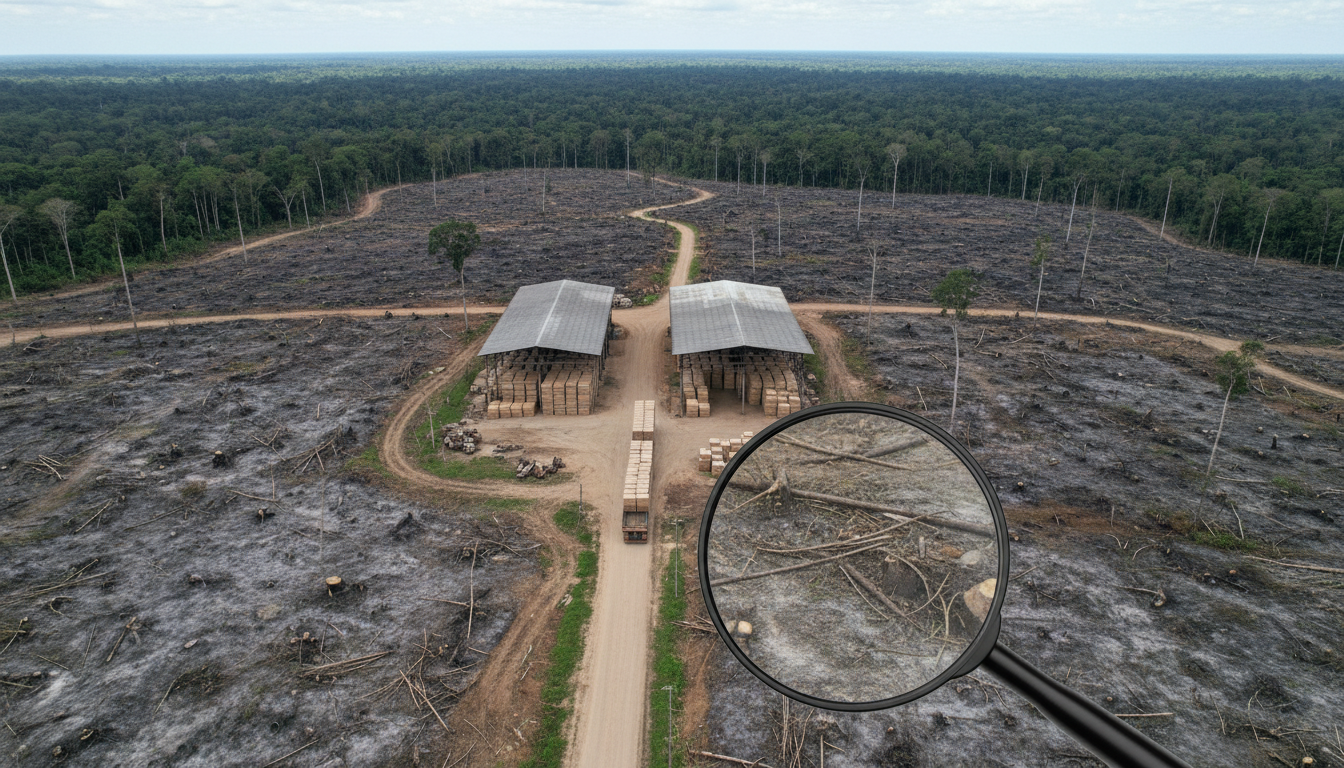
Indonesian rainforest deforestation linked to “carbon‑free” packaging supply chains
Investigation finds Indonesian rainforest deforestation supplying ‘carbon‑free’ packaging to Asia Symbol and Haleon-linked vendors, raising oversight concerns.
A joint investigation by global reporters has found that Indonesian rainforest areas — home to endangered orangutans — were cleared to create plantations supplying wood and pulp used in so-called “carbon‑free” packaging. The probe traces material from cleared forest tracts through processing plants to manufacturers that supply large international buyers, with the chain implicating a major pulp and paper firm and downstream customers. Indonesian rainforest deforestation is at the centre of renewed scrutiny over corporate sustainability claims and supply‑chain due diligence.
Investigative findings and supply‑chain trace
The reporting mapped how tens of thousands of forest trees were removed and converted into industrial plantations that subsequently fed mills producing pulp and paper. Investigators identified processing facilities that received timber originating from those converted tracts and then supplied product to larger manufacturers. Documents and supply records indicate multiple transfers along the chain, complicating efforts to isolate the source of raw material for finished packaging.
Evidence shows that wood from plantation sites — some established on land once classed as natural forest — passed through a mill before being sold to an established pulp and paper company that supplies packaging materials. The chain includes intermediaries that consolidate material from several providers, making origin verification more difficult. Investigators emphasised physical traceability gaps and the layered nature of transactions as central obstacles to transparent sourcing.
Companies named and their public commitments
The company supplying pulp and finished packaging has previously committed to a no‑deforestation policy and pledged not to use wood from converted natural forest. The investigation found, however, that pulp processed at a local mill — which later supplied the firm — included timber from plantations grown on land where forest had been cleared. The manufacturer in turn provided “carbon‑free” packaging used by multinational purchasers.
The downstream buyer named in the reporting is a large British consumer healthcare company whose products include widely recognised over‑the‑counter brands. That company says it sources packaging intended to meet decarbonisation goals and maintains supplier standards that prohibit conversion of natural forest. In response to the investigation, corporate statements emphasised ongoing efforts to strengthen supplier oversight while acknowledging the difficulty of verifying complex chains.
Legal permits and the question of legality
Investigators noted that the plantations supplying mills generally hold government permits authorising clearance and conversion, underscoring that the activity highlighted is not necessarily illegal under existing local regulations. Several analysts and conservation groups warned that legal sanction does not equate to sustainability, and that permitted conversions can nevertheless destroy critical wildlife habitat and undermine climate objectives.
Authorities in producing regions issue licences that allow forested land to be converted for industrial uses, including pulpwood plantations. Those licences create a legal supply channel that can be accessed by mills and processors. The presence of permits complicates calls for enforcement action, shifting the debate toward policy reform, tighter land‑use planning and improved corporate contracting practices.
Impact on orangutan habitat and biodiversity
Conservationists stressed that loss of old‑growth rainforest, even when replaced by managed plantations, severely degrades habitat for endangered species, notably orangutans that depend on intact canopy and diverse forest structure. The cleared areas recorded in the investigation overlap with regions known for high biodiversity value and long‑term conservation importance. Experts say plantation monocultures offer little of the food resources or structural complexity that native fauna require.
Researchers also pointed to the cumulative effect of repeated clearances and fragmentation, which reduces species’ ability to move, breed and adapt. Local communities and conservation groups have expressed alarm that permitted land conversion continues while global buyers market products as having low carbon footprints, prompting calls for more rigorous ecological risk assessments before approving plantation expansion.
Calls for stronger due diligence and transparency
Civil society organisations and some industry analysts urged buyers to demand full chain‑of‑custody information and to adopt stronger contractual protections against sourcing from recently converted forest. They recommended independent third‑party audits, satellite monitoring integrated with supplier contracts, and public disclosure of mill and plantation suppliers. Several NGOs called for corporate engagement with local authorities to ensure land‑use decisions are consistent with conservation and human‑rights safeguards.
Companies named in the investigation have said they are reviewing supplier lists and enhancing monitoring procedures. They highlighted the challenge posed by multi‑tiered supply routes and their reliance on intermediaries. Observers note that meaningful change will require coordinated action across manufacturers, financiers, regulators and civil society to close traceability gaps and align procurement practices with conservation goals.
Global buyers face reputational and operational risk if packaging marketed as “carbon‑free” or deforestation‑free is shown to contain material sourced from recently cleared rainforest. Investors and regulators are increasingly focused on whether sustainability commitments are backed by verifiable, auditable systems that can withstand independent scrutiny.
The investigation’s findings underscore the tension between legal land conversion in producing countries and international expectations for deforestation‑free commodities, and they have intensified calls for clearer rules, better transparency and immediate steps to protect remaining orangutan habitats.
