
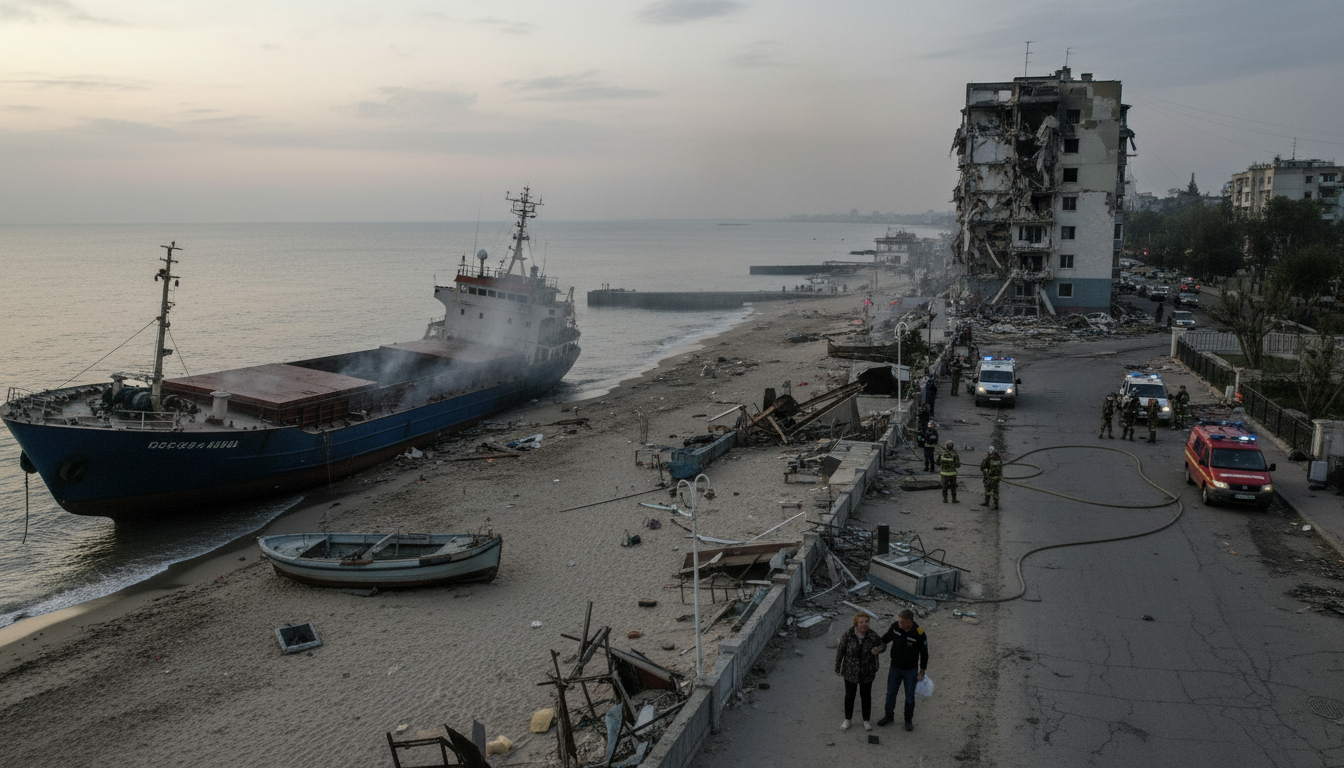
Odesa drone attack kills two elderly civilians and damages housing, merchant ship hit
Russia launched drone and missile strikes on Odesa on April 24, 2026, killing a married couple and damaging residential buildings while a merchant ship was struck. The Odesa drone attack also injured at least 13 people and set fires that emergency crews worked to extinguish. Ukrainian authorities reported hits in populated areas and damage to maritime traffic in the city’s wider port zone.
Casualties and residential destruction
A married couple, both aged 75, were killed in the strikes, Ukrainian emergency services confirmed, and another person was wounded in a separate incident. At least 13 people were treated for injuries after strikes that Ukrainian officials said struck residential buildings overnight.
Local authorities shared images of an apartment block engulfed in flames and a building with one side torn open, showing crews working inside to search for survivors and contain fires. Serhiy Lysak, head of the Odesa regional military administration, said municipal services and emergency teams had been working at multiple sites since the attack.
Impact on shipping: bulk carrier struck
Two Russian drones struck a bulk carrier transiting a Ukrainian maritime corridor toward a Black Sea port in the greater Odesa area, Ukraine’s seaports authority reported. The ship, flagged to Saint Kitts and Nevis, suffered a fire that the vessel’s crew were able to extinguish, and there were no reported injuries among those on board.
Authorities said the strike on a port-bound merchant ship underscores continued risks to commercial traffic in Ukrainian waters despite designated corridors for civilian shipping. Maritime officials warned that repeated incidents could affect insurance costs, reroute vessels and complicate grain and commodity exports from the region.
Scale of the aerial barrage
Ukraine’s Air Force said Russian forces launched two ballistic missiles and 107 drones in the overnight assault, and that air defences “destroyed or jammed” 96 of the drones. The service reported that 10 drones and the two ballistic missiles recorded hits on Ukrainian territory during the barrage.
Russia, meanwhile, said its own air defences intercepted 10 Ukrainian drones overnight, a claim reflecting the reciprocal exchanges that have characterised the conflict’s aerial dimension. Independent verification of every intercept and strike remains difficult amid the fog of ongoing hostilities.
Emergency response and rescue operations
State Emergency Service teams were deployed rapidly across hit neighbourhoods to extinguish fires, remove rubble and attend to victims, officials said. Rescue workers were seen operating amid smouldering debris and vessels of the regional seaports authority monitored coastal approaches for further threats.
Local officials emphasised the need for continued vigilance and coordination between municipal and national emergency services as aftershocks of the strikes persisted into the morning. Authorities also cautioned residents about unexploded ordnance and urged evacuation of heavily damaged buildings pending structural assessments.
Sanctions and European financial backing
The strikes occurred as the European Union imposed a new package of sanctions targeting elements of Russia’s energy, banking and trade sectors, aiming in part at vessels and networks used to evade export restrictions. Moscow’s mission to the EU criticised the measures, saying they lacked UN legitimacy and infringe the rights of third countries, according to Russian state outlets.
Separately, the EU formally approved a 90 billion-euro wartime loan for Ukraine intended to cover a sizeable portion of Kyiv’s funding needs for 2026 and 2027. European officials framed the loan as essential for sustaining public services and defence capabilities as the war enters its fifth calendar year.
Wider implications for maritime safety and reconstruction
The attack on a port-bound merchant ship adds to growing international concerns about safety in the Black Sea and the security of maritime corridors that have been used to move grain and goods. Shipping firms, insurers and ports will likely reassess routes and protective measures in response to the renewed strikes, which complicate efforts to stabilise trade flows.
At the same time, the EU loan and sanctions package reflect a two-pronged response: to limit Russia’s ability to finance the war while bolstering Ukraine’s capacity to operate despite attacks. Recovery in bombed neighbourhoods will depend on emergency relief, structural repairs and sustained financial support from international partners.
The Odesa drone attack and the broader overnight barrage reiterate the conflict’s continued toll on civilians and infrastructure, and they expose ongoing vulnerabilities in maritime and urban safety. Ukrainian officials have vowed to continue defensive operations and emergency relief as damage assessments and rescue work proceed.
