
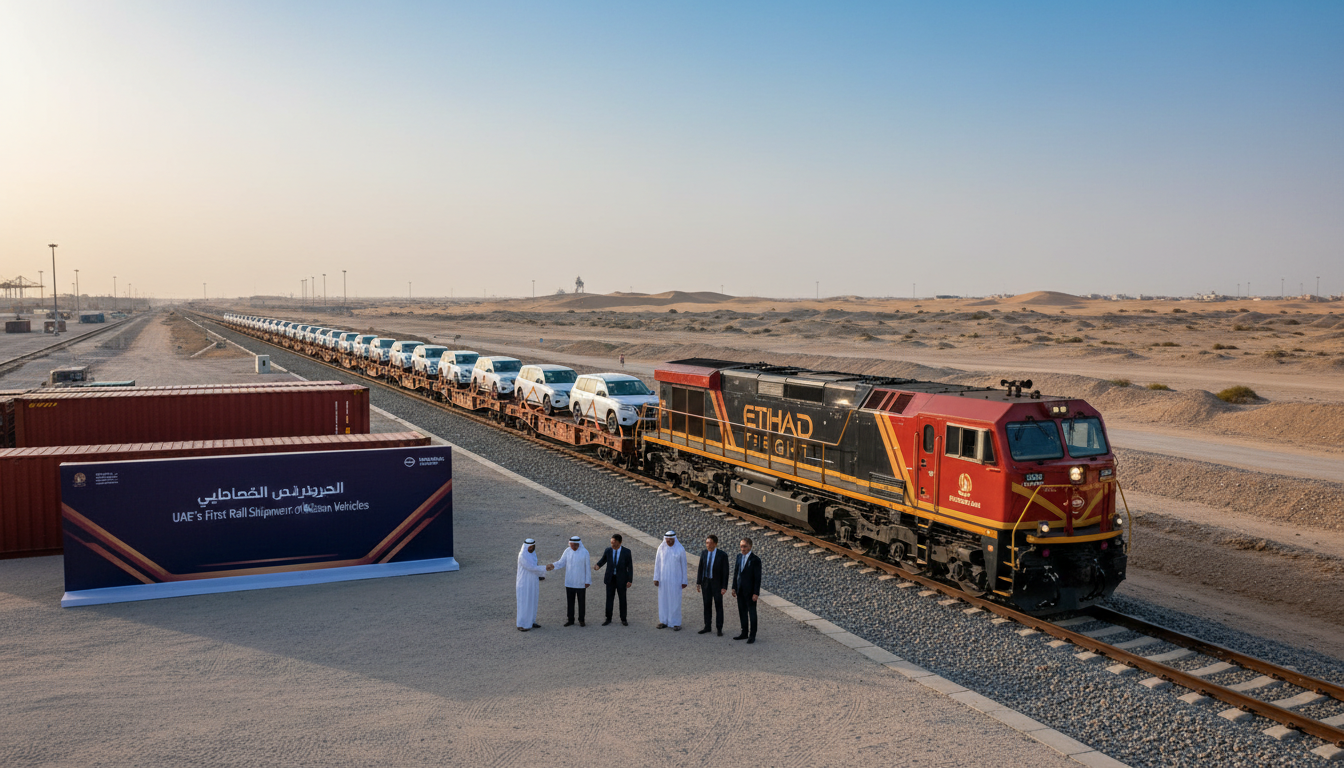
Al Masaood and Etihad Rail Freight complete UAE’s first rail freight shipment of Nissan vehicles
Al Masaood and Etihad Rail Freight completed the UAE’s first rail freight shipment of ready-to-drive Nissan vehicles, moving units from Fujairah ports to the ICAD dry port in Abu Dhabi. The rail freight operation marks a new logistics option for dealerships and aims to improve delivery accuracy and environmental performance.
Al Masaood and Etihad Rail Freight conduct inaugural shipment
Al Masaood Automotive partnered with Etihad Rail Freight to move a consignment of Nissan vehicles from east coast seaports to Abu Dhabi Industrial City. The operation is the first time a UAE car dealer has used the national rail network to transport fully built vehicles to a domestic destination.
The collaboration positions Al Masaood, the authorised distributor for Nissan, Infiniti and Renault in Abu Dhabi, Al Ain and Al Dhafra, as the first dealer to adopt rail freight for unit deliveries. Etihad Rail Freight provided door-to-dry-port carriage that integrated with existing port handling and inland logistics.
Route and handling from Fujairah ports to ICAD dry port
The shipment originated at the Fujairah ports on the country’s eastern seaboard and was routed by rail to the dry port at Abu Dhabi Industrial City (ICAD). Transport by rail replaced an equivalent road leg, enabling vehicles to be moved on a single-mode transit from port to final handling facility.
At the ICAD dry port, vehicles were received for final inspection and onward distribution to dealerships. The single-mode routing reduced transshipment steps and minimized handling exposure compared with multimodal transfers involving lengthy road segments.
Operational benefits: improved timing and scalability
Rail freight delivered more consistent transit times and tighter delivery windows for the consignment, addressing a key priority for automotive logistics. Dealers and fleet managers rely on predictable arrival schedules to coordinate inspections, registration and handover to customers.
The national rail network’s capacity also offers scalability as volumes grow, allowing more frequent unit movements without proportionate increases in road transport resources. Etihad Rail Freight said the service is designed to integrate smoothly into existing supply chains and to scale with demand.
Environmental implications and alignment with UAE Net Zero 2050
Shifting a portion of vehicle transport from road to rail reduces greenhouse gas emissions per tonne-kilometre, offering a lower-emission alternative for domestic freight. The move supports the UAE’s broader climate goals by cutting transport-sector emissions through modal shift and consolidated shipments.
Stakeholders framed the rail option as a practical step toward greener logistics that complements electrification and other efficiency measures. By lowering emissions in the vehicle supply chain, the initiative contributes to national efforts under the UAE Net Zero by 2050 strategy.
Industry response and potential uptake across auto logistics
Logistics professionals welcomed the demonstration of rail freight for finished vehicles as a template for other importers and dealers. The debut is expected to prompt evaluations across the automotive sector about when and where rail becomes the preferred inland transport mode.
Analysts noted that wider adoption will depend on network scheduling, cost competitiveness with road haulage, and the ability of ports and dry ports to handle rail-enabled vehicle transfers. If those elements align, rail freight could become a standard option for high-volume, regular routes.
Statements from company executives and next steps
Etihad Rail Freight executives highlighted the shipment as evidence of the rail network’s reliability and its role in national logistics resiliency. They described the operation as a scalable solution that integrates into existing supply chains and enables companies to reduce road mileage.
Al Masaood’s leadership said the move reflects a commitment to enhancing customer experience through operational improvements and closer coordination with national infrastructure. Both organisations indicated plans to explore additional rail-based shipments and to refine operational protocols based on lessons from this pilot.
The successful delivery underscores the UAE’s integrated infrastructure approach, where national transport assets and private-sector capabilities converge to improve efficiency. As more companies assess rail freight for finished vehicles and other high-value goods, the sector may see broader shifts in modal mix that benefit reliability and sustainability.
