
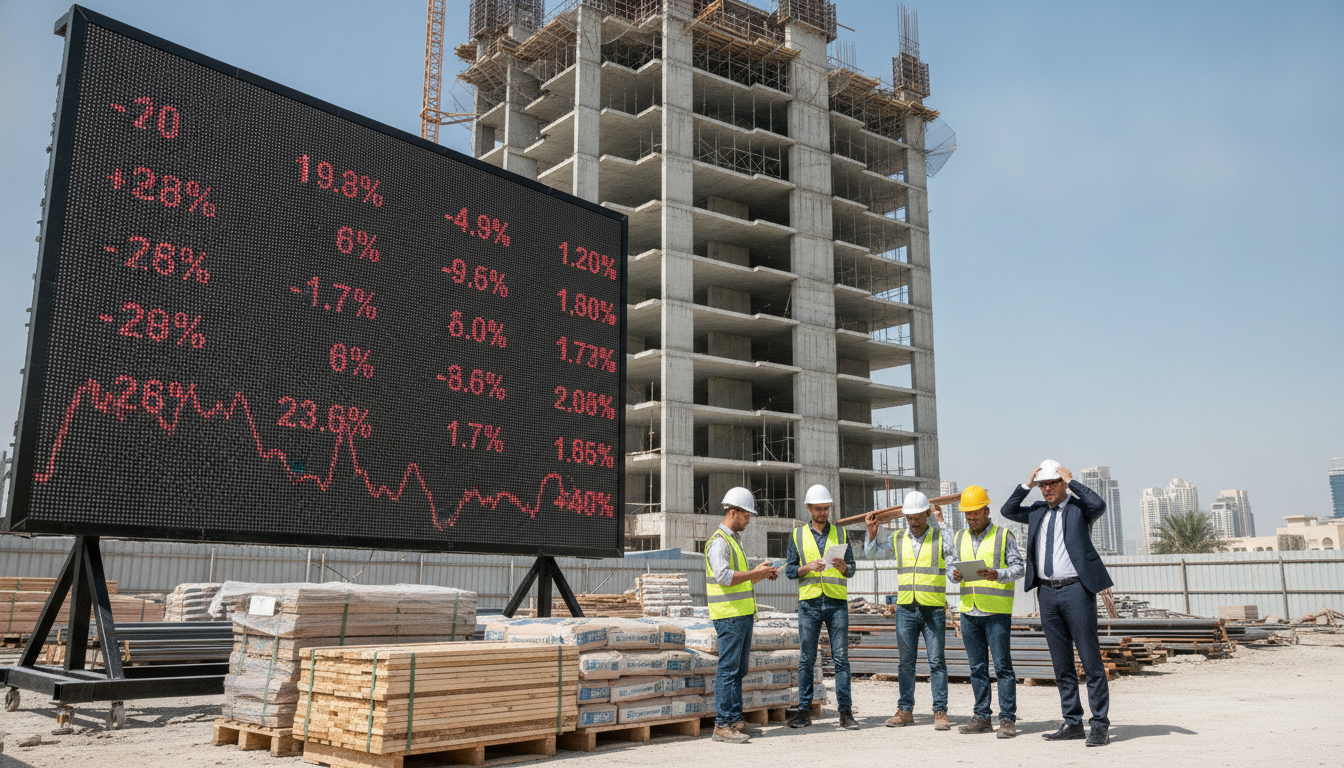
Construction material prices surge in UAE — rises of 21% to 143% recorded through June 2026
Survey finds UAE construction material prices climbed 21–143% through June 2026, raising project costs; contractors outline 12 practical measures to limit budget shocks.
Strong market-wide increases recorded in June 2026
A June 2026 survey by Emarat Al Youm of suppliers and retail outlets found construction material prices across the UAE rose sharply between 2025 and June 2026. The survey reported increases ranging from 21% to 143%, with services and auxiliary items among the hardest hit. These price movements are being attributed to regional tensions, disruptions around the Strait of Hormuz and global supply-chain pressures that accelerated after February 2026.
The survey covered a broad sample of dealers, logistics providers and hardware outlets and compared end-2025 price levels with those observed in June 2026. Contractors and project managers are now reassessing budgets and contract terms after seeing preliminary cost estimates outstripped by the recent inflation in inputs.
Highest spikes in equipment and site services
The largest relative increases were recorded in site services and equipment rentals rather than raw materials. The price of a construction pump rose around 143%, from a recorded minimum of 700 AED at the end of 2025 to approximately 1,700 AED in June 2026. Waste-collection truck fees jumped about 129%, moving from roughly 350 AED to 800 AED per load.
Other service-related costs climbed steeply: crane hire increased by around 125% and transport of steel rose by roughly 113%, underscoring how logistics and machinery availability have driven a disproportionate share of the cost shock. These service cost inflations amplified total project expenditures because they affect multiple phases of work simultaneously.
Steel, blocks and other core materials show notable rises
On the materials side, hollow concrete blocks (commonly used in partition and external walls) rose by about 71%, from 2.8 AED to 4.8 AED per unit. Reinforcing steel also posted significant increases: 8mm bars moved from about 2,240 AED/ton to 3,200 AED/ton, an increase near 43%, while 12mm and 16mm bars rose from roughly 2,150 AED/ton to about 3,000 AED/ton — a rise close to 40%.
These increases in core inputs have a direct effect on structural budgets, particularly in the early stages of construction where concrete and steel account for a large share of costs. Project estimators and owners face immediate pressure to revisit bill of quantities and contingency allocations to reflect the new price environment.
Contractor proposes 12 practical mitigation measures
Dar Al-Fursan Construction’s chief executive, Engineer Ahmed Niazi, outlined a 12-point program to limit the impact of rising construction material prices while preserving project quality. He emphasized the need for flexibility in project management and contract design, including the use of value engineering and substitution with locally available, equivalent materials.
Niazi recommended flexible contract clauses that establish clear mechanisms to share price fluctuations between owners and contractors, and suggested fixing prices for key strategic materials at project outset where feasible. He also advised phasing works to match cash-flow availability and prioritizing procurement timelines for materials most subject to volatility.
Guidance on whether to continue or delay projects
According to industry practitioners, continuing projects is generally preferable to delaying works, because protracted postponements can increase total cost and erode project timelines. Niazi noted that construction and property prices frequently trend upward over the long term, making delay an expensive choice in many circumstances.
However, he acknowledged scenarios where postponement may be prudent: insufficient liquidity, lack of stable financing, incomplete design documentation or the absence of a reputable contractor. In such cases, delaying formal start until these risks are mitigated can avoid the higher costs associated with mid-project stoppages and redesigns.
Priorities for quality and common cost-driving errors
Industry guidance stresses that cuts to budget lines should not compromise core structural quality. Niazi flagged the structural frame, concrete, steel reinforcement, waterproofing and mechanical-electrical works as items that must remain priorities, given the high cost and complexity of later remediation. Savings are more attainable in finishes and non-structural elements, which offer greater flexibility for phased upgrades or lower-cost alternatives.
Common errors that amplify costs include frequent design changes after works begin, awarding contracts solely on the lowest bid, and starting projects without detailed quantities and specifications. These practices lead to disputes, change orders and inefficiencies that can multiply the financial impact of market-driven price increases.
A combination of better upfront planning, continuous technical supervision and pragmatic design choices can deliver meaningful savings without degrading long-term performance.
Industry players say the current spike in construction material prices is testing conventional procurement and contracting models, while also accelerating interest in energy-efficient design and local-sourcing strategies that reduce exposure to international transport bottlenecks. Project owners, contractors and consultants are being urged to update risk matrices and adjust contingency funds to reflect the new market baseline.
