
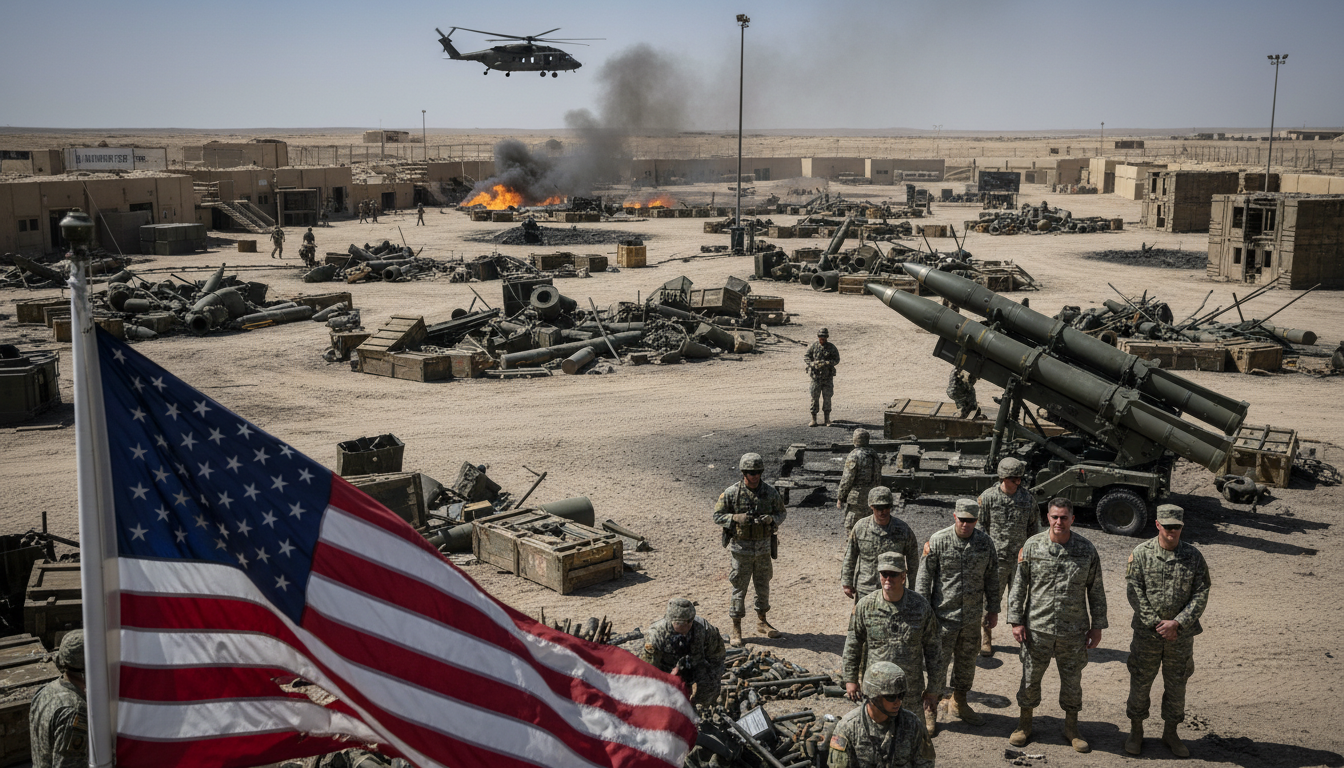
U.S. munitions stockpile severely depleted after intensive Iran war strikes
U.S. munitions stockpile has been heavily drawn down by months of high-rate missile and interceptor use in the Iran war, forcing rushed production and global redeployments.
The United States has sharply depleted its U.S. munitions stockpile after intensive strikes and air campaigns in the Iran war, according to internal Pentagon estimates and congressional officials. More than a thousand long-range cruise missiles and well over a thousand high-cost interceptors have been expended, leaving inventories at levels officials describe as worrisome for other potential contingencies. The rapid consumption has forced the military to shift weapons and systems from Asia and Europe to the Middle East and to press industry for fast production increases.
Stockpiles Drained by Intensive Missile Use
Since the conflict began in late February, U.S. forces have fired off large numbers of precision-guided weapons and interceptors that were designed for high-end combat. Internal estimates cited by lawmakers put JASSM-ER and Tomahawk cruise missile expenditures in the low thousands, while Patriot and other interceptor usage exceeded planned inventories. Analysts warn that these high rates of expenditure have brought some classes of munitions perilously close to historic lows.
High Cost of Interceptors and Cruise Missiles
The financial toll has compounded operational concerns: interceptors such as Patriot rounds carry multi‑million‑dollar price tags, and Tomahawk cruise missiles are similarly expensive. Independent studies and Pentagon briefings estimate that the early days of the campaign alone consumed billions of dollars in munitions, with total war costs so far running into the tens of billions. That price-per-shot calculus has renewed debate about reliance on expensive single-shot interceptors and long-range cruise missiles for massed operations.
Global Force Posture Shifts to Middle East
To sustain operations, the Pentagon has redirected ships, aircraft and air-defence systems from other theaters to the Middle East, officials say. Carrier strike groups and Marine expeditionary units were pulled from the Indo-Pacific, and Patriot and THAAD interceptors have been moved from bases in Asia, including South Korea. Those shifts have reduced presence and available deterrent capabilities in regions where the United States is also seeking to deter China and Russia.
Production Commitments and Funding Shortfalls
Defense leaders reached multi-year production agreements with major contractors this year to expand output of precision munitions and interceptors, but officials say funding shortfalls have delayed full implementation. Contractors agreed to invest in factory expansion in exchange for long-term orders, yet the Pentagon has not moved at scale to start the expanded runs without additional congressional appropriations. Lawmakers and defense officials warn that, at current production rates, rebuilding expended stocks could take years unless Congress approves emergency funds and lawmakers accelerate industrial capacity expansions.
Operational and Training Consequences in Europe and Asia
The munitions drawdown has reverberated through allied training and readiness plans, particularly in Europe and the Indo‑Pacific. Commanders have reported curtailed exercises, fewer available drones and constrained live-fire training because stocks are being prioritized for the urgent combat theater. Military leaders caution that sustained high operating tempos, equipment losses and the reallocation of critical systems undermine readiness for counter‑threat operations and reduce the margin commanders prefer to hold for deterrence.
Pentagon and White House Responses
Senior Pentagon and White House spokespeople have pushed back on some public estimates, saying the United States retains robust capability to defend homeland and forward forces. The White House called broader assertions about inadequate stocks “false,” while the Pentagon declined to discuss specific theater inventories on grounds of operational security. At the same time, senior lawmakers from both parties have increased pressure for funding to replenish stocks and to accelerate production of lower‑cost options, including attack drones and cheaper interceptors.
The conflict has also produced unexpected equipment losses and replacement costs beyond munitions, with several aircraft destroyed or damaged during operations and special missions. Analysts from think tanks such as the Center for Strategic and International Studies and the American Enterprise Institute have produced differing cost estimates, but both underscore the scale of expenditure and the strain on industrial supply chains. Experts emphasize the need for a mix of procurement strategies: rapidly scalable, lower-cost systems for sustained combat and retention of more advanced, higher-cost systems for specific missions.
Rebuilding the U.S. munitions stockpile will require policy choices about where to accept reduced capacity while industry ramps up, and how to prioritise funds and manufacturing capacity for the most critical ordnance. Lawmakers face decisions on emergency appropriations and on incentives to accelerate production lines, while military leaders balance ongoing operations against the imperative to preserve deterrence elsewhere. The outcome of those choices will shape U.S. readiness and posture in multiple theaters for years to come.
