
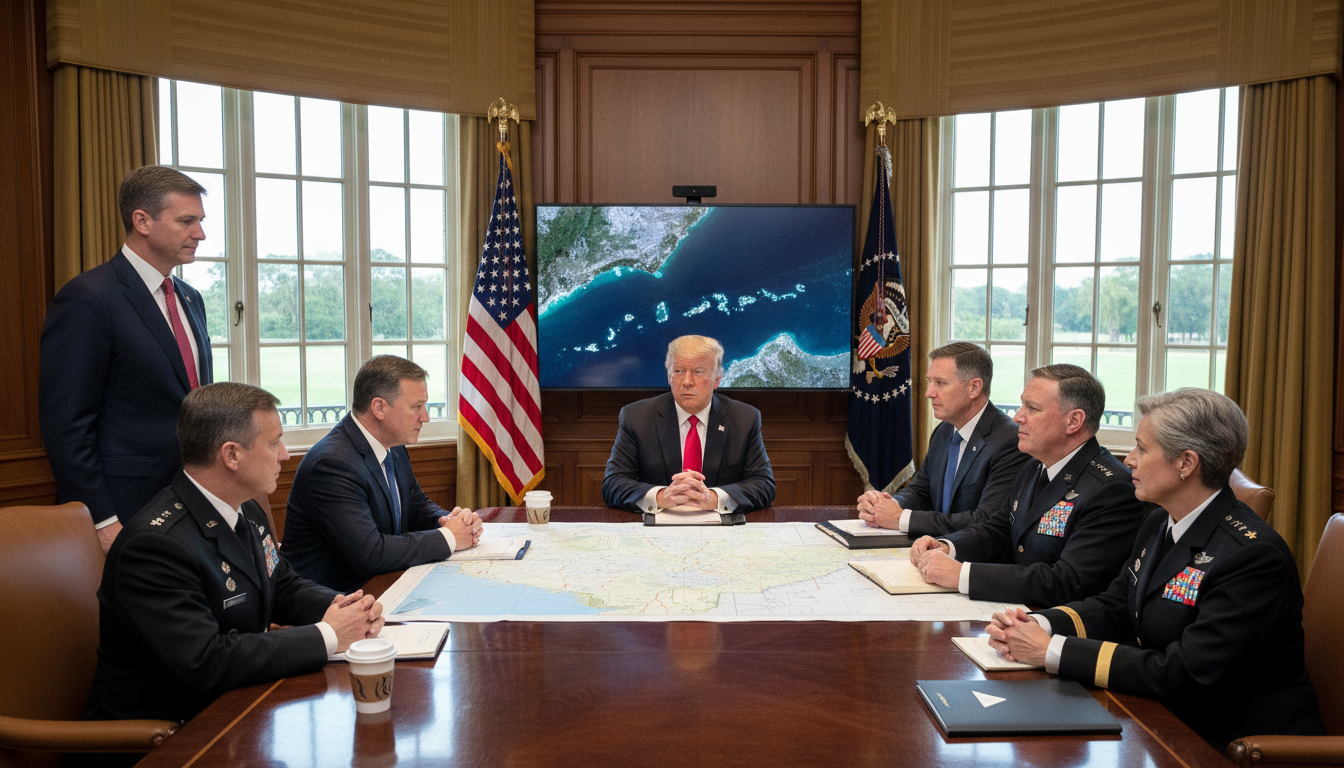
Trump convenes national security team to consider Iran offer to reopen the Strait of Hormuz
Trump meets national security advisers to discuss Iran’s proposal to reopen the Strait of Hormuz in return for eased US maritime pressure, White House says.
President Donald Trump on Monday held a meeting with his top national security advisers to review an Iranian proposal reportedly aimed at reopening the Strait of Hormuz in exchange for the United States easing its maritime pressure. The proposal, which officials say would link renewed shipping through the vital waterway to concessions on U.S. economic and naval measures, is said to be under active discussion inside the White House.
White House confirms proposal is being examined
A White House spokeswoman, Caroline Leavitt, told reporters the Iranian idea was “under discussion” after news reports first described the plan as tied to lifting aspects of the U.S. blockade on Iranian ports. She confirmed President Trump met with his national security team on Monday to evaluate options but declined to say whether the administration would accept the terms as presented.
Leavitt reiterated that the president’s red lines on Iran have been clearly communicated to both domestic audiences and foreign interlocutors. Officials described the session as part of a broader review of diplomatic and military options amid stalled talks and mounting regional tensions.
Lawmakers voice skepticism about conditional reopening
Senator Marco Rubio, speaking on Fox News, criticized the notion that the Strait of Hormuz could be considered “open” only if Iran controls access or charges fees for passage. Rubio argued such a condition would amount to normalizing a system in which Tehran dictates who may use an international waterway and on what terms.
He said the U.S. could not accept a framework that effectively makes Iranian approval a prerequisite for navigation through the strait, which handles a significant share of global oil and liquefied natural gas shipments. Rubio also warned that the United States retains the capacity to increase sanctions and pressure on Tehran if negotiations fail to produce a meaningful outcome.
Negotiations in Islamabad fail to revive cease-fire talks
Efforts to restart diplomatic talks earlier in April in Islamabad did not yield a breakthrough, according to multiple accounts. Delegations convened in Pakistan’s capital to pursue a cease-fire and the resumption of maritime traffic, but those meetings failed to produce a definitive agreement to end hostilities.
U.S. officials quoted by media outlets said the administration is increasingly confident that its maritime containment measures are affecting Iranian port operations, even as negotiators question whether current Iranian representatives have the mandate to strike binding deals.
Media reports outline contours of Iran’s proposal
Reporting from outlets including Axios suggested Tehran’s concept would prioritize immediate reopening of the Strait of Hormuz as a first step, with more complex issues such as the nuclear file to be negotiated at a later stage. The proposal reportedly frames de-escalation in stages, beginning with freedom of navigation guarantees.
U.S. officials, however, have flagged that the terms Tehran has floated so far fall short of Washington’s established demands. The administration has stressed that any reopening must reflect unfettered international access, not arrangements that leave Iran able to impose conditions or extract payments.
Russia offers to assist in peace efforts amid regional diplomacy
In a related diplomatic development, Russian President Vladimir Putin told Iran’s Deputy Foreign Minister Abbas Araghchi on Monday in St. Petersburg that Moscow would do everything possible to help restore peace in the Middle East. Araghchi, who arrived in Russia after the stalled Islamabad talks, placed some responsibility for the failed negotiations on the United States, according to Iranian statements.
Moscow’s offer to mediate or assist underscores the widening diplomatic footprint around the crisis, with regional and global powers positioning themselves in response to both the military standoff and the complex bargaining over sanctions and maritime access.
Final paragraph without a section title
The unfolding discussions over the Strait of Hormuz highlight the strategic, economic and diplomatic stakes for Gulf states and global energy markets. As Washington weighs whether to accept or reject Iran’s terms, officials say they are balancing immediate humanitarian and commercial imperatives against longer-term security and non-proliferation objectives.
