
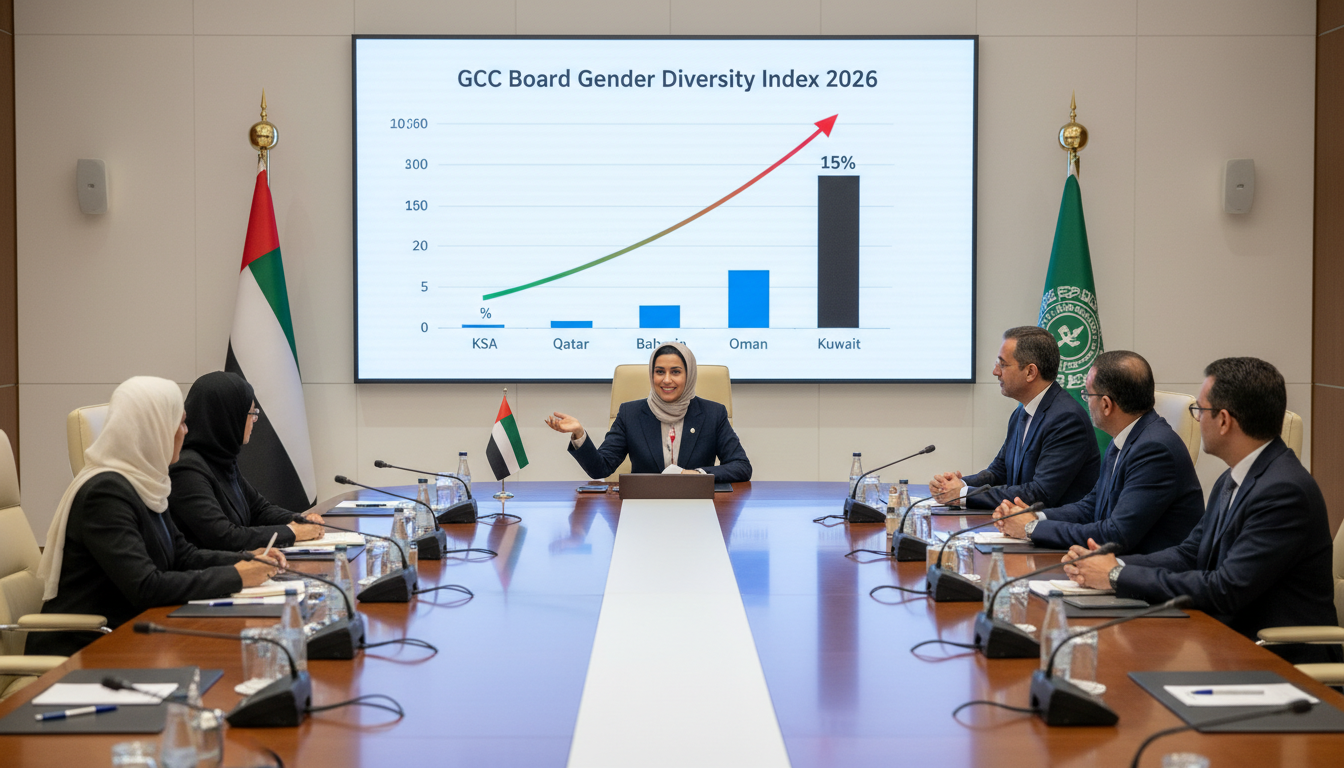
Women on GCC boards reach 7% in 2026 as UAE leads with 15%, Heriot‑Watt Dubai and Aurora50 index finds
New 2026 Gender Diversity Index shows women occupy 7% of GCC board seats, with UAE at 15% and 759 listed firms studied by Heriot‑Watt Dubai and Aurora50.
The latest Gender Diversity Index for GCC boards, published by Heriot‑Watt University Dubai in partnership with Aurora50, shows women on GCC boards now occupy 7% of all listed board seats across the region. The report, the third annual edition, analyzes 759 publicly listed companies and finds steady year‑on‑year progress driven largely by growth in the UAE and Bahrain. The index highlights both the advances made and the scale of work remaining to bring gender balance to boardrooms across the Gulf.
Index shows modest regional growth to 7% in 2026
The 2026 index records a rise from 6.9% in 2025 to 7.0% this year, representing a 1.4% annual increase in female board membership across the GCC. Total board seats in the sample increased from 5,668 to 5,755, a 1.5% expansion that coincided with a small but measurable uptick in the number of women serving. The report frames this as sustained momentum rather than rapid transformation, noting incremental gains across multiple markets and sectors.
UAE and Bahrain lead national rankings, Saudi Arabia records lowest share
Country breakdowns in the study place the United Arab Emirates at the top of the regional rankings, where women now hold 15.0% of board seats (191 of 1,274). Bahrain follows with 10.5% (36 of 342), while Oman records 7.0% (51 of 731). Kuwait, Qatar and Saudi Arabia trail with 5.6% (52 of 927), 3.2% (15 of 467) and 2.9% (58 of 2,014) respectively. The data underline marked differences in pace and scale across Gulf markets, with several jurisdictions still early in their board diversity trajectories.
Women’s presence across sectors highlights financial leadership
Sectoral analysis across 12 industry groups identifies the financial sector as the largest employer of women directors region‑wide, followed by the industrial sector. The UAE and Saudi Arabia are the only two countries in the sample where women hold board positions in every one of the 12 sectors examined. Within the UAE, the top three sectors for female board seats are financial services (86 of 564 seats), industrial (35 of 214) and consumer staples (15 of 94), demonstrating a concentration of female representation in finance and industry.
Headcount and board seat dynamics show broader participation
The 2026 index finds 341 women occupying 403 board seats, up from 334 women holding 390 seats in 2025, reflecting a 2.1% increase in female directors and a 3.3% rise in seats filled by women. The gap between the number of women and the number of seats indicates that some women serve on multiple boards, a sign of both growing demand for experienced female directors and a limited pool of candidates at senior governance levels. The report also notes that the overall expansion in total board seats provides opportunities to appoint new directors if companies prioritise diversity in their succession planning.
Institutional commentary urges continued acceleration of change
Aurora50 chair Sheikha Shamma bint Sultan bin Khalifa Al Nahyan described the index as a “trusted regional benchmark” and highlighted the UAE’s improvement from 3.5% in 2020 to 15% in 2026 as evidence of national leadership on the issue. Heriot‑Watt Dubai’s dean, Professor Heather MacGregor, said the index has become an essential reference for tracking change in GCC boardrooms and stressed the importance of sustaining and widening progress. Both organisations called for companies, regulators and investors to intensify efforts to broaden the pipeline of female leadership and accelerate appointments at board level.
Gender diversity advocates quoted in the report argue that greater female participation strengthens governance, brings broader perspectives to strategic decision‑making and improves institutional resilience. The authors recommend targeted measures such as board succession frameworks, transparency in nomination practices, leadership development programmes for women and investor engagement to incentivise appointments.
Women on GCC boards now occupy a modest but growing share of boardrooms, with the UAE and Bahrain demonstrating faster adoption while other markets lag. The 2026 index provides a clearer regional picture with expanded coverage and reinforces that sustained policy attention, corporate commitment and talent development are needed to move beyond incremental gains. Continued monitoring, combined with practical measures to widen the director pool, will determine whether the current momentum translates into meaningful parity over the coming decade.
