
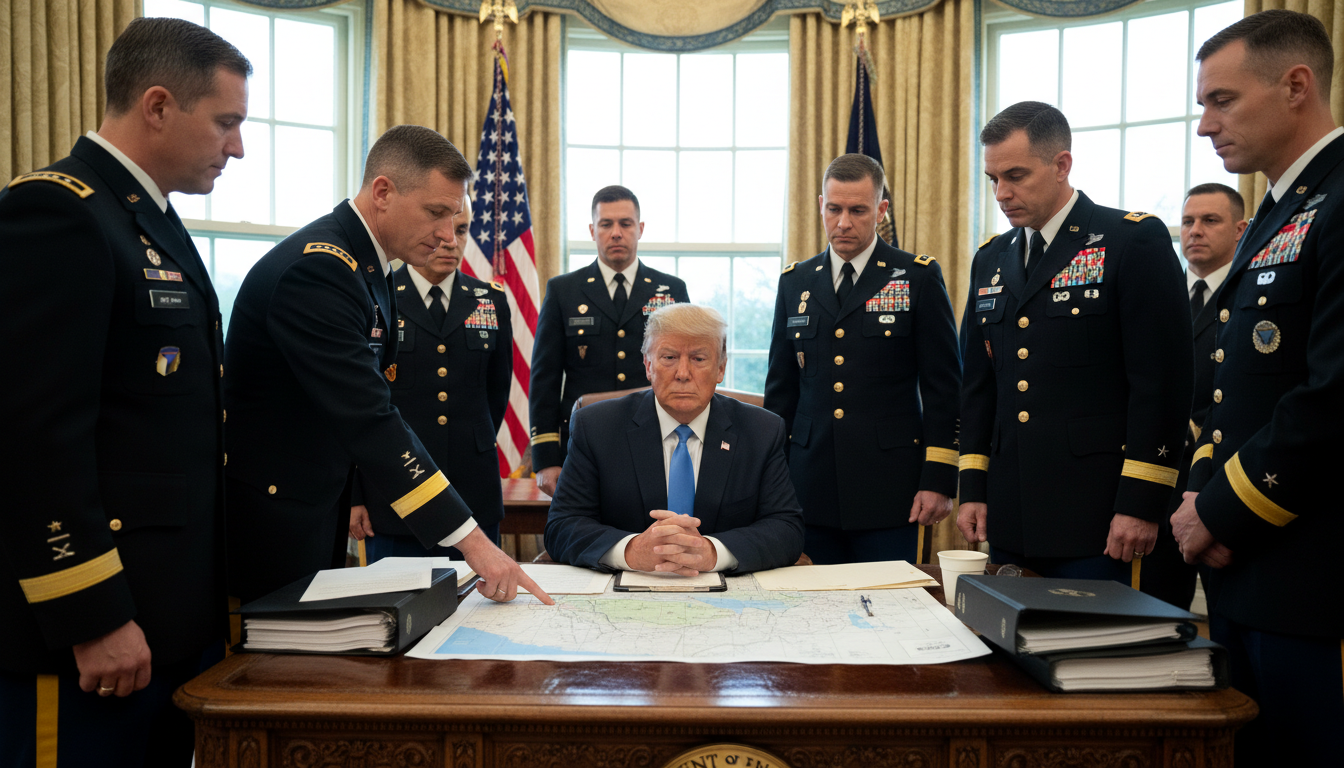
U.S. Military Leaders to Brief President on Possible Military Action Against Iran
Senior U.S. commanders will brief President Trump today on possible military action against Iran, focusing on options to pressure Tehran into negotiations, Reuters reports.
A senior U.S. official said on Thursday that top American military leaders, including the commander of U.S. Central Command, Brad Cooper, will provide a briefing to President Donald Trump later in the day on possible military action against Iran.
The official said Defense Secretary Pete Hegseth and Joint Chiefs Chairman Dan Kien will also participate in the session.
The official did not detail the scope of options to be discussed, but said the briefing will concentrate on steps designed to compel Iran to enter negotiations to end current hostilities.
Senior Officers Named for Presidential Briefing
The notice identified the CENTCOM commander Brad Cooper among the officers due to appear before the president.
Defense Secretary Pete Hegseth and Joint Chiefs Chairman Dan Kien were listed by the official as additional participants in the closed briefing.
The official account, provided to reporters and summarized by Reuters, did not specify whether other regional commanders or civilian national security advisers would attend.
Focus on Forcing Iran into Negotiations
Officials said the purpose of the meeting will be to present options aimed at pressing Iran toward talks rather than to announce imminent action.
According to the official, the deliberations will center on measures that could change Tehran’s calculus and create leverage for negotiation.
Those presenting options are expected to discuss a range of military and non-military tools, though no specific measures were disclosed at the time of the briefing notification.
No Details Released on Operational Options
The U.S. official explicitly declined to outline the range or scale of any potential strikes or escalation plans.
That silence leaves open whether the discussion will include limited strikes, broader campaigns, or contingency plans focused on deterrence and escalation control.
Analysts cautioned that public reporting of a briefing does not necessarily indicate an imminent decision to employ force.
Regional and Diplomatic Implications
A high-level U.S. briefing on military options is likely to reverberate across the Gulf region, where governments closely monitor any signs of escalation.
Neighboring states and allied capitals typically assess potential fallout for commercial shipping, energy markets, and local military posture.
Diplomatic channels may be activated in parallel as officials weigh the risks of kinetic steps against the prospects for renewed negotiation.
U.S. Framing and Strategic Objectives
The administration’s stated aim, as conveyed by the official, is to create conditions that bring Iran to the negotiating table.
Framing the meeting around negotiation leverage signals a preference for pressure that leads to diplomacy rather than open-ended conflict.
Still, decisions about the use of force would rest on assessments of credibility, proportionality, and the risks of unintended escalation.
Possible Timetable and Next Steps
The briefing to President Trump is scheduled for later Thursday, according to the official, after which further public statements may or may not be issued.
If the president requests follow-up work, the military and civilian agencies would likely be tasked to refine options, legal authorities and potential rules of engagement.
Any movement toward implementation would typically be accompanied by careful messaging to allies and operational security measures.
Reporting by Reuters provided the basis for the official account of the planned briefing, with U.S. officials declining to provide more detailed disclosure at the time.
The coming hours could clarify whether the session results in new directives, additional planning, or a decision to pursue intensified diplomatic engagement instead.
