
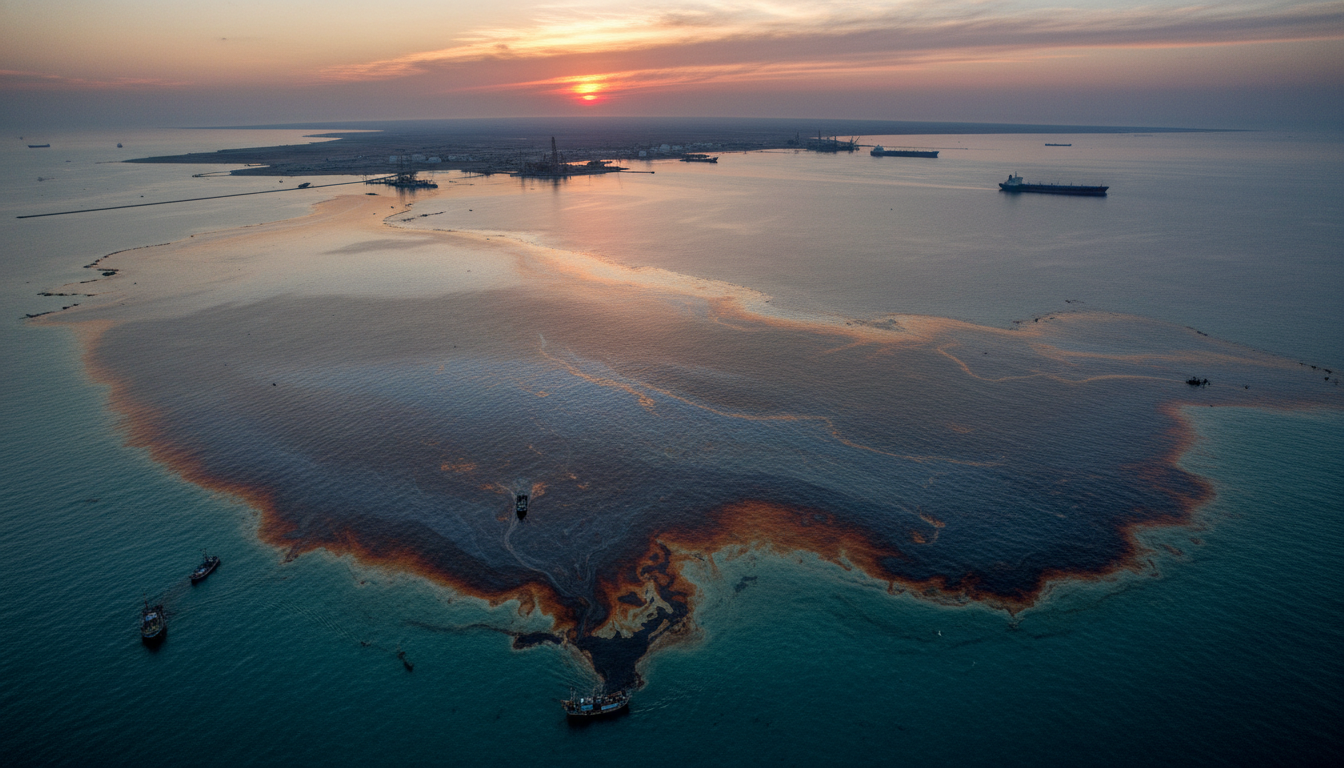
Large oil spill spreads off Kharg Island, satellite images show
Satellite images show a large oil spill spreading off Kharg Island in the Persian Gulf, raising urgent environmental and shipping concerns as oil drifts south. Now.
Immediate situation and satellite findings
A large oil slick has been detected off the western coast of Kharg Island, Iran’s main crude export terminal, according to satellite analysis. Monitoring firm Orbital EOS estimated the slick covered more than 20 square miles and that over 3,000 barrels of oil may have been released. The imagery shows a dark surface sheen extending from the island’s offshore facilities and drifting in a southerly direction toward neighbouring waters.
Officials in Tehran have not publicly confirmed the spill and state media had not reported details when monitoring firms released the satellite images. The lack of an official statement has left international observers and regional authorities relying on remote sensing and independent analysts for the earliest assessments.
Infrastructure strain and possible causes
Analysts point to multiple stressors that may have contributed to the incident, including years of underinvestment in ageing facilities and recent operational pressures. Iran’s oil network has been coping with constrained export routes after sustained U.S. naval measures affecting traffic through the Strait of Hormuz, and sources say tankers have been used as ad hoc storage while onshore tanks reach capacity.
Experts have also raised the prospect of damage from prior attacks on vessels and platforms in the Gulf, and the possibility of a rupture in an undersea pipeline connecting Kharg Island to nearby fields. Independent observers note that the pipeline system serving the hub is decades old and has experienced leaks in recent years, increasing the risk of further breaches.
Storage, tankers and the risk of deliberate discharge
With export lines disrupted and storage scarce, large volumes of crude have reportedly been kept afloat on tankers, a practice that increases the risk of accidental or deliberate releases. Some commentators have speculated that intentional discharges could occur when shippers have no available facilities to offload product, though there is no direct evidence to support that in this case.
Energy sector analysts caution that shutting wells or pipelines incorrectly can itself cause damage that makes later repairs more costly and complicated. Stopping production quickly is technically challenging and, if done improperly, can clog infrastructure or harm the reservoir, complicating attempts to resume normal operations.
Environmental exposure and regional vulnerability
Marine scientists warn that even a spill initially contained at sea can become a wider environmental crisis in the relatively shallow and sensitive waters of the Persian Gulf. The region’s high salinity and temperature, together with extensive coastal development, make recovery slower and ecological impacts potentially severe.
Authorities are particularly concerned about threats to mangroves, coral communities, seabirds, turtles and fisheries, as oil can settle into sediments and shorelines and smother critical habitats. The presence of desalination plants and coastal population centres along Gulf coastlines raises additional public health and water-supply challenges if oil contaminates intakes or beaches.
Trajectory, regional implications and response gaps
Current imagery and drift models indicate the slick moving southward, which could bring contamination toward Saudi Arabian waters if not contained. That prospect underscores the transboundary nature of the risk and the need for rapid regional coordination among Gulf states for monitoring and response.
So far there has been no publicly announced joint containment operation, and it is unclear which domestic or international agencies are engaged in clean-up efforts near Kharg Island. The absence of an immediate, transparent response increases the danger that a manageable release could spread and affect a broader swath of coastal ecosystems and infrastructure.
Energy security and longer-term consequences
The incident highlights broader vulnerabilities in Gulf energy infrastructure at a time when the Strait of Hormuz remains a critical chokepoint for global seaborne oil movements. Between 20 and 25 percent of the world’s exported oil typically transits the Strait, and disruptions can ripple through regional supply chains and global markets.
Beyond short-term containment and recovery, the spill amplifies questions about maintenance, investment and risk management across older facilities in the region. Policymakers will face difficult trade-offs between sustaining export capacity and repairing or replacing fragile infrastructure that has been exposed to sanctions, conflict and limited modernization.
As authorities and independent monitors continue to assess satellite data and on-the-ground reports, the immediate priorities are containment, damage assessment and protection of coastal communities and ecological hotspots. Prompt, coordinated action will be essential to limit environmental harm and to clarify the cause of the release so that similar incidents can be prevented in the future.
