
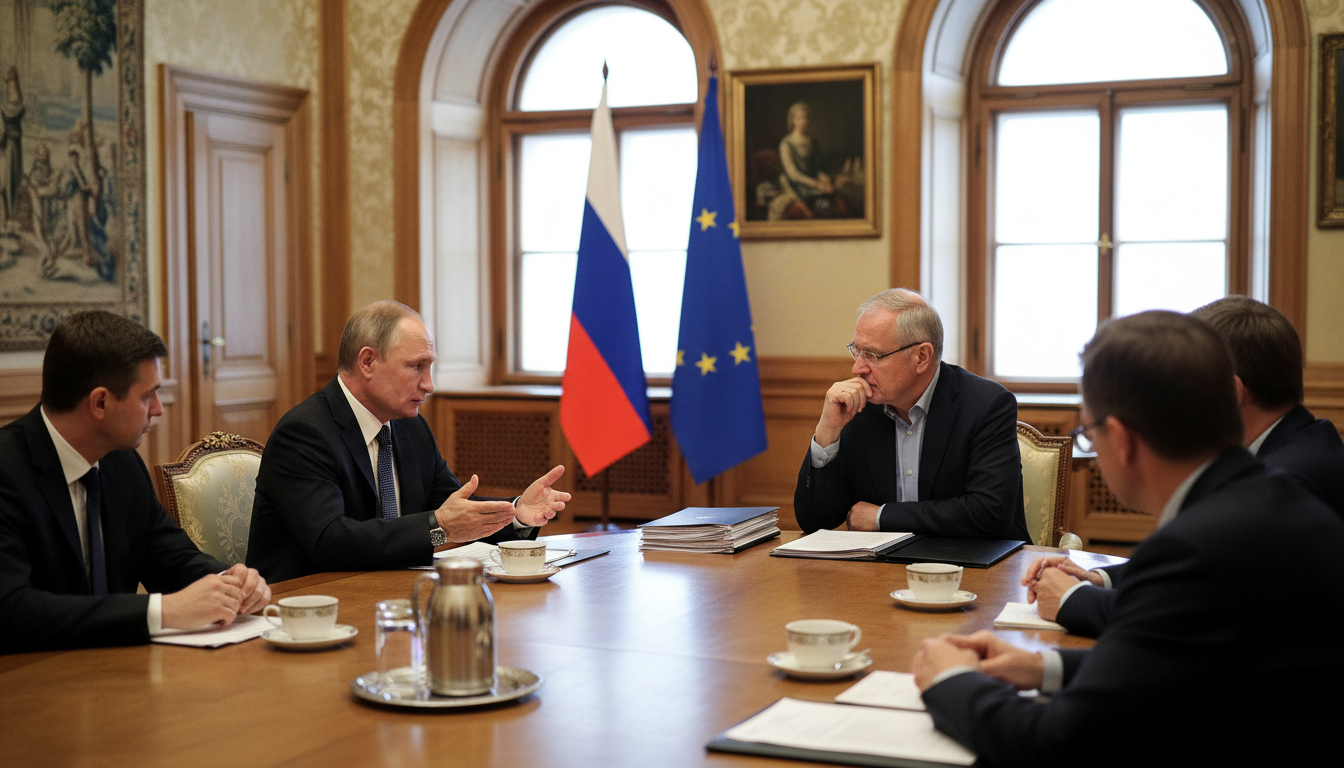
Putin Proposes Gerhard Schröder as European Mediator to Help End Ukraine War
Putin suggests Gerhard Schröder as a European mediator to help end the Ukraine war; Schröder’s office declined to comment after the May 9, 2026 press conference.
Russian President Vladimir Putin on May 9, 2026, publicly proposed former German chancellor Gerhard Schröder as a possible European mediator in efforts to end the war in Ukraine. Putin made the suggestion at an extraordinary press conference following Victory Day celebrations in Moscow and said he favored talks with Schröder above other European politicians. Schröder’s office told the German Press Agency it would not comment when asked about Putin’s remarks. The proposal adds a controversial but high-profile name to the list of potential interlocutors in a conflict that has reshaped security across Europe.
Putin’s May 9 remarks and the mediator suggestion
On May 9, 2026, Putin told reporters that “among all European politicians, I prefer talks with Schröder,” and he indicated he believed the conflict was moving toward an end. He also said a peaceful resolution ultimately rests with Ukraine and Russia, adding that Moscow would welcome outside assistance if it were offered. Those comments came during a wide-ranging briefing held immediately after the Kremlin’s Victory Day events, which marked the anniversary of the end of World War II in Europe. Putin’s public endorsement elevates Schröder’s profile once more in any diplomatic calculus around Ukraine.
Schröder’s office response and his public standing
When the German Press Agency sought a reaction, Schröder’s office responded that the former chancellor would not comment on Putin’s proposal. Schröder, 82, served as Germany’s chancellor from 1998 to 2005 and has remained a contentious figure in German public life. His longstanding personal and business ties to Moscow have drawn criticism domestically, complicating how German officials and the public view any role he might play in negotiations. For now, there is no indication that Schröder has accepted or been asked to pursue mediation.
Background on Schröder’s ties to Russia and energy sector roles
Schröder’s post-chancellorship years included high-profile involvement with Russian energy enterprises and frequent public interactions with President Putin, relationships that many critics say have clouded his impartiality. He has been associated with advisory and supervisory roles linked to major Russian energy projects, a history that has drawn scrutiny and political backlash in Germany and among NATO partners. Those connections are likely to be central to debates about whether he could function as an acceptable mediator for Kyiv. Any mediation candidacy will have to confront perceptions of bias tied to these past affiliations.
Diplomatic and political implications for Germany and the EU
Putin’s suggestion places Berlin in a delicate position, balancing the legacy of a former chancellor with current German and European policy toward Moscow. German leaders have repeatedly emphasized solidarity with Ukraine while maintaining carefully calibrated diplomatic channels, and a Schröder-mediated initiative could complicate that stance. European Union and NATO partners will assess both the optics and substance of any mediation involving figures linked to Russian state interests. Policymakers in Berlin may now face renewed pressure to clarify whether they view Schröder’s potential involvement as constructive or counterproductive.
Practical hurdles to mediation and Ukrainian consent
Effective mediation requires the consent and confidence of both parties, practical logistical arrangements, and credible guarantees, none of which are assured by a single presidential suggestion. Putin told reporters that a peaceful solution is the responsibility of Russia and Ukraine, and he added that Moscow would appreciate help if it is offered, but he did not outline a mechanism for how Schröder would be engaged. Kyiv’s response will be decisive in determining whether any mediation effort can proceed, and Ukrainian officials have previously expressed skepticism about intermediaries perceived as close to Moscow. Sanctions, battlefield conditions and legal questions surrounding negotiations further complicate the path to talks.
Next steps and what to watch in coming days
There is no public sign that formal talks with Schröder are being arranged, and his office’s refusal to comment leaves the proposal at the level of a Kremlin suggestion. Observers will watch for any outreach from German authorities, reactions from Kyiv, and statements from EU and NATO capitals that could indicate whether the idea has traction. International diplomatic channels, including back-channel communications, may move more quietly than public statements, but any tangible advance would require clear mandates and transparency to gain broader acceptance. For now, the announcement adds a new element to discussions about how the conflict might be brought to a close.
The inclusion of Gerhard Schröder’s name in Putin’s public remarks underlines both the search for interlocutors and the political sensitivities surrounding potential mediators in the Ukraine war.
