
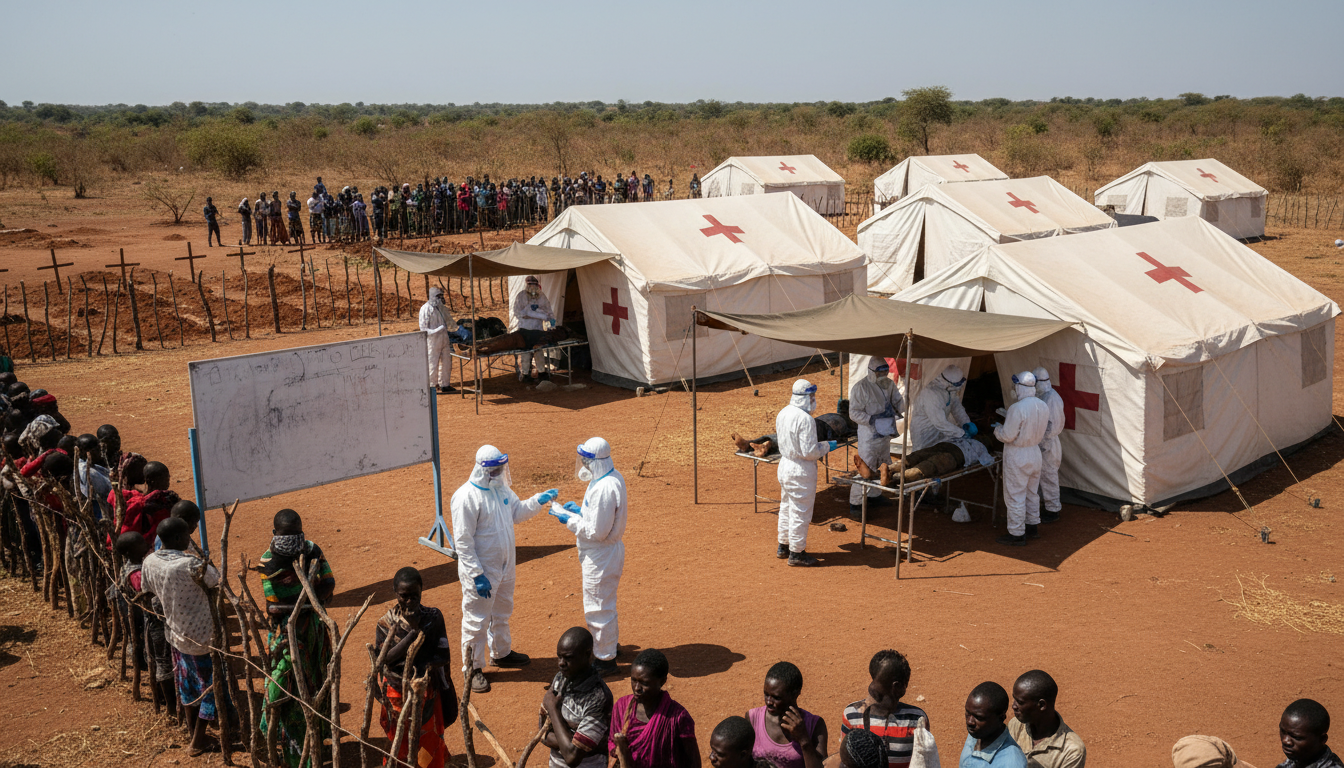
Ebola Bundibugyo outbreak in Ituri exposes surveillance gaps as deaths mount
Ebola Bundibugyo outbreak in DR Congo’s Ituri shows delayed detection, rising deaths and cross-border spread; WHO and regional authorities rush to contain it.
The Ebola Bundibugyo outbreak in Ituri province has exposed critical delays in detection and testing that allowed the virus to spread for weeks before authorities confirmed its presence. Local and international health agencies now report hundreds of suspected cases and a mounting death toll as teams scramble to trace contacts and secure laboratories. The World Health Organization has declared the situation a global health emergency, prompting neighbouring states to tighten border checks and screening.
Delayed reporting and detection failures
A combination of late alerts, limited local testing and misattribution of early cases contributed to a weeks-long detection gap that public health officials now say was decisive. Health workers in remote areas did not immediately recognise the pattern of hemorrhagic symptoms as Ebola, and samples were not sent rapidly to central laboratories for confirmatory testing. The result, according to investigators, was precious time lost while the virus circulated among communities and at funerals.
Local surveillance systems in the Democratic Republic of Congo have been strengthened after previous outbreaks, but officials acknowledge that those systems failed to flag this cluster early enough. Political absenteeism and mistrust between communities and authorities also undermined reporting, with some local leaders failing to raise alarms despite deaths in their constituencies. The consequence has been a broader and faster spread than would be expected with prompt detection.
Laboratory limitations and species identification
Initial field laboratories in Ituri were equipped to detect the Zaire species of Ebola, the most common strain in the region, which led to repeated negative results and a false sense of security. Only when samples were forwarded to Kinshasa did national experts identify Ebola Bundibugyo, a rarer species for which there are currently no licensed vaccines or widely available treatments. Technical delays and occasional sample contamination further hampered timely confirmation.
Laboratory specialists noted that some tests in the field had been designed for other Ebola species, producing misleading negatives that delayed the alarm. When more sensitive assays were applied at national reference centres, results confirmed the presence of Bundibugyo, prompting a rapid escalation of the public health response. That late identification has complicated clinical care and messaging to communities.
Human toll and geographic spread
Authorities report more than a hundred suspected deaths in Ituri alone, with suspected and confirmed cases emerging in other parts of eastern Congo and in neighbouring Uganda. An American doctor working in the region has been confirmed among the infected, underscoring the risk to frontline health staff. Health officials warn that the mortality rate for Ebola Bundibugyo can reach roughly half of those infected, making the outbreak particularly worrying.
Cases have been identified in towns and cities more than 200 miles apart, and recent reports indicate suspected infections in Goma and Kampala, signalling cross-border movement. The virus’s presence near major transit routes and in areas hosting displaced populations has increased the challenge of isolating cases and preventing further transmission.
Access constraints in mining areas and security challenges
The epidemic’s epicentre around Mongwalu, a gold-mining town, presents acute operational difficulties for response teams. The rainy season has rendered roads nearly impassable in places, and the presence of armed groups has restricted safe access for medical personnel and laboratory teams. These conditions have limited outreach and contact tracing efforts and made it harder to enforce safe burial practices.
Mining communities and migrant labourers move frequently and gather in informal settings, complicating efforts to map chains of transmission. Health workers reported that bodies were sometimes transported between communities for funerary rites without proper infection control, increasing the risk of onward spread.
International and regional response measures
The World Health Organization’s declaration of a global health emergency has mobilised international partners and alarmed regional public health agencies. Several neighbouring countries have activated traveler screening measures and tightened border controls, with at least one country temporarily closing its border to limit cross-border transmission. Africa’s Centres for Disease Control and other regional bodies have urged rapid resource mobilisation to support testing, protective equipment and isolation capacity.
International experts have emphasised the urgency of speed and coordination, noting that delays in detection make containment far more difficult. Teams on the ground are prioritising rapid diagnostic deployment, enhanced surveillance, and community engagement to restore trust and improve reporting.
Challenges for contact tracing and community trust
Public health teams face deep challenges in tracing contacts and persuading communities to report symptoms or seek care. Mistrust of authorities, reluctance to enter formal health facilities, and customary burial rites that involve close contact with the deceased have all contributed to sustained transmission. Health officials say rebuilding confidence will be as important as delivering tests and protective gear.
Community leaders and health workers are being enlisted to promote safe practices and to facilitate reporting, but outreach is complicated in areas where security and geography limit sustained engagement. Rapid training of local staff and distribution of protective equipment are being prioritised to reduce risk to frontline workers.
The unfolding outbreak in Ituri has highlighted vulnerabilities in surveillance, diagnostics and access, and it has underscored how quickly a localized cluster can become a regional crisis when detection is delayed. Efforts now focus on accelerating testing, expanding treatment and isolation capacity where possible, and working with communities to halt transmission before it spreads further.
